The answer in 30 seconds
- Aim for a down cluster ratio of 90% or higher. If quality matters to you, choose one labeled 93%. A lower ratio means more feathers, which makes the comforter heavier and lets quills poke through more easily.
- Goose down is warmer and less prone to odor than duck down. Its down clusters are said to be nearly twice the size of duck down clusters.
- For a winter-weight comforter, check that there is enough down. In Single, look for roughly 1.2–1.3 kg of white goose down, or 1.1–1.2 kg of mother goose down.
- Be careful with labels that read “90% or more down from [origin].” In some cases this refers to the share from that origin, not the down cluster ratio.
Choosing a down comforter is harder than it looks.
Why do comforters that look so similar differ so much in price?
There are a handful of key points to look for in a down comforter's specs. Once you know them, you can choose with confidence. In this article, we'll walk you through each one.
Contents
1. Types of comforters
2. The type of bird the down comes from
3. Where the down comes from
4. Down cluster ratio
5. High vs. low down cluster ratio
6. Down fill weight
7. Shell fabric
8. Origin (country of manufacture)
9. Other points
10. Summary
1. Types of comforters
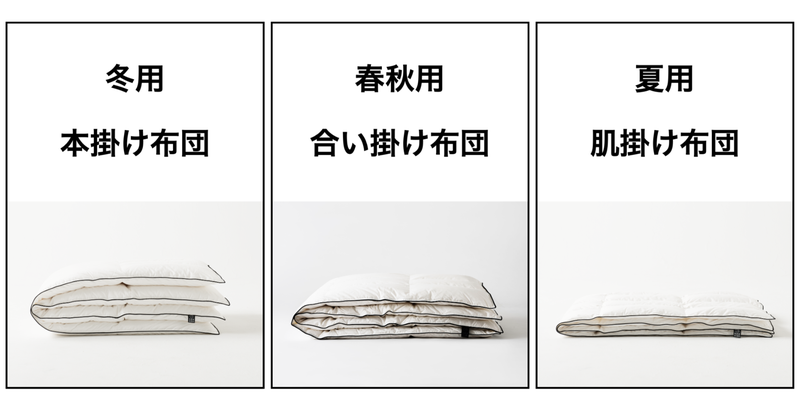
Start by checking the type of comforter.
Down comforters come in different thicknesses for each season, each with its own name.
For summer, the thin “summer-weight (light) comforter”
for winter, the thick “winter-weight comforter”
and for spring and fall, the mid-weight “all-season (medium-weight) comforter”
— these are the three types.
For details, see our column explaining how the three differ.
2. The type of bird the down comes from
Check which bird the down comes from.
Down comforters use two main types of birds.
Duck: the domesticated duck
Goose: the domesticated goose
A goose is about twice the size of a duck, and its down clusters are close to twice as large as well, which makes goose down noticeably warmer.
Another difference: goose down has far less odor than duck down. Because duck down requires more detergent to strip out its smell, many duck down comforters end up with a lingering animal or detergent odor.
Goose and duck down comforters differ in every way that matters — loft, lightness and warmth. If you're willing to pay a little more for a genuinely good down comforter, we recommend goose down.
3. Where the down comes from
Check the origin of the down.
Most down comforters on the market use down sourced from either Northern Europe or China.
In Northern Europe, Poland and Hungary are the main sources. Russian and Canadian down — not Northern European, but widely respected — is also on the market.
Generally speaking, thanks to the birds' rearing conditions and strict quality control, northern European down is rated as the higher quality, while Chinese down sells at lower prices than its Northern European counterpart.
4. Down cluster ratio
Check the down cluster ratio (the percentage of down).
The fill used in a down comforter contains two things: "feather" and "down."
Feather: the quilled plumage from the bird's wings and back
Down: the soft plumage from the bird's chest
Feathers have a stiff quill, so they can work their way out through the shell fabric and are a common cause of fill leakage. They also provide less warmth than down.
Down (the chest plumage) is light, soft and highly insulating.
The down cluster ratio tells you what percentage of the fill is down (soft chest plumage) — in other words, it's a measure of quality.
With a 90% down cluster ratio, for example, 90% or more of the fill in the comforter is soft chest down, and the remaining 10% is quilled feather.
In short: the higher the down cluster ratio, the warmer the down comforter.
5. High vs. low down cluster ratios
Next, check whether the down cluster ratio is high or low.
Down comforters on the market are broadly divided into four down cluster ratio tiers.
Tier 1: 50% or more
Tier 2: 80% or more
Tier 3: 90% or more
Tier 4: 93% or more
Even when the down cluster ratio is actually 95% or higher, the standard practice is to label it as 93%. At Omotesando Futonten, even when down performance testing returns a result of "95%," we label the product "93%." (A few companies do show 95% on their websites, but the quality label attached to the product itself should read 93%.)
A low down cluster ratio means more feather in the fill, which brings more drawbacks: a heavier comforter, less warmth, and quills poking through the shell. The trade-off is a lower price.
If you want a genuinely good down comforter, choose one with a high down cluster ratio. We recommend 90% or higher; if quality is your priority, choose a down comforter labeled "93%".
Watch out for misleading claims.
Some down comforters are advertised with lines like "90% or more ○○ (Northern European) down!" Be careful — this is not the same as a 90% down cluster ratio. It can mean that 90% of the material is Northern European, with the remaining 10% possibly blended with Chinese or other down. The down cluster ratio refers strictly to down clusters making up 90% or more of the fill material used. Some companies deliberately keep the wording vague so the product sounds better than it is, so read the label closely.
6. How much down is inside
Check the amount of down used.
If you've ever compared two down comforters with the same origin and the same down cluster ratio and wondered why the prices were so far apart, the answer may be the weight of the down inside.
Even among winter-weight comforters, the fill weight varies from company to company. Down accounts for by far the largest share of a comforter's cost, so some companies cut the fill weight to bring the price down.
Less fill means a lower price, but the trade-off is a comforter that may not feel as warm as you expected.
After repeated in-house testing, Omotesando Futonten uses the following fill weights for our down comforters:
White goose down (Single): 1.3kg
Mother goose down (Single): 1.2kg
Mother goose down is warmer than white goose down, so less fill is needed.
Some manufacturers fill their winter goose down comforters in Single size with only about 0.9 kg, so it pays to check before you buy.
If you want a down comforter that's warm enough on its own, use roughly 1.2kg–1.3kg of white goose down (Single), or roughly 1.1kg–1.2kg of mother goose down (Single), as your guide.
7. Shell fabric
Next, let's look at the shell fabric.
In fact, the shell fabric accounts for a surprisingly large share of what a down comforter costs to make.
Inexpensive products mainly use polyester, while premium ones mainly use 100% cotton, with the fabric further graded by yarn count. Occasionally, you'll even find comforters made with silk.
With cotton, the price varies greatly depending on the yarn count. Yarn count refers to how finely the fabric is woven. The higher the count, the finer and more delicate the weave — and the softer it feels against your skin.
Standard 100% cotton shells most often use 40-count yarn.
For a softer hand feel, some fabrics use 60-count yarn.
Some luxury down comforters use 80-count fabric.
At 100-count and above, the fabric feels almost like silk, and is found nearly exclusively on ultra-premium pieces.
At Omotesando Futonten, we use 60-count fabric for “Flower Down” and “Clean Cycle Down,” 80-count for “RDS White Goose Down,” and 120-count for “Premium RDS Down.”
8. Origin (country of manufacture)
Next, check where the comforter was made.
Even with great materials, the quality of the finished comforter depends on the skill of the people and the factory making it. Most comforters sold in Japan are either “made in Japan” or “made in China”.
Almost all of Japan's premium comforter makers manufacture domestically in Japan, while the down comforters sold by major retail chains are almost all “made in China”.
It can't be said across the board that Chinese-made means lower quality than Japanese-made, but if origin matters to you, be sure to check it before you buy.
9. Other factors
We've covered how materials and origin affect quality, but many companies also put effort into other details to build a better product.
Washing, for example. Raw down has a natural odor, so how thoroughly it is washed is key to bringing out the full quality of the down.
Storage is another. Many companies produce down comforters in large batches and warehouse them, so comforters that sit in inventory too long get cleared out all at once through deep discounts. There's always a reason behind a suspiciously cheap “bargain” price, so shop carefully.
At Omotesando Futonten, we fill each comforter with down only after your order is placed, so what arrives is freshly made. We think you'll be amazed by the loft — it's nothing like a comforter pulled from stock.
Summary
Here's a recap of how to judge a down comforter, using a winter-weight comforter as the example.
1: Goose or duck? (The good ones are goose.)
2: Where is the down from? (Northern Europe or China?)
3: Is the down cluster ratio high? (Aim for 90% or more.)
4: Is there enough down? (White goose down 1.2 kg or more; mother goose down 1.1 kg or more.)
5: What is the shell fabric made of? (Polyester, cotton, yarn count, etc.)
6: Where was it made? (Japan or China?)
Check a down comforter against the points above and you'll be able to tell whether you're choosing genuinely good down.
Some products on the market don't disclose these details at all. In that case, the quality may not be worth advertising (disclosing it would make the product look less competitive), so buy with caution.
At Omotesando Futonten, every product we make clears all of the criteria above at a high standard. If you're looking for a truly good comforter, we'd love for you to consider us.
Frequently asked questions
Why is a down cluster ratio of 95% or more still labeled 93%?
Because 93% is the standard figure used on labels. Even when testing returns 95%, the label reads 93%. So even if a website states 95%, the quality tag attached to the product normally says 93%.
Which down origins are considered best?
The down in most comforters on the market comes from Northern Europe or China. Thanks to the raising environment and quality control, down from Northern Europe, such as Poland and Hungary, is rated as high quality, while Chinese down is sold at lower prices than European down.
What should you look for in the shell fabric?
Check the material and the yarn count. Inexpensive comforters tend to use polyester, while premium ones are mostly 100% cotton. With cotton, the higher the yarn count, the finer and more delicately woven the fabric and the softer it feels against the skin: against a standard 40-count, premium shells use 80-count, and 100-count and above feels almost like silk.