The answer in 30 seconds
- A spring/fall comforter with a loft between a winter-weight and a summer-weight comforter. Ai-buton, aigake and aigake-buton are all names for the very same thing.
- Guideline fill weight: 600–800 g in Single. A summer-weight comforter uses 200–400 g. Warmth is determined by fill weight × down cluster ratio × fill power.
- Best in spring and fall, with an ideal room temperature of 15–20°C. If you wake up sweaty under a winter-weight comforter, or feel chilly at dawn under a summer-weight one, it's time to switch.
- For year-round use, pair it with a summer-weight comforter. An all-season comforter alone can't cope with midsummer or midwinter. In winter, layer the two together.
What you'll learn in this article
- What an all-season (medium-weight) comforter is, and why it's called "ai" (in-between) in Japanese
- Aibuton, aigake, aigake-buton: how the names differ and how to read them correctly
- How it differs from the winter-weight comforter and the summer-weight comforter in thickness, fill weight, and temperature range
- Concrete guidance on exactly when to start and stop using it in spring and fall
- Fill weight guidelines from Single through King — plus the answer to whether one comforter can really work year-round
An all-season (medium-weight) comforter is a mid-loft comforter — neither too thick nor too thin — made for the changing seasons of spring and fall. It covers that in-between stretch when a winter down comforter feels too warm but a summer-weight comforter leaves you cold, all with a single layer.
The trouble is that it goes by several names in Japanese — aigake, aibuton, aigake-buton, aigake futon — and stores label the thickness in all sorts of different ways. As a result, plenty of people buy one while still wondering, "What exactly is an all-season comforter?" and "How is it different from a winter-weight one?"
In this article, Omotesando Futonten — a down comforter specialist since our founding in 2013 — walks you through everything you need to make a confident choice: what an all-season comforter is, the different names it goes by, when to use it, fill weight guidelines, and whether it can be used year-round.
1. What is an all-season comforter?
An all-season (medium-weight) comforter, or aigake-buton, is a comforter whose loft sits in between a winter-weight comforter and a summer-weight (light) comforter. That "in between" is where the name comes from: ai means "between," and the comforter is made for the in-between time when one season turns into the next. It's the same idea as aigi, the transitional-season clothing you wear in spring and fall.
For down comforters, fill weight in a Single size generally breaks down as follows.
| Type | Fill weight (Single) | Season | Ideal room temperature |
|---|---|---|---|
| Summer-weight (light) comforter (for summer; down blanket) | Approx. 200–400g | June to September | Around 25°C |
| All-season comforter (spring/fall) | Approx. 600–800 g | March–May / October–November | Around 15–20°C |
| Winter-weight comforter (for winter) | Approx. 1,000–1,300g | December–February | Around 10°C |
In numbers, an all-season comforter holds roughly 60% of the fill weight of a winter-weight comforter. Less down means it's lighter, it presses down on you less, and it takes up less room in storage. At the same time, it carries about twice the down of a summer-weight comforter, so it handles chilly mornings and evenings with ease.
Key point: An all-season comforter isn't a "half-measure" — in Japan's climate, it's the comforter you'll reach for most. Apart from midsummer (July–August) and midwinter (January–February), its loft works for close to half the year.
All-season comforters in other fills
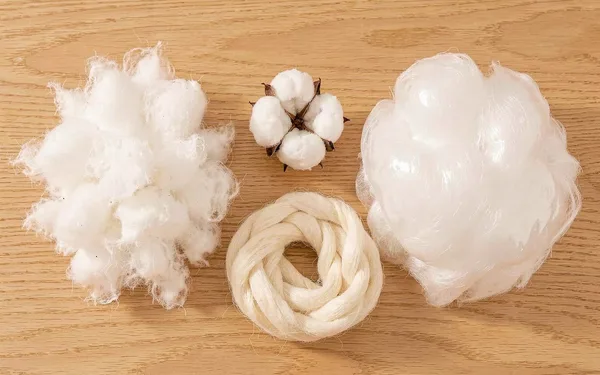
The all-season category isn't limited to down comforters. Cotton batting, polyester fill, and wool-blend comforters all come in medium-loft, all-season versions. That said, even under the same "all-season" label, weight and the quality of the warmth vary enormously by material.
- Down: the lightest option, with excellent moisture absorption and release. It doesn't feel stuffy even when you perspire, and its loft responds to your body heat
- Wool: highly absorbent but heavier than down. A good fit if you like a bit of weight on you
- Polyester: inexpensive and easy to wash, but poor at absorbing and releasing moisture, so it can feel stuffy
- Cotton batting: heavy and warm, but it requires upkeep such as refurbishing (re-fluffing the batting)
If what you want is an all-season comforter that's light and warm, a down version fits the bill best.
2. Name variations | Aibuton, aigake, aigake-buton
Stores and manufacturers spell and label this comforter in different ways. They all refer to exactly the same thing, but the variety makes searching confusing, so here's a quick guide.
| Size name | How to read it | Meaning & usage |
|---|---|---|
| All-season (medium-weight) comforter | Aigake-buton | The most common spelling. Makes it clear you're talking about a comforter. |
| Aigake-buton / aigake futon (all-season comforter) | Aigake-buton | Drops the okurigana (trailing kana). Common in bedding makers' catalogs. |
| aigake-buton (all-season comforter) | Aigake-buton | Hiragana spelling — written the way it sounds. |
| ai-buton / aibuton | aibuton | A shortened form that drops the "gake" (comforter) part. Often heard from older generations and in bedding-producing regions. |
| aigake / ai-gake | aigake | Casual shorthand that drops the word futon — as in “ours is an aigake.” |
The answer to “What is aigake?” and “What does aigake mean?”
In bedding, “aigake” refers to a medium-weight comforter for spring and fall. The name comes from the idea of a comforter used in between (ai) the seasons — it has nothing to do with the “aigake” (two toppings on one bowl) you see on rice-bowl menus. If you're searching for “What is an aibuton?”, the answer is the same: a medium-weight comforter for spring and fall.
Worth learning alongside it: “What is a honkake comforter?”
The term you'll always see paired with aigake is “honkake.” A honkake comforter is a winter-weight comforter with the most down inside. The name means “the comforter you use in earnest,” and most of the winter down comforters sold simply as “down comforters” fall into this category. You may also see them labeled “midwinter” or “heavyweight.”
An easy way to remember it: summer-weight hadagake (summer) < aigake (spring/fall) < honkake (winter). From thinnest to thickest, it goes hada, ai, hon.
3. How it differs from winter-weight and summer-weight comforters
Here's how the three compare, on the points that really matter when you're choosing.
| Category | Summer-weight (light) comforter | All-season (medium-weight) comforter | Winter-weight comforter |
|---|---|---|---|
| Fill weight (Single) | 200〜400g | 600〜800g | 1,000〜1,300g |
| Thickness / loft | Thin | Medium | Thick |
| Main months of use | June to September | March–May / October–November | December–February |
| Comfortable room temperature | Around 25°C | Around 15–20°C | Around 10°C |
| Quilt construction | Usually flat, sewn-through quilting | Mostly baffle-box quilting | Baffle-box quilting (tall baffles) |
| Bulk in storage | Limited | Medium | Large |
| Pairing with a blanket | Rarely needed | Only on cold nights | Not needed except in very cold regions |
Why all-season and summer-weight comforters are easy to confuse
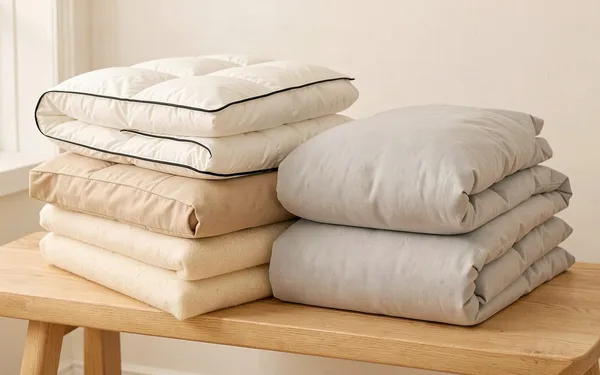
The tricky part is that an all-season comforter and a summer-weight one are hard to tell apart once folded. Here are the three things to check.
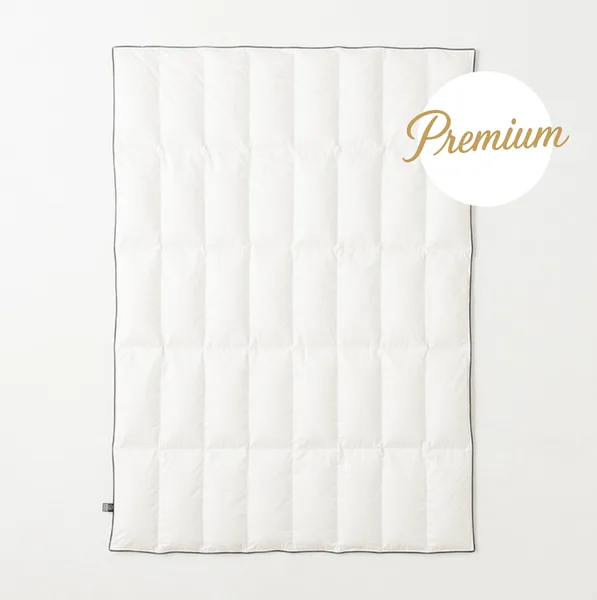
- Check the quilt gusset (the height of the side walls): all-season comforters use baffle-box quilting with gussets so the down can loft fully, while summer-weight comforters are usually flat-quilted.
- Check the stated fill weight: the quality label lists the fill weight in grams. If it's 600g or more, you can safely consider it an all-season (medium-weight) comforter.
- How it feels when you pick it up: a summer-weight comforter lifts easily with one hand, while an all-season comforter has a clear, noticeable heft.
For more on lightweight and summer-weight down comforters, see What is a lightweight or summer-weight down comforter? How to choose for summer and how it differs from an all-season comforter. If you'd like an overview of comforter types as a whole, also take a look at What is a comforter? How it differs from a down comforter, plus types and how to choose.
4. When to use it | From when to when in spring and fall
An all-season comforter gets its turn twice a year. The trick is to switch based on how mornings and evenings actually feel, not by the calendar.
Spring: around March to May
When you start waking up sweaty under your winter-weight comforter, it's time to switch to an all-season one. In lowland Kanto (the Tokyo area), that's generally from mid- to late March through early June. Days may be warm, but it still gets chilly before dawn, so switching to a summer-weight comforter too early will leave you cold.
Fall: around October to November
When your summer-weight comforter starts leaving you waking up cold at dawn, it's time to move to an all-season comforter. In lowland Kanto, that's roughly from early October to late November — bridging the gap until you need your winter-weight comforter in December.
| Season | Signs it's time to switch | Comforter to use |
|---|---|---|
| Late February – mid-March | You feel sweaty under the covers in the early morning | Winter-weight → all-season |
| March – May | Chilly mornings and evenings, warm days | All-season (medium-weight) comforter |
| June – September | You feel too warm as you're falling asleep | Summer-weight (light) + air conditioning |
| October – November | You wake up cold at dawn | All-season (medium-weight) comforter |
| December to February | Still cold even with a blanket over your all-season comforter | Winter-weight comforter |
If you'd rather go by bedroom temperature, 15–20°C is the sweet spot for an all-season comforter. Once you have a run of days above 20°C, switch to a summer-weight comforter; once it stays below 13°C, switch to a winter-weight one.
Differences by region and type of home
- Hokkaido, Tohoku and Hokuriku: the all-season window is short and the winter-weight season is long. It's not unusual for households to stay with a winter-weight comforter through May in spring and switch back to it as early as October.
- Kyushu and Okinawa: a winter-weight comforter sees little use, and in some areas the all-season comforter is the main bedding all winter.
- Reinforced-concrete apartment buildings: they're airtight and well insulated, so indoor temperatures stay up, and you can use an all-season comforter for longer than in a wood-frame house.
5. Fill weight guidelines
When choosing an all-season comforter, fill weight (the weight of the down) is the single biggest deciding factor. Here are the guidelines by size.
| Size | Dimensions (width × length) | All-season comforter: fill weight guide | Winter-weight comforter: fill weight guide |
|---|---|---|---|
| Single | 150×210cm | 600〜800g | 1,000〜1,200g |
| Semi-double | 170×210cm | 700〜900g | 1,200〜1,400g |
| Double | 190×210cm | 800〜1,000g | 1,400〜1,600g |
| Queen | 210×210cm | 900〜1,100g | 1,600〜1,800g |
| King | 230×210cm | 1,000〜1,300g | 1,800〜2,000g |
Fill weight alone doesn't determine warmth
One point to watch: even at the same 600g, warmth differs completely depending on the quality of the down. Think of warmth as a multiplication — fill weight × down cluster ratio × fill power.
- Down cluster ratio: the share of true down clusters (the dandelion-puff part) in the total fill. 90% or more is the benchmark for high quality.
- Fill power (dp): a figure showing how much 1g of down lofts. 350 dp and above is considered good quality; 400 dp and above, high quality.
With quality goose down that has a high down cluster ratio and 400dp or more, a fill weight in the 600g range delivers plenty of warmth. Fill with a low down cluster ratio, on the other hand, won't loft no matter how much you add — you simply end up with a heavy comforter. For more on this, see What is down cluster ratio? A clear guide to down comforter quality indicators.
Omotesando Futonten uses 93% Polish white goose down (fill power 400dp+) and 95% Polish mother goose down (430dp+), all certified under the RDS (Responsible Down Standard).
Check the shell fabric and the quilting, too
The shell fabric matters just as much as the quality of the down. The finer the yarn and the denser the weave, the lighter and more supple the fabric — and the less likely down is to work its way out. At Omotesando Futonten we use 80-count Indian extra-long staple cotton sateen, and each comforter is made one at a time with baffle-box quilting by artisans in Fujiyoshida, at the foot of Mt. Fuji. For how yarn count changes the feel, see 60 sateen vs. 80 sateen: what's the difference?
6. Can one comforter work year-round?
We're often asked, "If I buy one all-season comforter, can't I just use it all year?" The short answer: in some regions and homes, yes — but in most areas it falls short in midsummer and midwinter.
| Season | Comfort with an all-season comforter alone | How to supplement |
|---|---|---|
| Spring (March–May) | ◎ Comfortable just as it is | — |
| Rainy season (June) | ○ A few days feel slightly warm | Slip your feet out from under it at bedtime |
| Midsummer (July–August) | × Far too warm | A summer-weight (light) comforter or down throw is needed |
| Fall (October–November) | ◎ Comfortable just as it is | — |
| Midwinter (December–February) | △ Can feel chilly on cold nights | Add a blanket or layer two comforters together |
The practical answer: own two comforters — an all-season and a summer-weight
Our recommendation is to own one all-season (medium-weight) comforter and one summer-weight (light) comforter. Between them, these two cover almost the entire year, as follows.
- Summer: one summer-weight (light) comforter
- Spring and fall: one all-season (medium-weight) comforter
- Winter: layer the all-season comforter with the summer-weight one (the classic 4-season 2-in-1 setup)
Layering the two creates an extra pocket of air, giving you warmth close to that of a single winter-weight comforter. It also saves storage space compared with buying a separate winter-weight comforter, and putting a washable summer-weight comforter on the inside is a plus for hygiene.
One thing to note: ready-made “4-season 2-in-1 down comforters (duet type)” are designed so the all-season and summer-weight layers snap together with fasteners. Two comforters bought separately can't be buttoned together, so if shifting and bunching would bother you, either choose a 4-season 2-in-1 set from the start or tie both layers in at once using the ties inside your duvet cover.
If you want to get through winter with just an all-season comforter
If you really want one comforter to carry you into winter, these adjustments will make it feel warmer.
- Put blankets on top of the comforter: a down comforter lofts with your body heat, so a blanket placed between you and the comforter keeps the down from expanding. Layering the blanket over the down comforter is warmer.
- Upgrade what's under you: the chill you feel usually comes from your back. A thicker bed pad or mattress pad is often more effective than a heavier comforter on top.
- Avoid brushed-fleece duvet covers: a thick brushed cover can hold the down down and limit its loft.
7. How to choose your all-season comforter
When you're ready to shop for an all-season (medium-weight) comforter, checking these points in order makes the decision easy.
- Size: choose a comforter one size larger than your bed or futon mattress. Pairing a Queen comforter with a Double bed helps block drafts from the sides.
- Fill weight: 600–800g for a Single. Use the table above as a guide.
- Down cluster ratio and fill power: aim for a down cluster ratio of 90% or more and fill power of 350 dp or more.
- Shell fabric: 100% cotton sateen in 60–80 yarn count or finer. It makes a real difference in lightness and drape.
- Certification and traceability: look for RDS certification, a Gold Label or similar, so you can verify the origin of the down and how it was collected.
For specific product picks and comparisons by price range, see How to Choose an All-Season Comforter: A Specialist's Guide to the Best Down Comforters for Spring and Fall.
Omotesando Futonten's spring/fall all-season comforters range from the Flower Sleep Down All-Season Comforter (¥30,800 tax incl.) and Clean Cycle Sleep Down All-Season Comforter (¥42,800 tax incl.), both made with recycled down, to the Polish White Goose Down All-Season Comforter (¥68,000 tax incl.) and the Mother Goose Sleep Down All-Season Comforter (¥158,000 tax incl.) — so you can choose by budget and the level of quality you're after.
8. Frequently asked questions
Q. Is an "aigake-buton" different from an "aibuton"?
They're the same thing. "Aibuton" is simply "aigake-buton" (all-season comforter) with the "gake" dropped, and both refer to the medium-weight comforter made for spring and fall. The wording just varies by region and generation — there is no difference in quality or specification.
Q. What does "aigake" actually mean?
In bedding, "aigake" means a comforter you use in between ("ai") one season and the next. It follows the same logic as "aigi" for in-between-season clothing: a loft and weight matched to the mild weather of spring and fall.
Q. When should I use an all-season (medium-weight) comforter?
In the Kanto plains (greater Tokyo), figure on mid-March to early June in spring and early October to late November in fall. That said, how you feel matters more than the calendar: waking up sweaty under a winter-weight comforter, or waking up chilled at dawn under a summer-weight one, are your cues to switch. In terms of room temperature, 15–20°C (59–68°F) is the sweet spot.
Q. What is the difference between an all-season comforter and a summer-weight comforter?
The fill weight is roughly double. In Single, a summer-weight (light) comforter has 200–400 g of down, while an all-season comforter has 600–800 g. Summer-weight comforters use flat quilting and are made for midsummer nights with the air conditioning on; all-season comforters use baffle-box quilting and are made for the 15–20°C weather of spring and fall.
Q. What is a winter-weight comforter, and should I buy that or an all-season one?
A winter-weight comforter is a comforter for winter with a fill weight of 1,000 g or more. If you already own a winter down comforter, the next one to add is an all-season comforter. If you own nothing yet and this is your first purchase, we suggest an all-season comforter if you live in a warm, well-insulated reinforced-concrete building, and a winter-weight comforter if you live in a wood-frame home or a cold region.
Q. Can I get through winter with just an all-season comforter?
Yes, if you live in a well-insulated apartment building or a mild climate. If you still feel cold, you can raise your perceived warmth by layering a blanket on top of (not under) the down comforter, adding a summer-weight comforter to create a 4-season 2-in-1 setup, or using a thicker mattress pad underneath.
Q. Can an all-season comforter be washed?
As a rule, we don't recommend washing it at home. The down can shift and clump, and incomplete drying can lead to mold inside the comforter. If perspiration or odor is a concern, consider professional cleaning at a specialty store, or down comforter refurbishing — where the down is removed, washed, and refilled into a new shell. For details, see What is down comforter refurbishing (re-making)?
Q. How long does an all-season comforter last?
It depends on quality and use, but with good-quality down, 10–20 years is a reasonable guide. When you notice the loft no longer bouncing back, less warmth than before, or an odor that won't go away, it's time to consider replacing or refurbishing it. We've put together a checklist in How long does a down comforter last? How to decide between replacing and refurbishing.
9. Summary
Here are the key points about all-season comforters.
- An all-season comforter is a spring/fall comforter with a loft "in between" the winter-weight and the summer-weight comforter
- Aibuton, aigake, aigake-buton — all these names refer to exactly the same thing
- Fill weight in Single is typically 600–800 g. Winter-weight is 1,000 g or more; summer-weight is 200–400 g
- Use it from mid-March to early June in spring and from early October to late November in fall. The ideal room temperature range is 15–20°C (59–68°F)
- One comforter year-round is a stretch in midsummer and midwinter, so owning two — an all-season plus a summer-weight — is the practical choice
- Warmth comes down to fill weight × down cluster ratio × fill power. Don't judge by weight alone
In Japan's climate, the all-season comforter is actually the one you reach for most days of the year. That's exactly why it's worth choosing a good one.
Browse all-season (medium-weight) down comforters for spring and fall at Omotesando Futonten
10. "Aigake" and "down all-season comforter": the meanings once more
Q. Does "aigake" refer to a comforter?
Yes. In bedding, "aigake" is simply short for "aigake-buton" — the medium-weight comforter used during the spring and fall changeover seasons. The various Japanese spellings that drop okurigana look different but mean exactly the same thing.
Q. How is a down all-season comforter different from a regular all-season comforter?
An "all-season down comforter" is a medium-weight (all-season) comforter filled with down. The all-season thickness category also exists in cotton-batting and polyester comforters, but down is lighter and far better at absorbing and releasing moisture, so the comfort level differs even at the same fill weight. For details, see the section on non-down all-season comforters in "1. What is an all-season comforter?" above.
Q. Which grade does an "all-season down comforter" refer to?
Compared with a winter-weight down comforter, the term "all-season down comforter" refers to the spring/fall grade with a fill weight of roughly 600–800 g in Single. Think of it as the middle amount of down: not as thick as a winter-weight comforter (1,000 g or more) and not as thin as a summer-weight comforter (200–400 g).
Q. Do the selection criteria differ between an "all-season comforter" and an "all-season (medium-weight) comforter"?
There is no difference. "Ai-buton" is just another way of saying "aigake-buton," so the same selection criteria apply — fill weight, down cluster ratio and shell fabric — exactly as described in section 7, "Choosing an all-season comforter."