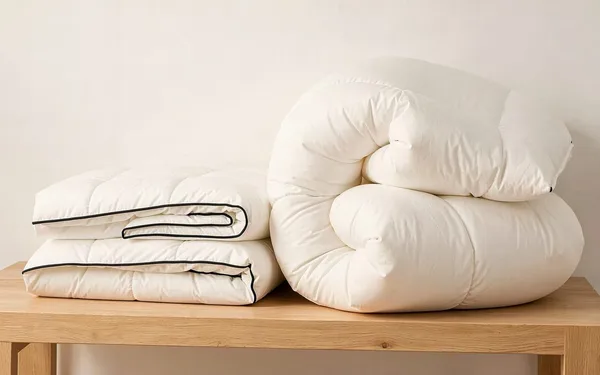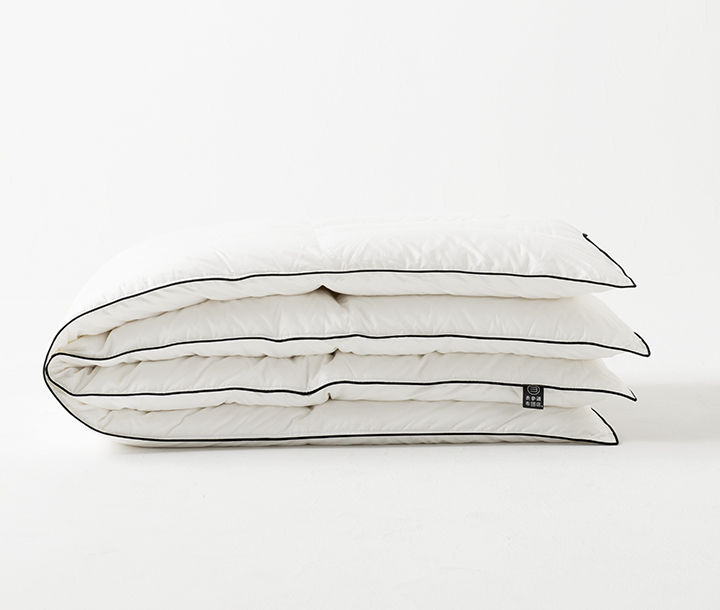
Loft (fill power): as a guide, look for 350dp or higher for winter, 270–350dp for spring and fall, and around 200dp for summer.
When you shop for a down comforter, you’ll see the terms “loft” (kasadaka) and “down power.” Both are measures of down quality — in other words, how well the down expands. The higher the number, the better the down, and the more warmth you get from a smaller amount of fill.
This article explains what loft and down power mean, how they differ, and what numbers to aim for season by season.
"Loft" and "fill power" are the two measures used to express how fully a down comforter puffs up.
Both are standards evaluated by the Japan Down Products Cooperative Association.
"Loft" (kasadaka) is also referred to as fill power, and it puts a number on the down's own ability to expand.
Harvested down is sorted into down used as-is and down used as filling material for comforters and similar products,
Down takes in air and lofts up, improving both warmth retention and moisture control.
Once you know what "loft" and "fill power" mean, you can judge the quality of the down inside — something you simply can't see from the outside of a comforter.
Here we take a closer look at loft in down comforters, how it differs from fill power, and what the Gold Label, the benchmark for high-quality down comforters, actually certifies.
If you're shopping for a high-quality, Japanese-made down comforter, we hope you'll find this guide useful.
What loft (fill power) means in a down comforter
Loft (fill power) is a measurement of how much a set amount of down expands after it has been compressed and then released. It has long been used internationally as an indicator of down quality.
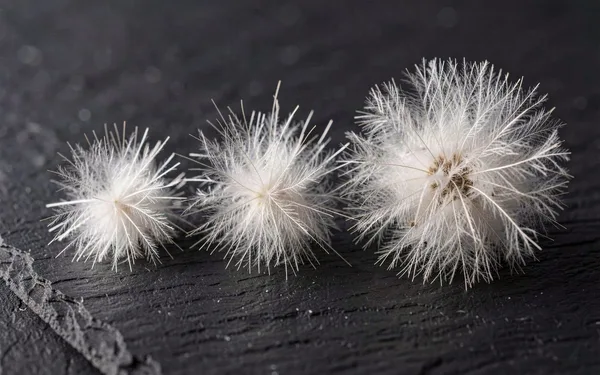
In practice, 30g of down is compressed, released, and the volume it springs back to is measured in cubic inches. The higher the number, the larger the down clusters (the fluffy spheres of down), so the down traps more layers of air with less fill — which means better warmth and lighter weight.
| How loft and fill power relate
Loft and fill power are the same thing. “Fill power” is the English term; “kasadaka” (loft) is what it’s called in Japanese. Since 2012, down power (dp) has been the mainstream rating in Japan. |
Here’s a rough guide to loft numbers.
- Around 400–500: entry grade
- Around 500–600: standard grade (typical quality for Japanese-made comforters)
- Around 600–700: high class (high quality and long-lasting)
- 700 and above: premium grade (mother goose down and other top-tier fills)
| One caveat: loft alone doesn’t determine warmth
Loft (fill power) tells you the quality of the down, but how warm the finished comforter feels depends on quality combined with fill weight. Even high-fill-power down will feel thin if there isn’t enough of it. |
What down power (dp) means
Down power is a uniquely Japanese rating based on JIS (Japanese Industrial Standards). It expresses the volume in cm³ that 1g of down expands to. Since April 2012, it has been used as the evaluation standard for Japan’s down product quality assurance label, the Gold Label.
The difference from loft (fill power) is the unit of measurement. Loft measures 30g of down in cubic inches, while down power measures 1g of down in cubic centimeters (cm³). The principle is the same for both: the higher the number, the better the quality.
Fill Power by Season: Quick Reference Chart
| Fill power | Grade | Use / Season | Best for | Matching Label |
| 200 dp range | Entry level | Summer: summer-weight (light) comforter | For air-conditioned summer nights and hot sleepers | — |
| 270〜350dp | Standard | Spring & fall: all-season (medium-weight) comforter | Best value for everyday use | New Gold Label |
| 350〜400dp | High class | Winter: winter-weight comforter | For typical winter cold | Excel Gold Label |
| 400〜440dp | Premium | Deep winter | For cold sleepers and winters in northern Japan | Royal Gold Label |
| 440 dp and above | Top of the line | Top-of-the-line class | For a comforter to last a lifetime; mother goose down | Premium Gold Label |
Related article: What is fill power, and why is it essential when choosing a high-quality down comforter?
Loft (international fill power) vs. Japanese fill power (dp): what's the difference?
| Loft (international fill power) | Fill power | |
| Standard | International standard (originated in the US) | JIS standard (Japan only) |
| Unit | Cubic inches (FP/in³) | cm³/g(dp) |
| Measurement basis | Loft volume of 30g of down | Loft volume of 1g of down |
| When it was used in Japan | Standard up to 2011 | Standard from April 2012 onward |
| Where you'll see it listed | Imported products and outdoor brands | Japanese brands and Gold Label products |
| What they have in common | With both, a higher number means higher quality | With both, a higher number means higher quality |
We're often asked, "Does higher loft mean a warmer comforter?" The answer is half yes, half no. Loft and fill power indicate the quality of the down per gram, while the overall warmth of a comforter is determined by fill weight (how many grams are inside) × fill power.
At the same fill weight, higher fill power is definitely warmer — but a lower fill power can deliver the same warmth if the fill weight is increased.
Loft (fill power) was based on how high the down itself lofts, whereas fill power (dp) expresses that loft as a volume.
From April 2012 onward, the measure was changed to one based on fill power (dp).
”This expresses the loft of the down inside a comforter as a volume per gram (cm3/g).
In general, the down inside a comforter is assumed to be under constant pressure of about 1.4kg/m2 (about 14 pascals).
(Identical to overseas standards) In the loft test method of the newly revised down testing standard JIS L-1903-2011, a pre-treatment method for the down and a method for measuring volume were added, so that in addition to stating the loft measurement as a height (mm), it can now also be stated as a volume (cm3/g).
Accordingly, the Japan Down Products Cooperative Association (JDPCA) calls the loft value (cm3/g) measured in line with the revised JIS standard — using steam pre-treatment and a 94.3g loading disc — "fill power (down power) cm3/g," and uses it for the new Gold Label criteria.
The unit used for evaluation changes, but for the same label there is no difference in quality between loft (fill power) and "down power."
Related reading: How to choose the right comforter weight: types and when to use them

What is the Gold Label?
The Gold Label is a quality assurance label issued by the Japan Down Products Cooperative Association. It is divided into four grades according to fill power, and a down comforter carrying this label has passed quality testing by an independent third-party organization.
| Label grade | Fill power requirement | Applies to (comforter type) | Characteristics |
| New Gold Label | 300dp and above | All-season and winter-weight comforters | Standard quality assurance |
| Excel Gold Label | 350dp and above | Winter-weight comforter | Assures comfortable winter sleep |
| Royal Gold Label | 400 dp and above | Premium winter-weight comforters | Assurance of upper-tier quality |
| Premium Gold Label | 440 dp and above | Top-of-the-line class | Top quality, such as mother goose down |
When buying a down comforter, we recommend checking first whether it carries a Gold Label. A labeled comforter comes with assured quality, giving you an objective way to judge the difference between it and no-name or bargain-priced products.
▼ Quality is divided into the following grades.
The highest fill power, at 440dp and above, is "Premium Gold."
Next is "Royal Gold," with a solidly high fill power of 400dp and above.
After that comes "Excel Gold," with a mid-level fill power of 350dp and above.
The lowest fill power within the Gold Label range, at 300dp and above, is "New Gold Label."
Note, too, that the Gold Label is issued only for down comforters manufactured in Japan.
Only down comforter makers with manufacturing facilities in Japan can join the Japan Down Products Cooperative Association, so the label assures you of genuine Japanese-made down comforter quality.
Related reading: Can you tell a down comforter's grade from its label? A guide to what each label means for quality
Looking for a luxury comforter? Take a look below.
Related article: Luxury comforter lineup
Frequently asked questions
Q1. What is loft (fill power)?
- It's the international measure of down quality: 30g of down is compressed and then released, and the volume it expands to (in cubic inches) is the rating. The higher the number, the larger the down clusters, so a comforter can deliver strong warmth with less fill weight. In Japan, the industry switched to the fill power (dp) rating from 2012 onward.
Q2. What is fill power (dp)?
- It's Japan's own quality rating, based on JIS standards, expressing the volume that 1g of down expands to (cm³/g). It is the criterion used for the Gold Label grades on down comforters. As a guide, a winter-weight comforter should be 350dp or above, a spring/fall all-season comforter 270–350dp, and a summer-weight (light) comforter around 200dp.
Q3. Which should I look at — loft or fill power?
- Japanese brands and Japan-made products mostly list fill power in dp, while imported and outdoor brands tend to list international fill power (FP). Either way, the rule is the same — the higher the number, the higher the quality — so just check whichever figure is printed on the product you're buying.
Q4. How do I read the Gold Label?
- There are four grades: Gold (280 dp and up), Excel Gold (350 dp and up), Premium Gold (400 dp and up), and Royal Gold (440 dp and up). When choosing a Japan-made down comforter, use this label as your quality guide.
Summary
In this article we have explained loft (fill power) and dp — the figures worth checking when you choose a down comforter.
Today dp is the standard in Japan, so if you want a high-quality down comforter, use the dp figure as your guide, look for a high number, and choose a Japanese-made down comforter that meets the Gold Label criteria.
▼ Omotesando Futonten down comforters that meet the “Gold Label” standard
| Flower Down | Excel Gold |
| Clean Cycle Down | Royal Gold |
| RDS Down | Royal Gold |
| RDS Down Premium Gold | Premium Gold |
At Omotesando Futonten, sustainability is at the heart of how we make things. We use high-quality recycled down carefully selected from around the world,
and our RDS Down (virgin down) carries RDS certification, an international standard with strict animal welfare requirements.
Flower Down and Clean Cycle Down are made with recycled down.
If you're looking for a down comforter (duvet) that combines Japan's finest quality with a refined design that complements your interior, do take a look at the Omotesando Futonten collection.
For high-quality Japanese-made premium down comforters (duvets), choose Omotesando Futonten
| Related articles
・How to Choose a Down Comforter by Fill Power |
| ▶ Browse all premium down comforters at Omotesando Futonten |
How “kasadaka” is read, and what “kasadakasei” means
The Japanese term 「かさ高」 (loft) is usually read “kasadaka,” though you'll sometimes hear “kasataka.” Both refer to exactly the same thing: the power of down to loft up and expand (fill power).
You may also come across the expression 「かさ高性」 (loftiness). It is used with the same meaning as 「かさ高」 and describes the way down traps air and expands.
What is the fill power of down?
“Fill power” is a number that expresses how much the down itself lofts up. As explained above, it is used with the same meaning as kasadaka (loft): the higher the number, the larger the down clusters and the better the quality of the down. When you are choosing a Japanese-made down comforter, check the Japanese dp (down power) figure and the Gold Label grade rather than an international fill power number.
How to use loft and dp numbers when you’re actually buying
Understanding what the numbers mean is only useful if you can apply it to a real purchase. Here’s how to put loft (fill power) and dp to work when comparing products.
Use 1 | Compare how many kilograms it takes to reach the same warmth
Warmth isn’t determined by fill weight alone — it comes from fill weight × fill power (dp) = total lofted volume. Use this relationship and you can compare very different comforters on equal terms.
| Fill power | Fill weight needed for the same loft (Single) | Weight difference vs. 1.2 kg |
|---|---|---|
| 450㎤/g | 1.20kg | ― |
| 400㎤/g | 1.35kg | +150g |
| 350㎤/g | 1.54kg | +340g |
| 300㎤/g | 1.80kg | +600g |
To get the same thickness from down rated 300 ㎤/g as from down rated 450 ㎤/g, you need 600 g more fill. So the way to answer “I want a lighter down comforter” is not to use less down, but to use better down.
Use 2 | Always read it together with the fill weight
Even a high dp won’t make a winter comforter if the fill weight is at summer-weight level (0.3–0.4 kg). Fill power (dp) is the efficiency per gram; fill weight is the total amount. Neither number tells the whole story on its own.
| Season | Fill weight (Single) | Recommended fill power (dp) |
|---|---|---|
| Summer (summer-weight comforter) | 0.3〜0.4kg | 200–280 ㎤/g is plenty |
| Spring & fall (all-season comforter) | Around 0.8 kg | 330 ㎤/g or higher |
| Winter (winter-weight comforter) | 1.2〜1.3kg | 350 ㎤/g or higher — ideally 400 ㎤/g or more |
Use 3 | What to do when no rating is listed
There is no legal requirement to state the dp rating. If a product doesn’t list one, think of it this way.
- If it carries a Gold Label, the grade tells you the minimum (New 300 / Excel 350 / Royal 400 / Premium 440 ㎤/g or higher)
- If there is neither a label nor a stated figure, assume it may be under 300 ㎤/g
- If a store can't answer your questions, cross it off your list
The fact that a store doesn't publish the numbers is itself a useful signal.
What to do when the loft starts to drop
If your comforter loses loft with use, the right fix depends on the cause.
| Cause | What to do | Does it recover? |
|---|---|---|
| Damp and clumped together | Air it in the shade for 2–3 hours | Recovers |
| The cover is too tight | Check the size and fasten all the ties | Recovers |
| Flattened in storage | Spread it out and leave it for a few hours | Recovers |
| Compressed in a vacuum storage bag for a long time | ― | Hard to recover |
| Beaten with a futon beater | ― | Does not recover |
| Down clusters broken down with age | Down comforter refurbishing (uchinaoshi): washing and topping up the down | Restored by refurbishing |
For step-by-step recovery methods, see How to Fluff Up a Down Comforter: 6 Steps to Fix a Flat Duvet at Home, Explained by a Specialist Store, and for airing tips, see How to Air a Down Comforter the Right Way: Why Direct Sunlight Is a No-Go, Explained by a Specialist Store.
In refurbishing, the down is washed to break up clumps caused by soiling, and any shortfall is topped up. For our Down Comforter Refurbishing / Clean Cycle Reform service, Omotesando Futonten tops up with Clean Cycle Down at a fill power of 400 cm³/g (Japanese dp).
The key numbers at a glance
The figures listed in down comforter specs each mean something different. Here's how to keep them straight.
| Figure | What it tells you | Guideline for winter | Labeling required |
|---|---|---|---|
| Loft (fill power, FP) | Volume per 1 ounce of down (overseas measure) | 700FP or higher | No |
| Fill power | Volume per 1 g of down (Japanese measure) | 350 cm³/g or higher | No |
| Down cluster ratio | The percentage of down clusters in the fill | 90% or higher | Yes |
| Fill weight | Weight of down filling | 1.2〜1.3kg | Yes |
We cover down cluster ratio in detail in What Is Down Cluster Ratio? A Clear Guide to This Down Comforter Quality Measure, and fill weight in Down Comforter Weight and Fill Weight Guide: 1.0kg vs 1.2kg vs 1.5kg, Explained by a Specialist Store.