The answer in 30 seconds
- A down comforter is a comforter filled with at least 50% down. Anything under 50% is classified as a feather comforter instead.
- Goose down comes from geese, duck down from ducks. Geese are larger birds, so their down clusters are generally bigger and considered higher quality.
- Judge quality by down cluster ratio and fill power rather than by species. Look for a down cluster ratio of 80% or more; 90% or more is high quality. For a winter-weight comforter, choose 350dp or higher.
- Down is the soft undercoat; feathers have a quill shaft. Down is lighter and drapes around the body better, but it costs more.
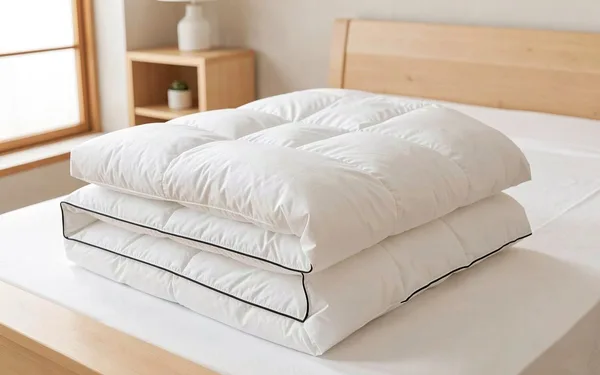
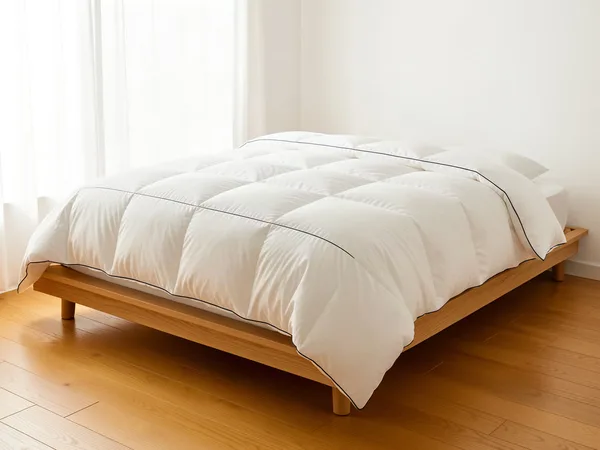
A down comforter is a comforter whose fill is at least 50% down.
When shopping for a down comforter, many people wonder: "What's the difference between goose and duck?" "What does down cluster ratio mean?" "What fill power should I look for?"
In this article, Omotesando Futonten — with more than 25 years in the bedding business — explains the basics of down comforters and how to choose the right one, in plain language.
"What's the difference between goose and duck down comforters?"
"I want to know the different types of down."
"What's the difference between down and feathers?"
Even people who know down comforters well are often unsure how goose and duck down actually differ.
This article covers not only the difference between goose and duck, but the other types of down as well.
If you want to sleep better — or you're looking for a comforter that also looks beautiful in your bedroom — read on to the end.
What is a down comforter? How it differs from a feather comforter
A down comforter is a comforter filled with at least 50% down — the soft, fluffy clusters found beneath a bird's outer feathers. Anything under 50% is classified as a feather comforter instead.
| Down comforter | Feather comforter | |
| Down cluster ratio | 50% or more | Less than 50% |
| Characteristics | Light and warm, with excellent loft | Resilient, but somewhat heavier |
| Price range | Somewhat higher | Relatively affordable |
| Best for | Anyone who puts warmth and light weight first | Anyone who puts resilience and value first |
Goose vs. duck down in a down comforter
Let's start with the difference between goose and duck down in comforters.
It becomes clear the moment you know what each word means.
- Goose: the bird known in Japanese as <em>gachō</em>
- Duck: the bird known in Japanese as <em>ahiru</em>
Both are birds with feathers, so a goose comforter is filled with down from geese, and a duck comforter with down from ducks.
In terms of quality, geese are the larger bird, so their down clusters are bigger — and generally considered higher quality.
Among geese, those raised in colder regions produce the finest down of all.
Goose down is also lighter in weight, so overall, goose can be called the higher-quality down.
Goose vs. duck vs. mother goose down
There are three main types of down used in down comforters. Here's how they differ, at a glance.
| Type | Type of bird | Down cluster | Price range | Characteristics |
| Duck down | Duck | Small to medium | ¥10,000–¥50,000 range | Great value. A good choice for your first down comforter |
| Goose down | Goose | Medium to large | ¥30,000–¥150,000 | A fine balance of light weight and warmth. Made to last for years |
| Mother goose down | Mature parent goose | Extra large (rare) | ¥100,000 to ¥500,000 or more | The finest quality. For anyone seeking one comforter for life |
| From our specialists: goose isn't automatically good, and duck isn't automatically bad
What matters more than the type of down is the numbers: fill power (loft) and down cluster ratio. A duck down comforter with high fill power can be warmer than a low-grade goose down one. |
Looking for a luxury comforter? Take a look below.
Related article: Luxury comforter lineup
For more on the differences between duck and goose down comforters, see the article below.
Related reading: Goose vs. duck down comforters: what's the difference?
Other types of down
So far, we've looked at the differences between goose and duck down.
But there are many other types of down as well.
From here, we'll walk you through the following five types of down.
- Eiderdown (eider duck down)
- White down
- Silver goose down
- Mother goose down
- Mother duck down
Let's look at each one in turn.
Eiderdown (eider duck down)
First up is eiderdown.
As the name suggests, it comes from a duck — the eider duck.
Going by what we said above, duck is generally outranked by goose — but eiderdown is the exception.
The eider duck (known in Japanese as honkewatagamo) produces down with a very distinctive structure.
The tips are hook-shaped, so the down clusters interlock with one another.
The space between these interlocked clusters creates the air layer unique to eiderdown, delivering exceptional insulation.
Its performance is remarkable, and its rarity is just as top-tier.
The eider duck is a sea duck found in the Northern Hemisphere, and the female's down falls out naturally during the breeding season.
She uses this shed down to line her nest, and the quantity is very small.
That limits how much can be collected, which is why eiderdown is traded at high prices as an outstanding — and exceptionally rare — down.
White down
Next is white down.
Here, "white" refers to the color of the bird's plumage.
"White goose down" comes from the greylag goose, which has been selectively bred into the white-plumaged "white goose" and the colored variety known as "silver goose."
That said, white duck down has a whitish tone, so the finished comforter looks cleaner and more refined.
That said, there is no difference beyond appearance.
Silver down
Next up is silver down.
Like white down, silver down is a category defined by the color of the down.
The term is generally used for geese rather than ducks, and it is also called “silver goose down.”
Here too, the only difference from standard down is its look — there is no difference in quality.
Mother goose down
Next up is mother goose down.
As the name suggests, it uses down from mature mother geese, so it costs more than standard down.
Standard down is harvested from young geese just 2–3 months old, while mother geese are raised for roughly 2–3 years and yield much larger down clusters.
That makes for a higher-quality, warmer down comforter — and its rarity is exactly why it comes at a premium.
Related reading: What makes mother goose down comforters special, and how to choose one
Mother duck down
Last up is mother duck down.
As the name suggests, it uses down from mature mother ducks, making it more expensive than standard duck down.
Just as with mother goose down, standard duck down comes from young birds 2–3 months old, whereas mother ducks are raised for roughly 2–3 years and yield larger down clusters.
The result is higher quality and a warmer down comforter.

The difference between down and feathers
Finally, let's look at the difference between down and feather.
As with goose and duck, the quickest way to understand it is to start with what the words themselves mean.
- Down: the soft, fluffy plumage
- Feather: the quill-bearing feathers
That's the essence of it: one is “fluffy plumage,” the other is “a feather with a quill.”
Here's a summary of the characteristics of each, to help you choose the right down comforter.
| Down | Feather | |
| Moisture retention | High | Moderate |
| Weight | Light | Somewhat heavy |
| Animal odor | Low | Slight |
| Drape (how well it hugs the body) | Good | Moderate |
| Price | High | Lower cost |
As a rule, down is the higher-quality material — and it's priced accordingly.
If you're shopping for a luxury comforter, take a look below.
Related article: Luxury comforter collection
Related article: What is fill power, and why is it essential when choosing a high-quality down comforter?
Goose vs. duck in down comforters: goose is the higher quality
For down comforters, goose down from the larger bird is both higher in quality and higher in price than duck down.
There are also exceptions to the above: the finest down of all, eider duck down; appearance-focused options such as white down and silver down; and down from mature birds, such as mother goose down and mother duck down.
Weigh the characteristics of each and choose the down comforter that suits you best.
At Omotesando Futonten, sustainability is at the heart of how we make things. We use high-quality recycled down carefully selected from around the world,
and our RDS Down (virgin down) carries RDS certification, an international standard with strict animal welfare requirements.
Flower Down and Clean Cycle Down are made with recycled down.
If you're looking for a down comforter (duvet) that combines Japan's finest quality with a refined design that complements your interior, do take a look at the Omotesando Futonten collection.
Description
We select only the best-performing, highest-quality recycled down circulating in Japan and wash it thoroughly in natural underground water from Hakushu, Yamanashi. The result is a sustainable down comforter built to the ultimate standard.
Omotesando Futonten uses three types of down.
Three numbers to check before you buy
① Down cluster ratio: the higher the number, the lighter and loftier the comforter
The down cluster ratio is the percentage of down clusters in the fill. Look for 80% or more as a baseline; 90% or more is considered high quality.
② Fill power (loft): the measure of warmth
This number shows how much 1g of down expands. As a guide, choose 350dp or more for a winter-weight comforter, 270–350dp for an all-season (medium-weight) comforter, and around 200dp for a summer-weight (light) comforter.
③ Shell fabric: it affects both feel and durability
100% cotton offers the best moisture absorption and the softest feel. If value for money is your priority, a cotton–polyester blend is a good option too. For the quilting, choose baffle-box construction to keep the down evenly distributed.
Frequently Asked Questions
Q1. What's the difference between a down comforter and a feather comforter?
A. If 50% or more of the fill is down (the soft plumage), it's a down comforter; under 50%, it's a feather comforter. Down comforters are lighter and warmer, and they tend to cost more.
Q2. Which is better, goose or duck?
A. There's no one-size-fits-all answer. Goose down has larger down clusters and is considered higher quality, but duck down with a high fill power offers plenty of quality too. The smart approach is to choose based on your budget and how you'll use it.
Q3. How warm is 350dp fill power?
A. It's the benchmark for enough warmth in a winter-weight comforter. At 350dp, you're covered for a typical Japanese winter. If you tend to feel the cold or live in a colder region, look for 400dp or higher.
For high-quality Japanese-made premium down comforters (duvets), choose Omotesando Futonten
| Related articles
・Can a Down Comforter Trigger Asthma? The Real Causes and What to Do About Them |
What are white goose down and white duck down?
"White" refers to the color of the down itself — both geese and ducks come in white-feathered varieties.
- White goose down: Down taken from geese with white plumage. Along with the large down clusters that are characteristic of goose, its white color shows through the shell fabric far less, giving the comforter a beautiful finish.
- White duck down: Down taken from ducks with white plumage. It is considered the best-looking of the duck downs, but because ducks are smaller birds, the down clusters tend to be smaller than goose.
Both terms are simply color classifications. Within the same species (goose or duck), color alone does not create a meaningful difference in quality.
Mother goose down vs. mother duck down
What both have in common is that the down comes from mature birds raised for two to three years, rather than young birds only two to three months old. The difference is simply whether that down comes from geese or from ducks.
- Mother goose down: Harvested from mature parent geese. Since geese are large birds to begin with, the down clusters grow even larger, making this down the rarest and the most expensive class available.
- Mother duck down: Harvested from mature parent ducks. The down clusters are larger than standard duck down, but generally one step below goose varieties in both cluster size and price.
Even when you compare mature birds head to head, the basic ranking holds: goose down still has the edge. Weigh it against standard duck down and goose down and choose what fits your budget.