The answer in 30 seconds
- There are seven main ways to dispose of one. Bulky waste (about ¥200–500 per comforter), burnable household trash, free recycling collection, junk-removal companies, moving companies, flea-market apps and secondhand shops, and donation.
- Whether you can put it out as burnable trash depends on your municipality. In some areas you can fold it into a designated bag and put it out free of charge with burnable trash; in areas where it's designated bulky waste, you can't. Check your local government's website first.
- Cutting it up isn't recommended. Enormous amounts of down scatter everywhere, and the cleanup is a real chore.
- If your comforter is still in good condition, consider refurbishing before you throw it away. High-quality down can often be washed and restored to like-new condition.
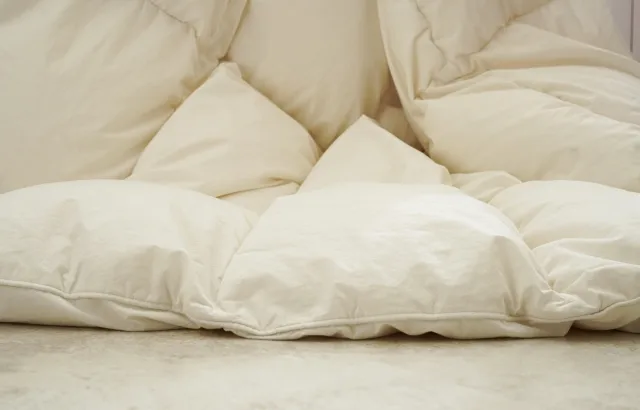
There are seven main ways to dispose of a down comforter.
Bulky waste (¥200–500), burnable trash (free), junk-removal companies, manufacturer take-back, free recycling collection, selling on a flea-market app, and donation — each differs in cost and effort.
In this article, Omotesando Futonten — a specialist that has worked with bedding for over 25 years — walks you through how to choose the best disposal method for your situation.
A down comforter you no longer use, or one that has gone flat and lost loft over the years, is one of those items that's surprisingly hard to get rid of. Maybe you're not sure how to dispose of it, or it's been sitting in the closet waiting for the day you finally throw it out.
Because a down comforter is filled with natural down, the more often you use it, the closer it comes to the end of its life. Keep in mind that the expected lifespan also varies depending on the materials used.
This article takes a closer look at how long a down comforter lasts, along with your disposal options and the steps to take before you throw it out. If you're wondering about the lifespan of the comforter you own or how to part with it, read on.
Start Here: Your Checklist Before Throwing Out a Down Comforter
Before you decide how to get rid of it, check these four points. The best option depends on which ones apply to you.
- Still in good condition → look first at resale apps, secondhand shops, or donation
- A high-quality comforter you've used for 10+ years → refurbishing (re-making) may bring it back to like-new condition
- Moving soon → bulky waste pickup usually has to be booked 1–2 weeks before collection day, so arrange it early
- Want to get rid of several at once → Booking a junk removal service to take everything in one go can work out cheaper.
Is there a set lifespan for a down comforter?
Because a down comforter is filled with natural down, its warmth gradually declines and it nears the end of its life unless you have it serviced through a process known as down comforter refurbishing (uchinaoshi).
Most down comforters last about 10 to 15 years, but the expected lifespan varies with the materials used, so let's look at this in more detail.
Related article: How many years does a down comforter last? How to decide between replacing and refurbishing
Lifespan varies with the materials used
Three things determine how long a down comforter lasts: the type of down, the material of the shell fabric, and how you care for it day to day.
Down is taken from birds such as ducks and geese, known in the trade as duck down and goose down. Among mature birds, down from parent birds is said to be more durable than down from younger ones.
Ordinary duck and goose down lasts around 10 years, but down from parent birds — "mother duck down" and "mother goose down" — resists flattening, so a comforter made with it can stay in service far longer.
Signs your down comforter is nearing the end of its life
There are several telltale signs that a down comforter is nearing the end of its life.
[Signs your down comforter is nearing the end of its life]
- Down starts escaping through the fabric
- The comforter is visibly soiled
- Odors have soaked into it
- It feels flat and thin
- It feels heavy
The first sign is down escaping through the shell fabric or the gaps along the seams. Even a comforter that still looks lofty is filled with very fine clusters, so they slip out through the tiniest openings and the fill gradually diminishes.
As it goes flat and thin, the comforter slowly loses its ability to hold warmth and reaches the end of its life. A lot depends on how you use it, so take care not to crush it or handle it in ways that cause the seams to fray.
After years of use, odors soak into a comforter. A thick down comforter isn't easy to wash, so household smells, pet odors and perspiration can build up and become noticeable.
When sweat and room humidity build up inside, the comforter can start to feel heavy and less pleasant to use. If that happens, it's usually a sign that it's time to replace it, dispose of it, or have it serviced.
Related article: Why your down comforter smells, and how to fix it
Looking for a luxury comforter? Take a look below.
Related article: Luxury comforter lineup
7 ways to dispose of a down comforter [cost, effort and speed comparison table]
There are seven options to choose from, depending on your situation. Start with the comparison table below for the big picture, then read the details.
| # | Method | Approx. cost | Effort | Speed | Any condition | Best for |
| ① | Oversized waste collection | ¥200–500 | Medium | 1–2 weeks | ○ | Keeping costs down |
| ② | Burnable household waste | Free | High (must be cut up) | Next week onward | ○ | Paying nothing at all |
| ③ | Junk removal service | ¥2,000–5,000 | Low | Same day to next day | ○ | In a hurry, or several items to clear |
| ④ | Manufacturer / retailer takeback | Free to paid | Low | At time of purchase | ○ | Dispose of it when you buy a new one |
| ⑤ | Free recycling collection | Free | Medium (drop-off required) | Depends on when you drop it off | △ | Want an eco-friendly way to dispose of it |
| ⑥ | Resale apps / buyback services | Free (you may earn money) | High | Varies | Only items still in usable condition | Want to get at least some money back |
| ⑦ | Donation / nonprofit | Shipping cost only | Medium | Varies | Only items still in usable condition | Want it to go to someone who needs it |
There are four main ways to part with a down comforter: throw it away, sell it, have it collected, or donate it. Each suits a different situation, so let's look at them in detail.
Put it out as oversized waste
To dispose of it as oversized waste (sodai gomi), you need to contact the office set up by your local city, town or ward and request a pickup. Collection is not automatic, so keep in mind that pickup days and collection fees are set by the municipality.
For details, check your local government's website or community newsletter.
Put it out with burnable trash
Depending on the size of the comforter, you may be able to put it out with burnable trash. However, in municipalities that require comforters to be set out as oversized waste, even burnable comforters must go out as oversized waste.
In municipalities that accept it as burnable trash, fold the down comforter, place it in the official bag for burnable waste, tie the bag securely, and set it out by collection day. Comforters placed in ordinary clear plastic bags will not be collected, so always use the designated bag.
Ask your movers to take it away
Another option is to clear out bulky items when you move. Some moving companies include a pickup service for unwanted items in their moving fee.
If you don't have time to put items out yourself, or to pack and dispose of them, a service that handles disposal for you is very convenient.
Even when it isn't included in the moving fee, some companies offer trash and appliance pickup as a paid option, or can arrange collection through a partner removal company — so it's worth asking.
Sell it at a secondhand shop or on a resale app
Popular items such as luxury down comforters can often be sold to a secondhand shop or through a resale app, provided they're in good condition.
That said, a comforter that has lost down and no longer keeps you warm may be hard to find a buyer for. If you're hoping to sell it, you may need to have it cleaned or refurbished (uchinaoshi — the down is washed and refilled into a new shell) first.
There are also services that let you pass the comforter on to someone in your area, either for free or for a fee. In that case, you choose between handing it over in person or sending it by courier.
With resale apps and auction sites, it can take a while to find a buyer. If you need it gone quickly, consider a secondhand shop or a buyback company instead.
Use a free recycling collection program
There are also programs that keep used comforters out of the trash altogether, putting the materials back into circulation.
Since October 2, 2023, Nitori Co., Ltd. has been running a limited-time down comforter recycling collection at Nitori stores and affiliated companies and stores throughout Japan. Usable material is washed again and recycled into new down products. (*)
The program accepts only items with a down content of 50% or more, and you need to bring the unwanted down comforter to a store in person — but comforters with stains or holes can still be collected.
*Source: Nitori Co., Ltd.
Hire a junk removal service
If you're not expecting any money for it and simply want someone to come and pick it up, hiring an unwanted-item collection company is another good option.
The big advantage of these companies is speed. They can take several unwanted items at once, so you don't have to put things out one at a time.
They're also useful if you've missed your municipal collection day or weren't able to book an oversized waste pickup. Note that some companies charge for collection as well as for loading and unloading, so it's reassuring to confirm the costs in advance.
Donate it
For a down comforter that has never been used but has been sitting for years, or one that has been cleaned up and is still in good shape, donating it is another option — mainly for items in good condition.
“ecosleep” collects down comforters that households no longer need, recycles them, and turns them into refurbished bedding for children's homes and for rescue dogs and cats. (*)
You do have to ship the comforter to the organization yourself, but instead of simply throwing it away, you contribute directly to recycling and charitable work.
*Source: ecosleep

How to dispose of a down comforter, step by step
Next, let's walk through how to actually dispose of a down comforter. We'll cover three methods: putting it out as bulky waste, putting it out as burnable waste, and hiring a waste collection service.
① Put it out as oversized waste (cost: roughly ¥200–¥500)
In most municipalities, a down comforter will be collected for a fee of ¥200–¥500 per item. This is a good choice if you want a sure, low-cost way to get rid of it.
[How to do it]
- Search your municipality's website for "bulky waste futon" and check the fee, how to book a pickup, and collection days
- Book a collection by phone or through the online application form (you'll usually need to apply 1–2 weeks before the collection date)
- Buy a bulky waste disposal fee ticket (a sticker) at a designated convenience store or post office, then write in the amount and your reservation number
- On the morning of collection day, fold the comforter, tie it with cord, stick the fee ticket somewhere clearly visible and put it out at the designated spot
⚠️ If you're getting rid of it around a move, remember that bulky waste collection has to be booked in advance — apply at least two weeks before moving day. Almost no local government accepts same-day requests.
2. Put it out as burnable household waste (cost: free)
In some municipalities, you can put a down comforter out with the burnable household waste as long as you fold it down small enough to fit inside the designated trash bag. It's a way to dispose of it at no cost at all.
[How to do it]
- First, search your municipality's website for "futon burnable waste" to confirm whether you can put it out as burnable trash (not allowed in municipalities that classify futons as bulky waste)
- Fold the comforter down small enough to fit inside your area's designated burnable waste bag
- Tie the bag tightly shut and put it out on a regular burnable waste collection day
| ❌ We don't recommend cutting it up into pieces You'll sometimes see advice online about cutting a futon up to fit it into burnable waste bags, but with a down comforter, cutting it open sends huge amounts of down flying everywhere. Years of accumulated dust and dust mites get stirred up along with it, which makes cleanup extremely difficult. Please fold and bundle it instead, or put it out as bulky waste. |
3. Free recycling collection (cost: free)
Collected and washed properly, down can be reborn as down all over again. Here are two ways to dispose of your comforter free of charge while being kind to the environment.
Green Down Project
Simply bring your down comforter to an AEON Mall, a department store, a participating Nishikawa retailer or another partner location, and it will be collected for recycling free of charge. The down that's collected is washed, regenerated and given a second life as material for new products.
- Just drop it off (most locations don't require you to call ahead)
- Comforters from other brands are accepted too
- Easy to drop off, since collection points are inside department stores and shopping malls
ecosleep
ecosleep collects unwanted household down comforters by mail. The comforters they receive are remade into recycled bedding for children's homes and for rescue dogs and cats — a disposal route that gives back to the community.
- Just ship it from home (no drop-off needed)
- You cover the shipping cost
- Recycling that lets you support a good cause
| A word from Omotesando Futonten
Good-quality down can keep going for years when it's properly regenerated. Before you throw yours away, please consider recycling as an option. At Omotesando Futonten, we also carry eco-friendly products made with recycled down. |
4. Hiring a junk removal service
To have a junk removal company collect your down comforter, follow these steps.
[How to arrange a junk removal pickup]
- Tie the comforter up with cord or string
- Contact a junk removal company
- Get a cost estimate
- Hand over the comforter on the scheduled day
Junk removal companies either come to your home to collect the item or ask you to drop it off yourself — in most cases, they will come and pick it up at your door.
One word of caution: some operators collect waste without a license, and there have been cases of illegal dumping and billing disputes. Always check that the company is a properly registered, trustworthy operator before booking a pickup.
Which disposal method is right for you? A guide by situation
The best way to dispose of a comforter depends on your situation. Find the case below that matches yours.
◆ You need it gone fast (within 3 days)
→ Hire a junk removal service. Most can come the same day or the next, and they handle the packing and carrying out for you. Ask several companies for quotes and compare prices.
◆ You don't want to spend anything at all
→ Put it out as burnable household trash (check your local rules first), or use the Green Down Project's free recycling collection. Both options cost nothing.
◆ You're moving house
→ Book your bulky waste (sodai gomi) pickup at least two weeks before moving day. If you can't make the deadline, a junk removal service is the sure bet. If your moving company also handles unwanted items, bring it up when you get your quote.
◆ The comforter is still in good condition
→ Try a resale app such as Mercari or Rakuma, or take it to a secondhand shop. If dust mites or stains are a concern, have it cleaned first.
◆ You have several down comforters to get rid of
→ Having a junk removal service take them all at once is by far the easiest route. The more items you have, the lower the per-item collection cost can be.
◆ A high-quality comforter you've cared for over many years
→ Before you throw it out, consider down comforter refurbishing (re-making). If the down is still in good shape, it can be taken apart, washed and restored so the comforter feels like new again (more on this below).
What not to do when disposing of a down comforter
Choosing the wrong disposal method can lead to unexpected trouble. Watch out for these three things.
| ❌ | Cutting the comforter up to fit it in a burnable trash bag
Some people try to cut a comforter up with scissors or a utility knife and stuff it into a trash bag, but with a down comforter the down bursts out everywhere the moment you cut into it. A comforter used for many years also holds dust and dead mites, so the cleanup becomes a real ordeal. If you do want to put it out as burnable trash, don't cut it — simply fold it down small enough to fit in the bag. |
| ❌ | Leaving it on the street or at a collection point without permission (illegal dumping)
Leaving an unwanted comforter at the roadside or on someone else's property violates Japan's Waste Management Act. Penalties can reach up to five years' imprisonment or a fine of up to ¥10,000,000. Always dispose of it according to your municipality's rules. |
| ❌ | Using an unlicensed operator that advertises "free collection"
Among the trucks that drive around offering to "collect your items for free," some are unscrupulous operators who bill you a hefty disposal fee afterward. If you do hire someone, always get a written quote in advance and confirm that the company holds a municipal license for the collection and transport of general waste. |
Think twice before throwing it out: refurbishing is an option
That down comforter you're thinking of throwing away may well be brought back to like-new condition.
Down comforter refurbishing (uchinaoshi) is a re-making service in which the comforter is taken apart, the down removed, washed, dried and restored, then refilled into a brand-new shell fabric.
Comforters in the following condition are especially good candidates for refurbishing.
- Used for 10 years or more, but the down is still good quality
- It has lost its loft, but it seems a waste to throw it away
- The shell fabric is soiled, but the down inside still looks usable
- You'd like to keep using a comforter you're sentimentally attached to
Talk to us before you throw it out. We'll check the condition of the down and let you know whether refurbishing is a good fit.
| ▶ See our down comforter refurbishing (re-making) service |
How to make your down comforter last longer
What should you keep in mind to make your down comforter last as long as possible? Here are four key points for getting more years out of the comforter you already own.
Always use a duvet cover
Using a down comforter without a cover makes it easy for dirt and odors to build up, and the fill absorbs moisture and grows heavy. With frequent use, friction can also widen the seams, allowing down to escape.
Rather than using the comforter bare, always put a cover on it. We recommend a breathable cotton cover that wraps the entire comforter, not just one side.
Air it in the shade rather than in direct sun
Airing out your bedding regularly will extend its life. In poorly ventilated spots, moisture builds up and speeds up deterioration, so frequent drying is essential.
As a rule, don't air it in direct sunlight — hang it in a shaded spot with good airflow. Allow at least 3 hours, longer than you would for ordinary laundry, and make sure both sides dry thoroughly, not just one.
Never beat it with a futon beater
Beating the comforter with a futon paddle is not a good idea for down.
Whacking it to knock out dust loosens the down with every impact and can dramatically shorten the comforter's life. Use a futon dryer or air it in the shade on a drying rack instead.
Never compress or crush it
A new down comforter is so soft and plump that you just want to sink into it. And when the off-season arrives, many people flatten and compress it to save storage space.
Both habits, however, can shorten its life. Crushing the comforter puts pressure on the fill, and in comforters with a high feather content this makes it easier for quills and down to work their way out through the shell fabric and seams.
Likewise, compressing a down comforter flat for storage is bad for it. It loses resilience, and down can start poking out through the shell fabric.
Related reading: Never store a down comforter in a compression bag!
Frequently Asked Questions
Q1. Is a down comforter oversized waste, or can it go out with burnable trash?
- It depends on your local municipality. Most municipalities treat down comforters as oversized waste (sodai gomi), but some allow them as burnable trash if you fold the comforter small enough to fit inside a designated burnable-trash bag. Start by searching “(your city or ward name) futon gomi” to check your local rules.
Q2. Is there a way to dispose of a down comforter for free?
- There are two. ① If your municipality accepts it as burnable trash, you can put it out free of charge. ② If you bring it to a participating Green Down Project store, it will be collected for recycling at no cost. Neither option costs anything.
Q3. How should I dispose of a down comforter when I move?
- As soon as your moving date is set, we recommend booking an oversized waste collection right away. Most municipalities require a reservation one to two weeks in advance. If the dates don’t work out, you can hire a junk removal company, or ask your moving company at the quote stage whether they offer an unwanted-item pickup service.
Q4. Can I take the down comforter apart myself before throwing it away?
- You can, but we don’t recommend it. Opening up a down comforter sends enormous amounts of down flying everywhere. Comforters used for years also hold a lot of dust, so cleaning up afterward is a real chore. Please just fold it and put it out as it is.
Q5. Is it okay to throw away a down comforter that’s still usable?
- Consider the alternatives first. If it’s in good condition, you may be able to sell it through a resale app or a buyback service. Donating it to a nonprofit or handing it over for free recycling collection also puts it to good use for someone else. And if it’s a high-quality comforter you’ve used for years, down comforter refurbishing (re-making) can bring it back to life.
Summary
There are seven main ways to dispose of a down comforter.
- Need it gone immediately → junk removal company (same-day to next-day service)
- Don’t want to spend anything → burnable trash or free recycling collection (Green Down Project)
- Moving house → oversized waste (book two weeks ahead)
- Comforter still in good shape → resale app, buyback service, or donation
- A comforter you’ve cherished for years → look into refurbishing (re-making) first
If you’re not sure which option suits you best, please get in touch with Omotesando Futonten. Our bedding specialists will advise you on the best approach for your situation.
And if you feel your comforter “might still have some life left in it,” we’d encourage you to look into our down comforter refurbishing (re-making) service.
For high-quality Japanese-made premium down comforters (duvets), choose Omotesando Futonten
| Related articles
・Can a Down Comforter Trigger Asthma? The Real Causes and What to Do About Them |
Will a Down Comforter Fit in a Burnable Trash Bag? Folding Tips
Plenty of people wonder whether a down comforter will fit inside an official municipal trash bag. Because down compresses down to far less bulk than other types of bedding, a Single-size comforter often does fit in a larger official bag. That said, many municipalities set a size limit for items accepted as burnable trash (for example, up to roughly 30 cm on any one side), so always check your local government's rules first.
How to fold it
- Fold the comforter in half
- Fold it in half again, into quarters
- Roll it up, pressing gently to push the air out, until it's compact enough for the bag to close
- Tie the bag securely so the contents aren't visible, and put it out on collection day
Be careful not to force or overstuff the bag — it can tear and send down feathers flying. If the comforter simply won't fit in the official bag, don't fight it; put it out as oversized waste instead.
Can Double and Queen Sizes Go Out as Burnable Trash?
Double and Queen down comforters use far more fabric than a Single, so even folded into quarters they may not fit in an official trash bag. In that case, don't try to cut or cram it — the reliable route is to book an oversized waste pickup. We recommend checking your municipality's website first to see how each size is classified.
Trade-In and Take-Back Options When You Buy
If you're replacing a down comforter, it saves a lot of hassle to first check whether disposal and purchase can be handled together, rather than arranging each separately.
Common types of take-back service
| Type | Details | Estimated cost |
|---|---|---|
| Free take-back with purchase | Your old comforter is collected when the new one is delivered | Free (usually limited to the same quantity and same type) |
| Paid take-back | Collection regardless of quantity or type | Roughly ¥1,000–¥3,000 per item |
| Trade-in (discount) | The store takes your old comforter and deducts a discount from the purchase price | A discount of a few thousand yen |
| Recycling collection | Down is collected for use as recycled raw material | Free, or you cover shipping |
One thing to watch for: take-back programs usually come with conditions.
- Up to the same number of items you purchase
- Comforters only (mattresses and blankets not accepted)
- Only at the time of delivery (no pickup on a later date)
- Heavily soiled or damaged items not accepted
Checking whether take-back is offered — and on what terms — before you buy saves you from arranging disposal twice.
Down is one material that doesn't have to end up in the trash
What sets down apart from every other bedding material is that it can be restored. Once a polyester or cotton comforter goes flat, the only option is to throw it out — but down regains its loft once it's washed.
The main cause of "going flat" isn't the down itself breaking down; it's night sweat and body oils clinging to the fibers. The down clusters clump together with the grime and can no longer trap air. Washing releases those clumps.
That's why collected down is washed and sorted, then turned back into products as "recycled down." Before you throw anything away, it's worth knowing this option exists.
We explain how recycled down works in detail in What Is Recycled Down? A Specialty Store Explains How It Differs from Virgin Down and How to Choose.
3 questions to ask before you throw it out
Answer these three questions and you'll know whether to dispose of your comforter or give it a second life.
Question 1 | What down cluster ratio is on the quality label?
At a down cluster ratio of 90% or higher, refurbishing (re-making) has a good chance of bringing the comforter back to full value. At 70% or below, the work isn't worth the cost, so disposal is the sensible choice.
If the label is missing, pinch the edge of the comforter and lift it. If it drapes softly, it's mostly down; if it feels stiff and coarse, the fill contains a lot of feather.
Question 2 | Has the fill weight dropped?
If the comforter looks noticeably thinner than when you bought it, down may be escaping through the seams. Refurbishing can top up the fill, but if too much has been lost, the amount of new down needed rises and the value for money drops.
Question 3 | Will the odor come out?
An odor that disappears after a few hours of airing in the shade is simply trapped moisture, and washing will take care of it. If an animal-like smell lingers even after airing, the down may not have been washed thoroughly when the comforter was made, and even refurbishing may not remove it completely.
As a rule of thumb: a goose down comforter you paid ¥100,000 or more for is worth refurbishing; a mostly-duck comforter under ¥30,000 is better disposed of. When refurbishing costs more than the comforter itself, replacing it is the sensible call.
How to time your replacement and disposal together
When you're replacing a down comforter, this order keeps you from spending a single night without one.
- Choose your new comforter first: Made-to-order comforters take time to produce, so place the order early.
- Ask whether your old comforter can be taken away: If the retailer offers a takeaway service, you won’t need to arrange disposal yourself.
- If not, arrange disposal: Oversized waste collection can take one to two weeks from booking to pickup.
- Get rid of the old comforter only after the new one arrives: if you throw it out first, you'll be left without bedding until the delivery shows up.
From fall into winter, both bedding demand and municipal bulky-waste bookings get busy. Work backward from the date you want to start using your new comforter and allow about a month.
Your options, ranked by disposal cost
| Method | Cost | Effort |
|---|---|---|
| Free take-back with purchase | Free | Minimal (handled at delivery) |
| Recycling collection | Free to shipping cost only | Low (packing and shipping) |
| Bulky waste collection | A few hundred yen | Moderate (booking, buying the fee sticker, carrying it out) |
| Junk removal service | From a few thousand yen | Minimal (they come to you) |
Refurbishing: the third option
If you're weighing only two choices — throw it away or buy new — it's easy to overlook down comforter refurbishing (re-making).
The down inside is removed and washed, any shortfall is topped up, and it's re-made into a fresh shell fabric. If the down was good quality to begin with, it comes back with like-new loft and can serve you for another 10 years or so.
Cost comparison
| Disposal + buying new | Down comforter refurbishing (uchinaoshi) | |
|---|---|---|
| Cost (Single) | Disposal: a few hundred to a few thousand yen + comforter ¥30,000–¥300,000 | ¥40,000–¥70,000 |
| Result | Brand new | Depends on the quality of the original down |
| Turnaround | Same day to a few weeks | 3 weeks to 2 months |
| Waste | Yes | None |
Omotesando Futonten's Down Comforter Refurbishing / Clean Cycle Reform service starts at ¥45,800 for a Single. We remove the down and wash it in natural underground water from Hakushu, Yamanashi, with no detergent, then top up any shortfall with our own Clean Cycle Down. The shell fabric is 100% cotton 60s-count sateen, and you can upgrade to 100s-count sateen.
For more on how to decide, see What is down comforter refurbishing (re-making)? Costs, the process, and when to do it — explained by a specialist store.
More frequently asked questions about disposal
Will the store take away my old comforter when I buy a new one?
It depends on the store. Take-back is usually limited — for example, up to the same number of items you buy, comforters only, or only at the time of delivery — so check the conditions before you commit to a purchase.
Can a down comforter be put out with recyclables?
In most municipalities, a down comforter is treated as bulky waste (sodai gomi) or burnable household trash, not as recyclables. To have the down itself recycled, you need to use a dedicated collection program. Check the rules for your own municipality.
How do I decide whether to throw it away or have it refurbished?
The down cluster ratio on the quality label is your guide. At 90% or higher, refurbishing is worth it. At 70% or lower, the result won't justify the cost of refurbishing, so consider disposal instead.
Can a comforter that leaks down still be refurbished?
If worn shell fabric is the cause, refurbishing with new fabric solves the problem. However, if it has been leaking for a long time and a large amount of down has been lost, more down has to be added and the cost goes up.
Which should come first — disposing of the old one or buying the new one?
Dispose of the old one only after your new comforter arrives. If you throw it out first, you'll be left without bedding until the new one is delivered. Made-to-order items take time to produce, so allow about a month to be safe.