The answer in 30 seconds
- There are two routes: made-to-order production and refurbishing. Either choose your specifications and have a new comforter made, or have your current comforter re-made using the down already inside it.
- You choose the type of down, the fill weight, the size and more. The shell fabric yarn count and color are up to you as well. Truly bespoke, one-off work is only needed for non-standard beds and similar cases.
- Made-to-order comforters arrive freshly made, but take time to produce. Because nothing is held in stock, inventory costs aren't built into the price. Not the best choice if you need a comforter in a hurry.
- Refurbishing can never exceed the quality of the original down. Before you order, check the down cluster ratio and what will be used to make up any shortage.
There are two main ways to have a down comforter made to suit you. The first is made-to-order production, where you choose the specifications and have a new comforter made. The second is refurbishing (re-making), where the comforter you're using now is re-made using the down already inside it.
This article sets out what you can choose with each option and who each one suits. It's written for anyone whose situation means ready-made comforters don't work, and for anyone who wants to keep using a comforter they're attached to.
What you'll learn in this article
- The specifications you can choose on a down comforter
- Made-to-order and refurbishing: what sets each apart
- When ready-made doesn't fit, and how to solve it
- What to check before you place your order
Specifications you can choose on a down comforter
A down comforter is defined by the combination of the elements below. Which of them you can actually choose depends on the store.
| Element | Example options | What it changes |
|---|---|---|
| Type of down | Goose down / mother goose down / recycled down | Fill power, price |
| Fill weight | Summer-weight (light) / all-season (medium-weight) / winter-weight | Warmth, season of use |
| Size | Single to King | Fit with your bed |
| Shell fabric yarn count | 60-count / 80-count / 100-count | Feel against the skin, lightness |
| Color and piping | Black / white, etc. | Appearance |
| Quilt construction | 3D box quilt / two-layer quilt | Heat retention, weight |
Even ready-made comforters leave room to choose
You don't need a true one-of-a-kind piece: if you can combine the elements above, in most cases you'll end up with a comforter that genuinely suits you.
In practice, a down comforter only truly calls for individual made-to-measure work in special cases — unusual sizes (for ryokan inns or non-standard beds), or an exceptionally large or small build.
The made-to-order (by-order) approach
What made-to-order means
Each comforter is sewn one at a time after the order is placed. Because no stock is built up, a few things change:
- Freshly made on arrival: not a comforter that has sat in a warehouse for months
- Your choice of specifications: size, fill weight, color and more, specified when you order
- No inventory costs: that savings goes into quality or price instead
The trade-off is time: it takes a while from order to delivery, so it isn't suited to urgent needs.
We explain why Omotesando Futonten insists on made-to-order production in Why we insist on made-to-order down comforters, and in #5 Why we make everything by order.
What you can choose with made-to-order (at Omotesando Futonten)
- Type of down: mother goose down (fill power 450cm³/g) / white goose down (400cm³/g) / Clean Cycle Down (400cm³/g) / Flower Down (360cm³/g)
- Season: summer-weight (light) comforter / all-season (medium-weight) comforter for spring and fall / winter-weight comforter
- Size: Single / Semi-double / Double / Queen / King
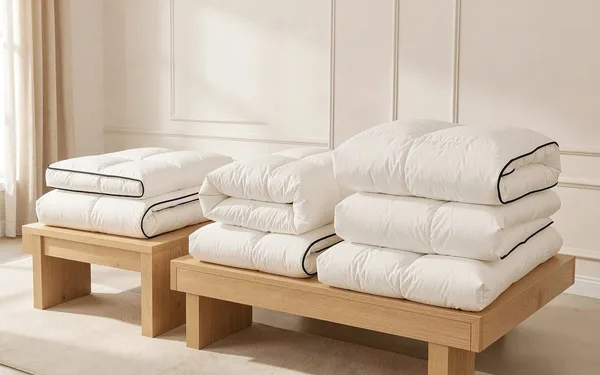
- Piping color: black / white
Because you can build a set for different seasons with the same down and the same construction, your sleeping comfort stays consistent all year round.
The down comforter refurbishing (re-making) approach
What is down comforter refurbishing?
The shell fabric of your current down comforter is opened up, the down inside is removed and washed, any shortfall is topped up, and everything is sewn into a new shell.
This is actually the closest thing to what people picture when they hear the word "custom-made" — your own down is used, and you choose the specifications as it is rebuilt.
What you can choose when refurbishing
- Shell fabric yarn count: standard 60-count sateen, upgradable to 100-count sateen (additional charge)
- Change of size: if there is enough down, the size can sometimes be changed
- Finished design: your comforter comes back with the new shell fabric's design
Down Comforter Refurbishing / Clean Cycle Reform at Omotesando Futonten starts at ¥45,800 for a Single. We remove the down and wash it in natural underground spring water from Hakushu, Yamanashi, without detergent, then top up any shortfall with our own Clean Cycle Down. Upgrading the shell to 100-count sateen is available from +¥12,000 — just ask.
When refurbishing makes sense
- The comforter was originally filled with high-quality down (goose, with a down cluster ratio of 90% or higher)
- The shell fabric is worn, but there's still a good amount of down inside
- It was part of your wedding trousseau or a gift, and you simply can't part with it
- You want to spend less than you would on a brand-new comforter
When refurbishing isn't the right choice
- Comforters with a low down cluster ratio to begin with (70% or less), or that are mostly feather
- The amount of down itself has dropped significantly
- The odor won't come out
Refurbishing can never produce a result better than the quality of the original down. Check the down cluster ratio on the quality label before you decide. We've summarized how to judge in What Is Down Comforter Refurbishing (Re-Making)? Costs, the Process, and When to Have It Done — Explained by a Specialist Store.
When a ready-made comforter doesn't fit — and how to fix it
Case 1 | You're tall and the comforter is too short
If you are 180 cm or taller, a standard 210 cm length may not cover your shoulders and your feet at the same time.
The fix: Going one size up (a wider comforter) keeps the same length while adding side coverage, so there's less of a gap around your shoulders. If you want extra length itself, ask us directly about a custom order.
Case 2 | You toss and turn, and the comforter slides off
The fix: Moving up one size usually solves this. Also, tying all of the duvet cover's corner and mid-edge ties keeps the comforter from shifting inside the cover.
Case 3 | You sleep hot, but winter nights are cold
The fix: Instead of relying on one winter-weight comforter, keep an all-season (medium-weight) comforter and a summer-weight (light) comforter on hand and switch between them — it gives you far more control. Choosing both from the same series, with the same down and the same construction, keeps the feel consistent.
Case 4 | You don't like heavy comforters
The fix: Choose down with a higher fill power and you get the same warmth with less weight. At 450 cm³/g (Japanese dp), you get the same loft as 400 cm³/g with over 100 g less fill weight. Going up to a finer yarn count also makes the shell fabric itself lighter.
Case 5 | You have a non-standard bed
With imported beds or custom built-in beds, Japanese standard sizes don't always fit.
The fix: Measure the dimensions, then get in touch with us for a personal consultation. In some cases a standard size will work just fine.
How to think about size | Standard sizes and actual dimensions
Down comforter sizes in Japan generally follow these standards.
| Name | Comforter dimensions | Matching mattress width | Number of sleepers |
|---|---|---|---|
| Single | 150×210cm | 97〜100cm | 1 person |
| Semi-double | 170×210cm | 120cm | 1 person (roomy) |
| Double | 190×210cm | 140cm | 2 people |
| Queen | 210×210cm | 160cm | 2 people (roomy) |
| King | 230×210cm | 180cm | 2 adults + a child |
A comforter is about 50 cm wider than the mattress so that it drapes down on both sides of your body. That drape acts like a wall, keeping warm air from escaping out the sides.
210 cm is the standard length
In Japan, down comforters are generally 210 cm long regardless of size. If you are 180 cm or taller, pulling the comforter up to your shoulders can leave your feet exposed.
In that case, going up in width is more practical than adding length. With extra width, you can lie slightly diagonally without opening up a gap. If you want a genuinely longer comforter, please contact us to ask about a custom order.
If you have an imported bed
Beds made overseas follow different standards and dimensions than Japanese ones. North American and European sizes in particular can share the same name but differ in actual measurements, so always measure your mattress before choosing.
| Overseas name | Approximate width | Closest Japanese size |
|---|---|---|
| Twin (US) | Approx. 99 cm (39 in) | Single |
| Full / Double (US) | Approx. 137 cm (54 in) | Double |
| Queen (US) | Approx. 152 cm (60 in) | Queen |
| King (US) | Approx. 193 cm (76 in) | King |
Thinking in terms of a seasonal set
When you think about "the right comforter for me," you'll sleep more comfortably if you change the weight by season rather than using one comforter all year round.
If you build a set of three comforters with the same down, the same shell fabric and the same construction, differing only in fill weight, the feel of your sleep stays consistent as the seasons change. Switch to a different type of down and both the loft and the feel against your skin change.
| Type | Fill weight (Single) | When to use it |
|---|---|---|
| Summer-weight (light) comforter | 0.3〜0.4kg | June to September |
| All-season (medium-weight) comforter | Around 0.8 kg | April to June / September to November |
| Winter-weight comforter | 1.2〜1.3kg | November to March |
If buying all three at once isn't realistic, a practical order is to start with the winter-weight comforter, since you'll use it longest, then add the summer-weight comforter the next year, and the all-season comforter after that.
How to decide on your specifications
How to choose the type of down
| Your priority | Down to choose |
|---|---|
| Lightness above all | Mother goose down with a fill power of 440 cm³/g or higher (Japanese dp) |
| Balance of warmth and price | Goose down with a fill power of around 400 cm³/g (Japanese dp) |
| Keeping to a budget without losing quality | Recycled down with published specifications |
| Care for the environment | RDS-certified new down, or recycled down |
How to choose the shell fabric yarn count
- 60-count yarn: Standard. Durable and easy to live with. More than enough for everyday use
- 80-count yarn: Supple and light. You can clearly feel the difference against your skin
- 100-count yarn: Top of the line. Silk-like smoothness, and the lightest of all
The higher the yarn count, the lighter the fabric itself, so the whole comforter weighs less. If lightness is what you're after, both the quality of the down and the yarn count of the shell fabric make a difference.
For the full details, see 60 satin vs. 80 satin: how to choose the shell fabric for your down comforter, explained by a specialist store.
How to choose the color
Since the comforter is used inside a cover, the color of the comforter itself is essentially invisible. That said, a dark comforter can show through a white or light-colored cover, so choose with your cover color in mind.
Estimated lead times and when to order
Both made-to-order comforters and down comforter refurbishing (remaking your existing comforter with its own down) take time from order to delivery, and seasonal demand can add to the wait.
| Season | How busy we are | Estimated lead time |
|---|---|---|
| April–June | Quiet | Short. Ideal timing for refurbishing |
| July–August | Fairly quiet | Short |
| September–November | Peak season | Long. Allow plenty of time |
| December–February | Moderately busy | Medium |
| March | Getting quieter | Short |
If you want to start using it in winter, place your order by the end of October at the latest. For refurbishing, spring through summer is ideal: you hand it over right after the season ends, so soiling isn't carried over, and you avoid the peak season.
What to check before you place your order
For made-to-order comforters
- How long the turnaround takes
- Whether the down cluster ratio and fill power are disclosed
- Is the washing method and standard explained?
- Shell fabric material and yarn count
- Quilt construction
- Return and exchange conditions
For down comforter refurbishing
- The down washing method and standards used
- What any shortfall is topped up with (the quality of the added down)
- Shell fabric options and any surcharges
- Whether the size can be changed
- Turnaround
- Pickup and delivery arrangements
- How it's decided — and communicated — if the comforter can't be refurbished
"What any shortfall is topped up with" matters most. Mixing low-quality down into originally high-quality down lowers the performance of the whole comforter. Check that the quality of the added down is clearly stated.
Frequently asked questions
Can I have a down comforter made to order?
Yes, in the sense of choosing the type of down, fill weight, size, shell fabric and color and having it made up for you. Fully bespoke one-off pieces are handled differently from store to store, so share your dimensions and requirements and ask us directly.
What's the difference between made-to-order and ready-made?
A made-to-order comforter is sewn after your order is placed, so you receive a freshly made piece rather than one stored in a warehouse for months. Inventory costs aren't built into the price, either. The trade-off is a longer lead time.
How is refurbishing different from made-to-order?
Refurbishing reuses the down from the comforter you already own and remakes it. Because it isn't made from new down, the cost is lower — and you get to keep a comforter you're attached to.
Can the size be changed?
With refurbishing, a size change may be possible if there's enough down inside. Going up a size requires topping up with additional down. Please talk to us in advance.
Can I replace just the shell fabric?
Replacing the shell fabric means taking the down out and refilling it, so in practice it involves the same process as refurbishing. It makes sense to have the down washed at the same time.
How long does delivery take?
Lead times for both made-to-order and refurbishing vary by season. Demand is especially concentrated in autumn (September–November), so please get in touch well ahead of time.
How much does a bespoke comforter cost?
It depends on the specification. Send us your dimensions and requirements first, and we'll confirm what's possible and what it will cost.
What if I'm not happy with the finished comforter?
Refurbishing is a service that remakes a comforter using your own down. Once it has been remade it can't be returned to its original state, so unlike a purchased product, returns are generally not possible.
That's exactly why checking everything beforehand matters. Confirm the finished shell fabric, size, approximate fill weight and the quality of the down used for topping up in writing or by email before you place your request.
What happens if I'm told there isn't enough down?
In some cases, once the comforter is opened up, there turns out to be less down inside than expected. When that happens, one of the following applies.
- Finish the comforter with more added down (an extra charge may apply)
- Finish it in a smaller size (for example, Single → Junior)
- Stop the refurbishing and return the comforter to you
How this is handled varies from shop to shop. Asking in advance how a shortage of down is handled will make everything run more smoothly later on.
Can two comforters be combined into one?
Technically, it is sometimes possible. If you have two old comforters that have each lost loft, the down can be combined into a single comforter. However, if the quality of the down doesn't match, the finished comforter can feel uneven. Please talk with us beforehand.
Can you make baby or junior sizes as well?
It depends on the shop. Some offer only a limited range of standard sizes, so give them your measurements and ask.
Can I just ask a question first?
Of course. Tell us your measurements and requirements, and we'll let you know whether we can do it and what it will cost.
Summary
- There are two ways to have a down comforter made for you: made-to-order production and refurbishing your existing comforter
- You can choose the type of down, fill weight, size, shell fabric yarn count, color and more
- With made-to-order production, nothing sits in a warehouse — your comforter arrives freshly made, with no inventory costs built into the price
- Refurbishing re-makes your own comforter using the down already inside it — ideal for a comforter you're attached to
- Refurbishing can never produce better quality than the original down. Check the down cluster ratio before deciding
- When you place an order, always confirm the cleaning method and what will be used to top up any shortage of down
Down comforter refurbishing / Clean Cycle Reform (Single from ¥45,800)