The short answer: vacuum storage bags for a down comforter are fine for the short term (up to one to two weeks), but not for long-term storage.
A down comforter keeps you warm because its down clusters trap air and loft up. Compress it for a long stretch and those clusters can collapse and never fully recover.
In this article, a specialist store explains why compression is a bad idea, how to store and keep your comforter correctly, and how to revive one that's already been compressed.
A down comforter is filled generously with waterfowl down, and while all that loft feels wonderfully soft, it's best not to sit or lie on it with your full weight or squeeze it into a vacuum bag.
If storage space at home is tight, you'll need to get creative. But why exactly is compressing a down comforter considered a bad idea?
This article explains why you should avoid compressing a down comforter and how to store one without a vacuum bag. If you want to be sure you're caring for yours correctly, read on.
Is it OK to vacuum-compress a down comforter? A situation-by-situation guide
| Situation | Verdict | Why | Recommended approach |
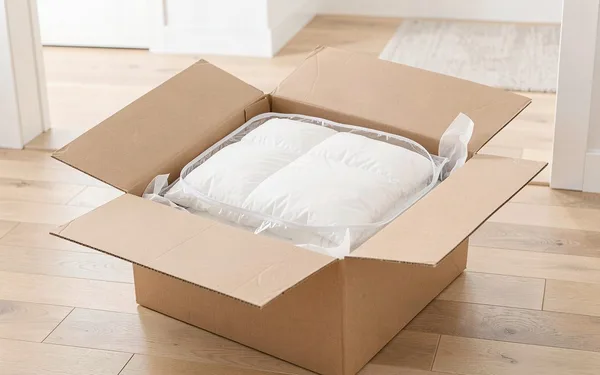
| Moving or travel (up to 1 week) | △ OK for short periods | Loft usually bounces back after a short time | Release the compression as soon as you arrive and air it in the sun |
| Off-season storage (several months) | ❌ NG | The down clusters get permanently crushed | Use a dedicated nonwoven storage bag or another breathable bag |
| Premium comforters (93% or more goose down) | ❌ Never do it | The finer the down, the greater the damage | Ask a specialist about storage along with down comforter refurbishing and cleaning |
A down comforter is designed to make the most of down's natural qualities — a soft, airy feel and excellent warmth — so compressing it is not recommended.
Compression methods include pressing down with your body weight to flatten the comforter and using a vacuum storage bag, but both have a negative effect on the down inside.
If your storage space is tight, compression may be unavoidable. But whenever you can store the comforter as it is, avoid forcing it: simply fold it and put it away.
Related reading: Why is a down comforter so warm when it's light and fluffy? The reasons and how it regulates temperature
Looking for a luxury comforter? Take a look below.
Related article: Luxury comforter lineup
Why you shouldn't compress a down comforter
So what actually happens when you compress a down comforter? Here are four reasons why you shouldn't.
The down clusters close up and lose their loft
Each individual piece of down is called a "down cluster." Every cluster has a natural loft, and the number used to express that loft is known as fill power (Japanese dp).
Down with higher fill power insulates better and is therefore considered higher quality — but when pressure is applied, the clusters close up and lose the fill power they started with.
Lower fill power affects more than just the fluffy look of the comforter; it affects real-world performance. Insulation drops, so the comforter may no longer feel warm and you can end up feeling chilly in bed.
Related article: What is fill power, and why is it essential when choosing a high-quality down comforter?
It breaks the quills and down clusters
If you try to compress a down comforter the way you would other bedding, the down packed inside is squeezed under the pressure and shrinks.
It isn't the soft filaments that suffer most, but the core and the quill shaft that support the whole cluster. When these are crushed under pressure, the structure collapses and the soft, airy feel is lost.
Down comforters are filled with down from the breast of waterfowl plus feathers from the wings. Feathers have stiff quills, so if they are crushed under pressure the loft can be badly compromised.
Flattening and dents caused by compression are most common in down comforters and feather comforters with a high feather content.
If you're shopping for a luxury comforter, take a look below.
Related article: Luxury comforter collection
It damages the shell fabric
Compressing a comforter applies strong force, which damages the materials — not only the down inside, but also the shell fabric that encases it.
While compressing it, pressing down again and again with your hands creates friction on the fabric, and broken quills can push outward and pierce the shell fabric from the inside.
Once there's a hole in the shell fabric, down escapes through it easily. Everything may look fine while the comforter is compressed in storage, but when you take it out and let it fill with air again, down can burst out all at once.
Any hole needs to be repaired right away — if you leave it, more and more down will escape and the comforter will lose volume. This is especially true of comforters with a low down cluster ratio and a high feather content, since stiff quills break easily and punch straight through the shell fabric.
If you truly have no choice but to compress, go with a down comforter that has a low feather content.
Related article: Don't overlook the shell fabric of your down comforter! Fabric types and how to choose
Moisture builds up inside the comforter
A down comforter owes its soft, airy feel to the resilience of each individual cluster. Compression crushes the whole thing and packs the clusters tightly together.
If the comforter is stored for a long time with the down tightly packed and without enough ventilation, moisture builds up and the risk of mold and dust mites rises.
Compression is a great way to store bedding compactly, but it is fundamentally unsuited to down comforters, which are made from natural materials used in their natural state.
If you really have no choice but to use compression storage, take the comforter out regularly to dry and air it, and choose a well-ventilated spot to keep it in.

How to store your down comforter correctly in the off-season
- Always air it out before storing (2–3 hours in the shade) so it is completely dry
- Pat the comforter lightly to spread the down evenly, then fold it loosely
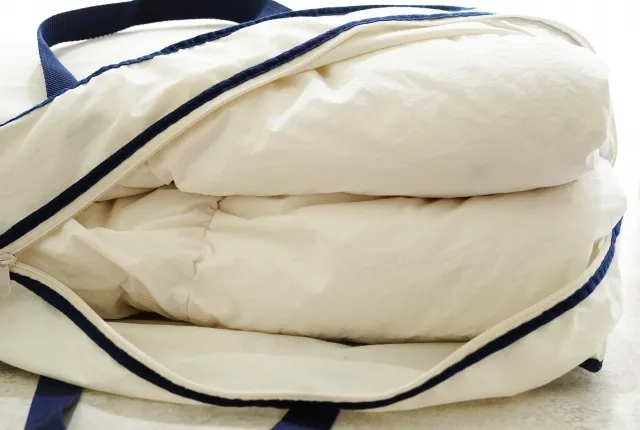
- Place it in a breathable nonwoven storage bag made for comforters (a non-compression type)
- Keep it somewhere with little humidity, such as the top shelf of a closet or the upper section of an oshiire (Japanese built-in closet)
- Place moth repellent outside the storage bag so it never touches the down directly
| ❌ Storage mistakes to avoid at all costs
・Long-term storage in a vacuum compression bag → crushes the down clusters ・Storing somewhere damp (under-floor storage, the bottom shelf of a closet) → invites mold and odors ・Sealing it in a plastic bag → traps moisture, causing mold and down deterioration |
How to revive a comforter flattened by compression storage
- Put it in a large dryer at a laundromat (coin laundry) and run a low-to-medium heat cycle (under 60°C) for 30–60 minutes
- Take it out once partway through and fluff it by hand to break up any clumps of down
- Return it to the dryer to finish
- Once home, air it in the shade for another 1–2 hours until completely dry
| If the dryer doesn't help, consider down comforter refurbishing
Once the down clusters are completely crushed, there's only so much a dryer can do. With refurbishing (re-making), the down is removed, washed and revived, and in some cases the loft comes back. |
How to store a down comforter without compressing it
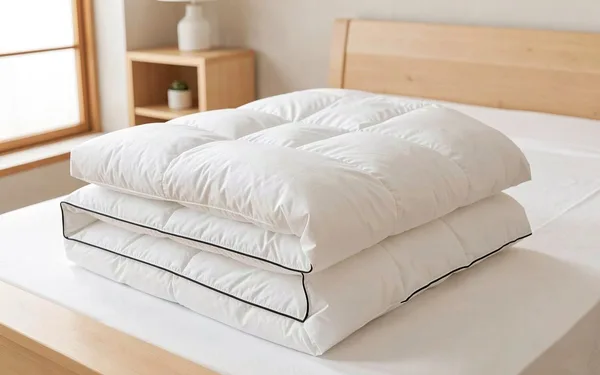
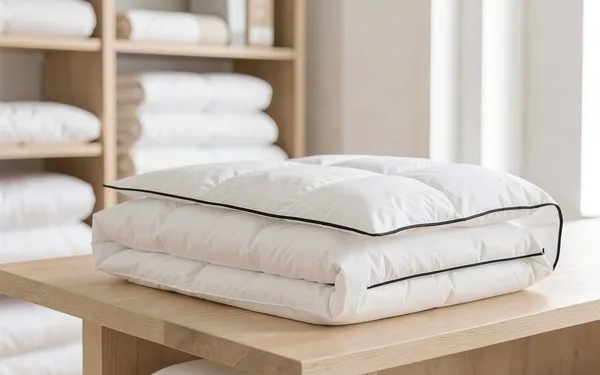
To store your comforter without compressing it, simply fold it away. Use a breathable case or bag so mold and dust mites are less likely to take hold.
Use a breathable case, such as non-woven fabric
Cases and bags made from non-woven fabric — the same material used in face masks — allow air to circulate, so mold and insects are less likely to develop and storage stays hygienic. Non-woven cases are sold as storage bags and boxes for down comforters and blankets.
Before storing a down comforter, make sure it is thoroughly dry and free of dust. Gently vacuum off any dust, then even out the down using a technique known as "furisabaki" (shaking out). Hold the edges of the comforter with both hands and shake it briskly so the down is evenly distributed.
After shaking it out, turn the comforter lengthways and fold the left and right sides in by a third each, following the seams. With the comforter now long and narrow, fold the top and bottom in by a third each and you're done.
Wrap it in a cotton sheet
If you don't have a storage bag, a bed sheet works just as well. Remove the duvet cover, lightly brush off any dust, shake the comforter out, then fold it down compactly in the same way as for a non-woven case.
Next, spread the sheet out on the floor. Place the folded comforter in the center and wrap the sheet around it completely. Tie the corners of the sheet together and the comforter will keep its folded shape in storage.
As with non-woven fabric, choose a lightweight, breathable sheet — it helps prevent mold and keeps the comforter clean in storage.
What to watch out for when storing a down comforter
When storing a down comforter, always remove dust and soiling first. If it isn't washable, having it cleaned by a specialist gives you real peace of mind.
Storing a comforter while it's still soiled invites mold. Don't keep closets and storage cupboards shut all the time — open the doors regularly to let air circulate.
Related article: How many years does a down comforter last? How to decide between replacing and refurbishing
Frequently Asked Questions
Q1. Will a down comforter bounce back after being in a vacuum compression bag?
- For a short period (about 1–2 weeks), a run through the dryer will restore it in most cases. But after several months or more under compression, the down clusters can be permanently crushed and may never fully recover.
Q2. Is it OK to put a down comforter in a compression bag when I move?
- For the length of a move (within a week), it's fine. Take it out of the bag as soon as you arrive and either run it through a laundromat dryer or air it in the sun.
Summary
In this article, we looked at why it's best not to compress your down comforter, along with storage methods that don't involve compression.
Understanding the right way to store your comforter is key to extending its life. Compression should be avoided to preserve fill power, but if your storage situation leaves you no choice, a down comforter with a high down cluster ratio is the better bet.
How long a down comforter lasts depends on the down and the shell fabric. Omotesando Futonten's "Premium RDS Down" uses premium mother goose down — clean for the animals and for the environment.
Its fill power of 450db (㎤/g) exceeds the 350db (㎤/g) generally regarded as high quality, making it a great choice if compression is unavoidable in your home.
If you're looking for a down comforter (duvet) that combines Japan's finest quality with a refined design that complements your interior, do take a look at the Omotesando Futonten collection.
Premium RDS Down Winter-Weight Comforter / Mother Goose Down
For high-quality Japanese-made premium down comforters (duvets), choose Omotesando Futonten
| Related articles
・How to Make a Down Comforter Fluffy Again [6 Fixes]: A Specialty Store Explains Flat, Sagging Down |
Feather Comforters Need Even More Care Than Down Comforters When Compressed
Comforters with a high proportion of feathers (the quills from a waterfowl's wings) — so-called "feather comforters" — have stiff quills that snap more easily under the pressure of compression, and they're more likely to poke through the shell fabric. If you must compress a feather comforter, keep it compressed for an even shorter time than you would a down comforter, and always air it out in the shade and let it dry thoroughly once you take it out.
More Frequently Asked Questions
Q3. Is it safe to put a down comforter in a compression bag?
- For short periods of one to two weeks — a move or a trip, for example — it's fine. But using a vacuum bag for months of off-season storage can crush the down clusters so that they never fully recover their warmth, so we recommend a breathable non-woven storage bag instead.
Q4. Is it safe to compress a feather comforter?
- Feather comforters contain a high proportion of feathers with stiff quills, so they tend to suffer more damage from compression than down comforters do — broken quills and holes in the shell fabric. If you do compress one, keep it brief, and after taking it out, air it in the sun or run it through a dryer to restore it properly.