| “It's too hot to sleep under a down comforter in summer” — the causes and what to do about it
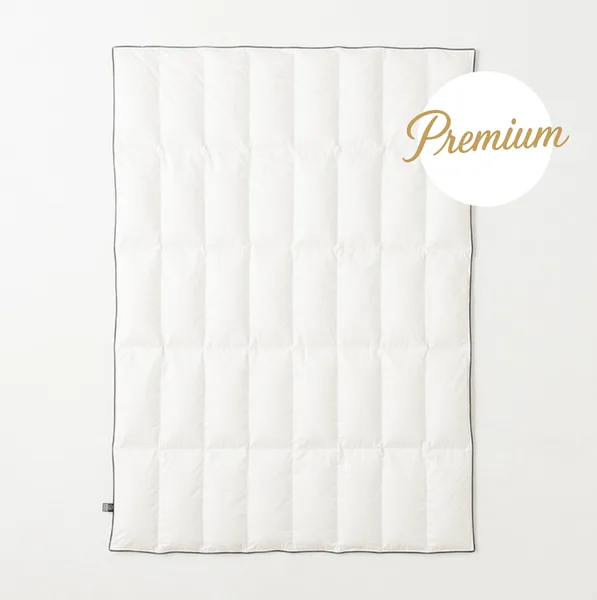
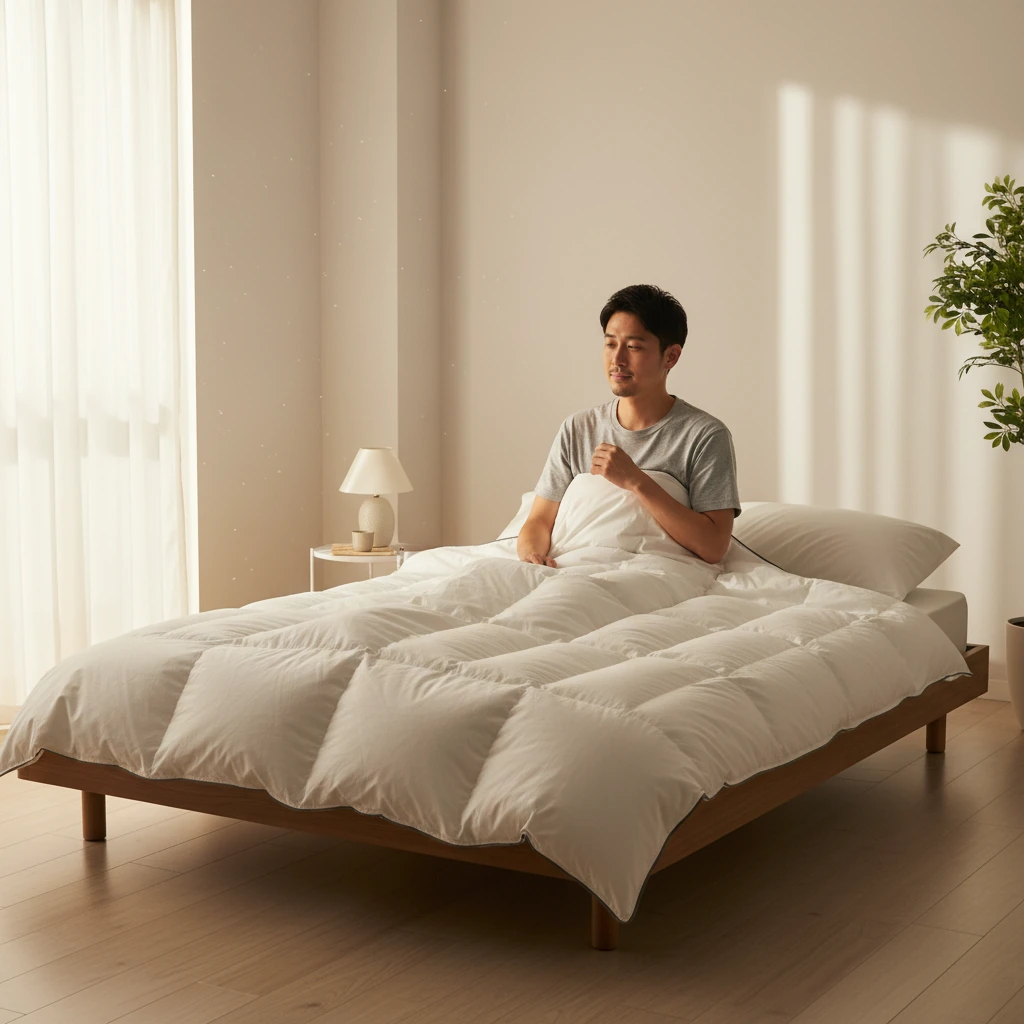
The short answer: it feels hot because you're using a winter down comforter (fill weight 1.2–1.3 kg) straight through the summer. Switching to a lightweight summer down comforter (a down blanket with a fill weight of 0.2–0.4kg) makes for cooler, more comfortable summer sleep than a cotton towel blanket. In this article, we explain exactly why you overheat, how to fix it, and how to choose the right comforter for summer. |
Every summer we hear the same thing from customers: "My down comforter is too hot to sleep under," and "But a single towel blanket leaves me cold by morning."
In most cases, the cause is simple: you're still using your winter down comforter in summer. Down comforters aren't unsuited to summer — the problem is using a heavily filled winter comforter in hot weather.
Here, Omotesando Futonten — with more than 25 years in the bedding business — explains why down comforters feel hot in summer, what causes that clammy, stuffy feeling, and how to solve it.
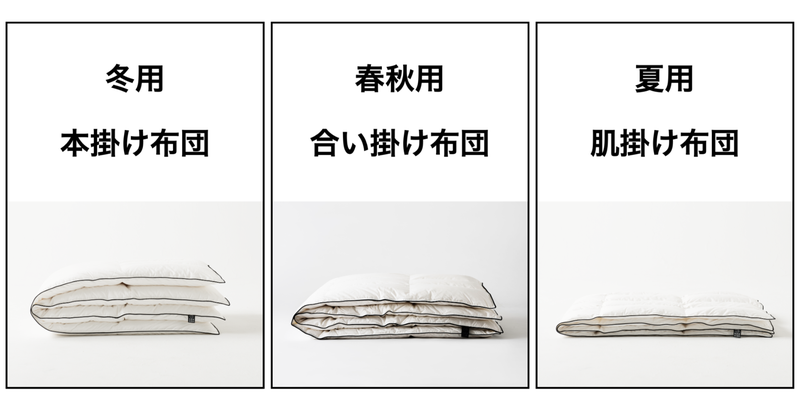
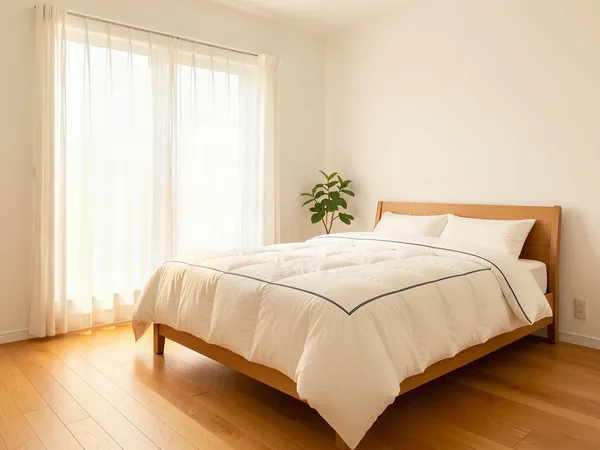
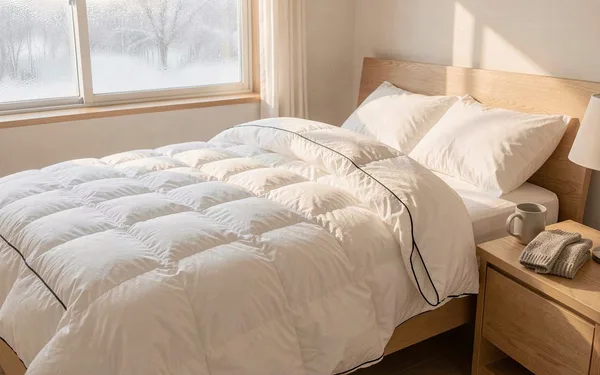
Left: winter-weight comforter (fill weight 1.2–1.3kg). Right: summer down blanket (0.2–0.4kg). The difference in loft is obvious at a glance.
3 reasons a down comforter feels hot and stuffy in summer
Reason 1: The fill weight is too high (you're still using your winter comforter)
A winter down comforter in Single size typically has a fill weight of 1.2–1.3kg. The air layer created by that much down delivers superb warmth in winter, but in summer it traps heat — and that's the main reason you overheat.
On a summer night with a room temperature above 25°C, a winter down comforter can push the temperature inside the bedding above your own body temperature. That's what leads to night sweats, clamminess and poorer sleep quality.
| Nine times out of ten, “my down comforter is too hot” comes down to using a high-fill-weight winter comforter in summer. |
Reason 2: Low-quality down can't absorb and release moisture fast enough
Down naturally absorbs and releases moisture extremely well, but low-quality down (with a low down cluster ratio) can't cope with heavy summer perspiration, leaving the inside of the comforter humid and stuffy.
Budget comforters with a down cluster ratio of 50% or less are especially slow to absorb and release moisture, so night sweat lingers in the comforter and it quickly feels muggy. By contrast, a high-quality comforter with 90% or more goose down cycles moisture in and out quickly, so it stays comfortable even in summer.
| Down cluster ratio | Moisture absorption & release | Summer comfort | Notes |
| 50% or less | △ Slow | × Feels muggy | Closer to a feather comforter |
| 50〜80% | △ Average | △ Can feel slightly stuffy | Best for value seekers |
| 80〜90% | ○ High | ○ Comfortable | Well-balanced |
| 90% or higher | ◎ Very high | ◎ Great sleep | Our recommended level |
Reason 3: You're switching comforters too late in the season
If you keep telling yourself "I can get a little more use out of this," and hang on to your winter comforter, nights turn uncomfortable by late May or early June. Once room temperatures stay above 20°C, that's your cue to switch to a summer comforter.
Switch too late and even a perfectly good comforter will feel too warm. The moment you think "this might be too hot," it's best to make the change right away.
| 3 signs it's time to switch comforters
✓ It feels stuffy and damp under the covers when you wake up ✓ You find yourself sticking your feet out from under the covers at night ✓ Your pajamas or bedding feel damp from night sweats → If even one of these sounds familiar, it's time to switch to a summer comforter |
Solutions: 3 ways to sleep well under a down comforter in summer
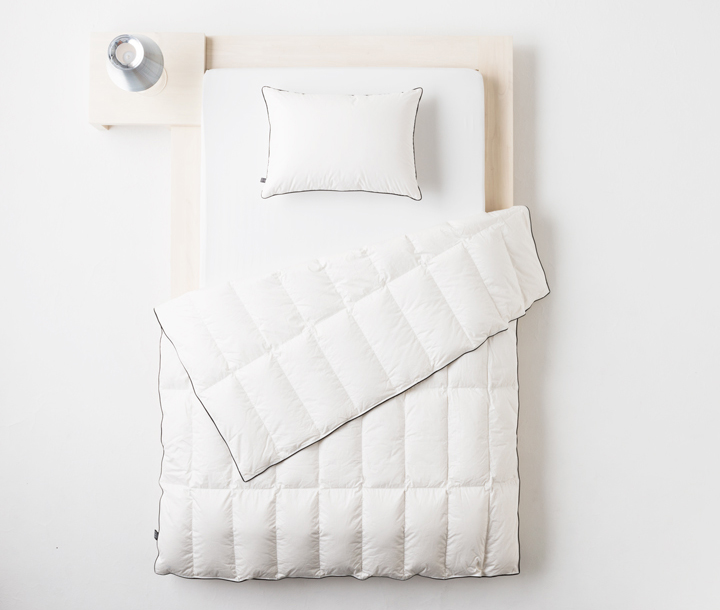
Solution 1: Switch to a summer-weight down comforter (down blanket)
This is the most fundamental solution. A summer down comforter (down blanket or summer-weight comforter) has a fill weight of just 0.2–0.4 kg — less than a quarter of a winter comforter. Thin and lightweight, it uses down's natural moisture-wicking and releasing ability to create a cool, breathable sleep environment all summer long.
Summer comforters filled with 90% or more goose down are especially good at delivering both a crisp, airy lightness you'll never get from a cotton blanket and just enough warmth for those chilly early-morning hours.
| Types of summer comforters | Characteristics | Recommended for |
| Down blanket (duck down) | Lightweight, easy to wash, great value | For those who want to give it a try first |
| Down Blanket (Goose Down) | Breathable, excellent moisture control, high quality | For those who prioritize quality sleep |
| Down blanket (mother goose down) | Best-in-class temperature regulation, ultra-light, top quality | Those who want the very best quality |
Solution 2: Go with a 4-season 2-in-1 comforter you can use all year
If you're short on storage space or find swapping comforters each season a hassle, a 4-season 2-in-1 comforter is the way to go.
A 4-season 2-in-1 comforter consists of a summer-weight comforter and a winter-weight comforter that snap together with buttons, so one set covers all four seasons.
- Summer: summer-weight comforter only (fill weight 0.2–0.4 kg)
- Spring & fall: summer-weight comforter alone, or as the equivalent of an all-season comforter
- Winter: snap the summer-weight and winter-weight comforters together
Solution 3: Rethink your AC setting and the comforter you pair with it
If you've already switched to a summer comforter and still feel hot, your air conditioner may simply be set too warm. The ideal room temperature for restful sleep is said to be 26–28°C.
| Room temperature guide | Comforter for comfortable sleep |
| 30℃ or higher | Lightweight summer down blanket (0.2–0.3 kg) + air conditioning on a cooler setting |
| 27〜30℃ | Standard summer down blanket (0.3–0.4 kg) + air conditioning |
| 24〜27℃ | Standard summer down blanket (0.3–0.4 kg) |
| 22〜24℃ | All-season (medium-weight) comforter (0.5–0.7 kg) |
| Below 22°C | Winter-weight comforter (1.0 kg or more) |
If you find the air conditioner makes the room too cold, try using the timer so the cooling eases off two to three hours after you fall asleep.
How to choose a summer down comforter: key points
Check three things: fill weight, down cluster ratio and material
To choose a down comforter that sleeps comfortably in summer, always check these three points.
- Fill weight: 0.3–0.4 kg for a Single (0.2–0.3 kg if you sleep hot)
- Down cluster ratio: 80% or higher, ideally 90% or higher
- Material: goose down or better (especially fill power of 390 dp or higher)
- Shell fabric: 100% cotton or double gauze
Watch out for these signs of a comforter that traps heat and moisture
- Budget comforters with a down cluster ratio of 50% or less (they can't absorb and release moisture fast enough)
- Shell fabrics blended with polyester (they trap heat and humidity)
- Comforters marketed for summer with a fill weight of 0.5 kg or more (these are really all-season weight)
A high-quality summer comforter lasts for years, so it pays for itself
A high-quality summer comforter filled with goose down or mother goose down will last 15–20 years. Using one excellent comforter for many years costs less overall than replacing a cheap one every two or three years.
Let go of the idea that "it's just for summer, so cheap is fine." Choosing quality for summer is the shortest route to better sleep.
Frequently Asked Questions
My down comforter is too hot to sleep under. What should I do first?
Start by checking the fill weight. Anything 1.0 kg or more is a winter comforter and isn't suited to summer. Switching to a summer down blanket (0.3–0.4 kg) is the single most effective fix. If you'd rather not buy anything new, try a lightweight cotton towel blanket instead, or review your air conditioner settings.
How should I store my down comforter over the summer?
After airing it in the shade or having it professionally cleaned, store it in a breathable non-woven bag or case on the upper shelf of a closet or wardrobe, where humidity is lowest. Avoid vacuum compression bags — they damage the down clusters. Make sure the comforter is thoroughly dry before long-term storage.
My down comforter has picked up a sweaty smell. What can I do?
First, try airing it in the shade. If the odor remains, we recommend taking it to a specialist cleaner. Washing at home can damage the down depending on the comforter, so always check the care label first.
Summary
There are two main reasons a down comforter feels hot in summer: you're still using a winter comforter with a high fill weight, and low-quality down can't absorb and release moisture quickly enough.
The solution is simple: switch to a summer down comforter (a summer down blanket with a fill weight of 0.3–0.4 kg). Choosing 90% or higher goose down in particular keeps summer stuffiness to a minimum for comfortable sleep.
- Put your winter down comforter away from late May to early June
- Switch to a summer down blanket (fill weight 0.3–0.4 kg)
- Choose 90% or higher goose down with a 100% cotton shell fabric
- Set your air conditioner for a room temperature of around 26–28°C
| ▶ Browse all summer down blankets from Omotesando Futonten here |