| What you'll learn in this article
・How to check whether your comforter can be washed at a laundromat (coin laundry) ・The right way to wash and dry each material: down, cotton, and synthetic fills ・Key precautions to avoid mistakes, plus how often you should wash ・When washing isn't enough: professional cleaning and down comforter refurbishing options |
“I'd like to wash my comforter at a laundromat, but I'm worried about ruining it.” “Can't you wash a down comforter at home?” These are questions we hear all the time.
The short answer: if the care label shows a “machine washable at home” or “hand wash” symbol, your comforter can be washed at a laundromat. Down comforters, however, are made from delicate materials, so if you skip the correct steps the down can shift and clump, and the shell fabric can be damaged.
In this article, Omotesando Futonten — with more than 25 years of experience working with comforters — walks you through the correct washing method for each material, the right drying process, and the points that keep things from going wrong.
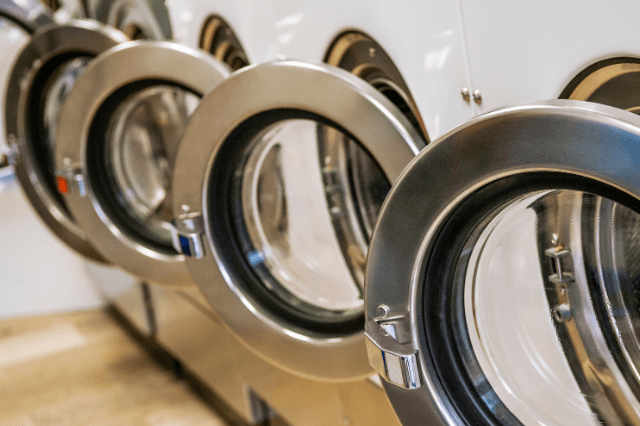
Use a large washing machine made for comforters. As a guide, a Single comforter needs a machine of 14 kg or more, and a Double needs 20 kg or more.
First, check: how to tell if your comforter can go in a laundromat washer
Always check the care label
Before washing your comforter at a laundromat, always check the care label attached to it. If it shows one of the following symbols, it can be washed.
| Symbol | Meaning | What to do |
| Tub symbol (no number) | Machine washable at home | Laundromat OK |
| Tub symbol with a hand | Hand wash only | OK in a large washer on the hand-wash cycle |
| Tub symbol with an X | Do not wash | Take it to a professional cleaner |
| Silk or wool fabric | Delicate material | Generally not washable |
| If the care label shows an ✕ mark, or if you have a luxury comforter in silk or cashmere, avoid the laundromat. We recommend taking it to a professional cleaner instead. |
Laundromat-safe or not, by material
| Material | Washable? | Why / what to watch for |
| Down comforter (90% or more down) | △ Check first | Always check the care label. Some are washable, some are not. |
| Down comforter (less than 80% down) | ○ Washable | Relatively easy to wash. Use a large-capacity washer. |
| Cotton futon | × Often not washable | The cotton filling shifts and clumps easily, so most cannot be washed. |
| Synthetic comforter (polyester) | ○ Washable | The easiest to wash. Use 30–40°C on a gentle cycle. |
| Wool and cashmere | × Not available | Shrinks and gets damaged, so leave it to a professional cleaner. |
Washer capacity guidelines
At a laundromat, the larger the washer's capacity, the better it cleans a comforter. Use the size guide below.
| Comforter size | Recommended capacity | Laundromat cost (approx.) |
| Single comforter | 12–14 kg or more | Approx. ¥600–¥800 |
| Double comforter | 18–20 kg or more | Approx. ¥900–¥1,200 |
| Single + duvet cover | 14 kg or more | Approx. ¥700–900 |
How to wash a down comforter at the laundromat, the right way
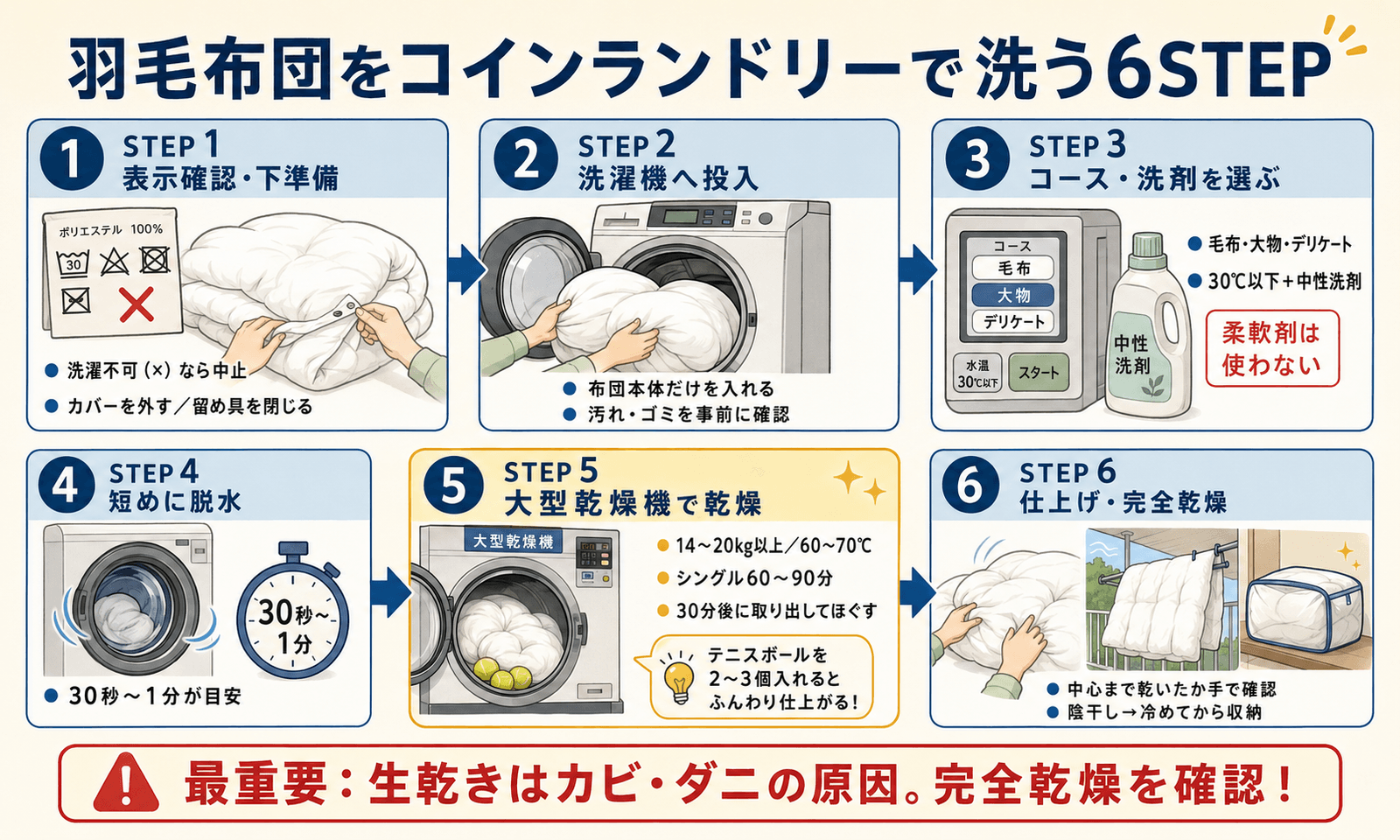
STEP 1–6 illustrated: load the washer → select the cycle → dryer → finishing touches
STEP 1: Prep before washing
- Check the care label (stop if there is an X mark)
- Check for visible stains or areas with odor
- Close all zippers and buttons
- Remove the duvet cover and wash it separately (bring only the comforter itself)
- Remove large debris and dust by hand
STEP 2: Choosing the right cycle and detergent
- Cycle: select "Blanket," "Bulky Items," or "Delicate" mode
- Water temperature: 30–40°C (30°C or below is safest for a down comforter)
- Detergent: use a detergent made for down comforters or a mild (neutral) detergent (no fabric softener needed)
- Spin: use a short setting (about 30 seconds to 1 minute)
| Fabric softener reduces down's ability to absorb and release moisture. We recommend skipping it for down comforters. |
STEP 3: Drying matters most — how to dry it properly
Drying is the most important part of washing a comforter. Storing it while still damp invites mold and dust mites.
- Use a large-capacity dryer (14–20 kg or more)
- Dry on a low to medium setting (60–70°C)
- Estimated drying time: 60–90 minutes for a Single
- Take it out once partway through (after 30 minutes) and fluff it (to prevent the down from clumping to one side)
- Tossing in 2–3 tennis balls helps the down fluff up
- Confirm it is completely dry (feel with your hand to check that the center is dry too)
STEP 4: Finishing touches after drying
- Fluff the comforter by hand right after drying
- Air it in the shade in a well-ventilated spot for a few hours to release any remaining moisture
- Once it has cooled completely, put the duvet cover back on and store it
How often to wash your comforter, and how to store it
Recommended washing frequency
| Type of comforter | How often to wash | Why |
| Down comforter (high quality) | Once every 3–5 years | Washing too often damages the down |
| Down comforter (standard) | Once every 3–5 years (once every 1–2 years if used without a cover) | Using a cover keeps the comforter itself from getting dirty |
| Synthetic-fill comforter | 1–2 times a year | Easy to wash and easy to keep clean |
| Duvet covers & sheets | 1–2 times a week | Wash frequently, since they touch your skin directly |
Storage tips before and after the laundromat
- Before washing: wash after 2–3 days of continuous sunny weather (avoid rainy days)
- After washing: make sure it is completely dry before storing (never store it damp — this is really important)
- Where to store: somewhere well ventilated. Don't use vacuum storage bags
When to leave it to the professionals
Some problems simply can't be solved at a laundromat.
If your comforter is in any of the conditions below, we recommend professional cleaning or down comforter refurbishing rather than a laundromat.
- The down has shifted and clumped to one side (a laundromat won't fix this)
- Years of use have left the down flat and lifeless
- Odors that won't come out, even after washing
- Premium down comforters whose care label shows a × (do not wash) symbol
- Luxury down comforters with a down cluster ratio of 90% or higher
| About our Down Comforter Refurbishing & Clean Cycle Reform service
This is a specialist process that restores a down comforter to like-new condition. We remove the down, wash it thoroughly, and replace the shell fabric with new fabric, bringing back that soft, lofty feel. See down comforter refurbishing for details |
Frequently Asked Questions
- Can you wash a down comforter at a laundromat?
- Always check the care label first. If it can be washed, use water at 30°C or below with a mild (neutral) detergent, then dry it thoroughly in a large-capacity dryer. For comforters with a × symbol on the care label, or high-quality comforters with a down cluster ratio of 90% or higher, we recommend professional cleaning.
- How long does it take to wash and dry a comforter at a laundromat?
- Plan on about 90–130 minutes in total: 30–40 minutes to wash plus 60–90 minutes to dry. Allow about 90 minutes for a Single and 120 minutes or more for a Double. Pausing partway through drying to fluff and redistribute the filling makes the drying far more effective.
- What should I do if my comforter still smells after washing?
- If an odor doesn't improve even after a laundromat wash, the cause may be deep inside the down itself. Consider professional cleaning or a refurbishing service. With Clean Cycle Reform at Omotesando Futonten, we remove the down and wash it completely.
Summary
Here's a quick recap of the key points for washing a comforter at a laundromat.
- Check the care label first (a × symbol means it can't be washed)
- Choose the cycle and water temperature that match the material
- Dry completely in a large tumble dryer (never leave it damp)
- Pause partway through to fluff the comforter and keep the down from clumping to one side
- Take high-quality down comforters to a specialist cleaner
| ▶ Omotesando Futonten: see Clean Cycle Reform (specialist down comforter cleaning and refurbishing) |
Common questions about washing a comforter at the laundromat
What size comforter fits in a 20 kg washer?
Large laundromat washers are usually labeled by capacity: 14 kg, 18 kg, 20 kg and up. As shown in the table above, a Single comforter needs a machine of roughly 12–14 kg or larger, and a Double needs 18–20 kg or larger. A 20 kg-class washer can handle one Double comforter, or a Single comforter together with a duvet cover. If the comforter is packed in too tightly to tumble, the dirt and detergent won't rinse out properly, so always choose a machine with plenty of room for the size of your comforter.
Why cotton-filled futons are difficult to wash at the laundromat
Because cotton futons are filled with cotton batting, they become extremely heavy once wet, and the batting easily shifts and bunches to one side inside the drum. Once the batting has clumped, it's very hard to restore in a dryer, and you risk torn fabric or mold forming inside if it doesn't dry all the way through. For that reason, even when the care label says the item is washable, it's best to keep cotton futons out of the laundromat and consult a specialist cleaner instead.
Choosing the right detergent for washing a comforter
Use a neutral detergent or a detergent made specifically for comforters so you don't damage the materials. Avoid bleach (both chlorine and oxygen types), as it damages the fabric and the down. As noted earlier in this article, we also recommend skipping fabric softener on down comforters, since it can reduce the down's ability to absorb and release moisture. Follow the machine's guidance on detergent quantity — using too much can leave residue deep inside the comforter, which leads to odors and mold.
Laundromat cost and time for washing a comforter
It's frustrating to arrive without knowing what it will cost or how long it will take. Here are the rough figures:
| Step | Typical cost | Time required |
|---|---|---|
| Wash (large machine, 15–20 kg) | ¥700–¥1,200 | 30–40 minutes |
| Dry (large machine) | 8–10 minutes per ¥100 | 60–90 minutes |
| All-in-one washer-dryer | ¥1,500–¥2,500 | 90–120 minutes |
| Total (one comforter) | ¥1,500–3,000 | 1.5–2.5 hours |
Considering that professional cleaning runs ¥8,000–¥13,000, that's less than one-fifth of the cost. But you make up the difference by taking on the drying risk yourself.
Don't underestimate drying time
The most common mistake is underestimating drying time. If you head out thinking “30 minutes to wash plus 30 minutes to dry — one hour total,” it almost certainly won't be enough.
With a down comforter, the surface can feel dry while moisture is still trapped inside. A winter-weight comforter in particular (fill weight 1.2–1.3 kg) may not be fully dry even after 60 minutes.
As a rough guide, allow 40–60 minutes for a summer-weight (light) comforter, 60–80 minutes for an all-season (medium-weight) comforter, and 80–120 minutes for a winter-weight comforter. Bring plenty of ¥100 coins so you can add extra drying time if needed.
Choosing the right machine and cycle
Washer size
| Comforter size / type | Washer capacity needed |
|---|---|
| Summer-weight (light) comforter (Single) | 10 kg or more |
| All-season (medium-weight) comforter (Single) | 15 kg or more |
| Winter-weight comforter (Single) | 15–17 kg or more |
| Winter-weight comforter (Double) | 22 kg or more |
| Two comforters | 27 kg or more |
If you cram a comforter into a machine that's only just big enough, it won't move around and the detergent won't reach every part. Leftover detergent is a common cause of clumped down. Take a look inside and check that the comforter has room to tumble in the drum.
Wash cycle
Cycle names vary from one laundromat to the next — “Blanket,” “Bulky Items,” “Delicate,” and so on. What matters is choosing a cycle with gentle tumbling and plenty of water.
The standard cycle agitates too vigorously, which can shift the down to one side and put strain on the seams.
Drying temperature
If you can select a temperature, choose medium heat. High heat dries faster, but it strips the natural oils from the down and damages the shell fabric. Low heat simply takes too long.
All-in-one washer-dryer vs. separate machines
| All-in-one | Washer + separate dryer | |
|---|---|---|
| Effort | Minimal (just leave it in) | You have to move it over yourself |
| Adjusting the drying | Often not possible | You can add extra time |
| Can you fluff it partway through? | No | Yes |
| Suitability for down comforters | △ | ◎ |
For a down comforter, separate machines are the better choice. You can take it out partway through to fluff the down, and you can add more drying time as needed.
What to prepare before you go
What to bring
- A large mesh laundry bag: an oversized bag made for comforters. It prevents wear on the fabric and keeps the comforter from losing its shape
- Plenty of ¥100 coins: for extra drying time. Bringing about ¥1,000 worth gives you peace of mind
- String: if you don't have a mesh bag, fold the comforter accordion-style and tie it loosely in about three places
- 2–3 clean tennis balls: tossed in during drying, they help break up clumps and fluff the down
- A bag to carry it home in: a large laundry bag
- Something to pass the time: plan on about 2 hours
Check these before washing
- Does the care label say it can be washed in water?
- Are there any loose seams or tears? (Repair them first — they will only get worse in the wash.)
- Have you removed the duvet cover?
- Have you spot-cleaned any noticeable stains?
How to check the results
When the drying cycle ends, always check the comforter on the spot. Discovering it's still damp after you get home is too late.
Step-by-step check
- Spread the comforter out and run your palms over it from corner to corner, pressing as you go.
- Feel for any cool, damp spots or areas where the down has clumped up.
- Pay extra attention to the four corners and the areas around the quilt stitching.
- If even one spot still feels cold, run it for another 20–30 minutes
"Cold to the touch = still damp." A fully dry down comforter feels faintly warm all over and light in your hands.
After you bring it home
Once home, spread the comforter out indoors for 1–2 hours before putting a cover on it. If you add the cover while the dryer's heat is still trapped inside, condensation can form within the comforter.
Common mistakes and how to fix them
Mistake 1 | The down clumped up and went flat
Cause: Not dried thoroughly. Wet down clumps together, and if it dries in that state it stays matted.
What to do: Run it through the dryer again on medium heat for 20–30 minutes with a few tennis balls added. The physical tumbling often breaks the clumps apart and restores the loft. At home, you can also air it in the shade with good airflow and work the clumps apart by hand.
Mistake 2 | The down shifted to one side
Cause: The spin cycle was too strong, or the comforter was too big for the machine's capacity.
What to do: Spread the comforter out flat and move the down by hand from the thick areas toward the thin ones. If the down migrates across the quilted baffles, the shell fabric may not be stitched tightly enough.
Mistake 3 | A seam split open
Cause: The seam was already coming apart, or the fabric had deteriorated with age.
What to do: Small tears can be repaired by hand stitching. For larger damage, down comforter refurbishing (remaking) lets you replace the shell fabric with new material.
Mistake 4 | It developed an odor
Cause: Detergent left behind from insufficient rinsing, or incomplete drying.
What to do: Air it in the shade with good airflow. If the smell remains, it's leftover detergent, so run a rinse-only cycle once more.
Laundromat vs. professional cleaning vs. washing at home
| Laundromat | Professional cleaning | Home washing machine | |
|---|---|---|---|
| Cost | ¥1,500–¥3,000 | ¥8,000–13,000 | A few dozen yen |
| Time | 1.5–2.5 hours | 2 weeks to 1 month | 1–2 days (including drying) |
| Result | Depends on drying | Stable | Depends on drying |
| Risk of going wrong | Medium | Low | High |
| Best suited for | Summer-weight (light) and all-season (medium-weight) comforters | Winter-weight and high-end comforters | Summer-weight comforter only |
How to choose
- Summer-weight (light) and all-season (medium-weight) comforters: A laundromat is plenty; a home washing machine works too
- Winter-weight comforters: Hard to dry fully, so professional cleaning is the safer choice
- High-end down comforters: Go with professional cleaning. Don't risk it.
- Comforters that have lost their loft: Washing won't bring it back. Consider down comforter refurbishing.
That last point matters. If you wash your comforter hoping it will come out fluffy again, it won't if the down itself has deteriorated. Loft that never comes back, an obviously thin feel, and feathers poking through are all signs that washing can't fix.
In that case, the right choice is down comforter refurbishing (Clean Cycle Reform), where the down is removed, washed, topped up with new down to replace what's lost, and remade into a fresh comforter. For help deciding, see How many years does a down comforter last? A specialist explains when to replace and when to refurbish.
How to choose a laundromat
Not every laundromat can handle a comforter. Check before you go, so you don't arrive only to find the machines are too small.
What to check
- Are there large-capacity machines (15 kg or more)?: You can often check on the store's website or in photos on map services
- Are comforters allowed?: Some locations post a "No comforters" policy. Check the signage.
- Are the washer and dryer separate units?: Separate machines are better suited to down comforters
- When is it busy?: Weekend mornings are crowded. Weekday afternoons are quiet.
- Is there parking?: Realistically, you'll want a car to transport a comforter
Laundromats with dedicated comforter machines
Some locations have washer-dryers made specifically for comforters. Water levels and drying times are set for the thickness of bedding, so there's less that can go wrong. They cost a little more, but they're worth considering if you want reliable results.
Before you wash: ask whether washing is really the answer
Before you head to the laundromat, check the following. Depending on what's bothering you, washing may not be necessary at all.
| What's bothering you | Will washing fix it? | The right solution |
|---|---|---|
| Sweat odor | Yes | Wash |
| Body-oil soiling and yellowing | Yes | Wash |
| Dust mites and house dust | Yes | Wash it (including high-heat drying) |
| Feels damp and clammy | Don't | Air it in the shade for 2–3 hours |
| It's gone flat | Don't | Air it out and fluff it up. If the loft doesn't come back, it's time for down comforter refurbishing. |
| Feels thinner or lighter than it used to | Don't | The down has been depleted. Time for refurbishing. |
| Feathers are poking through | Don't | The shell fabric has worn out. Time for refurbishing. |
Many people wash a comforter hoping it will come back fluffy, but if the loss of loft is caused by worn-out down, washing won't fix it. In fact, the stress of washing and drying can leave it in worse shape than before.
Start by airing it in the shade for 2–3 hours and see whether the loft returns. If it does, moisture was the culprit and there's no need to wash it.
Washing a comforter at the laundromat (more FAQs)
How much does it cost to wash a comforter at a laundromat?
Figure on ¥700–¥1,200 to wash and ¥600–¥1,200 to dry, for a total of roughly ¥1,500–¥3,000. Drying often takes longer than expected, so bring plenty of extra 100-yen coins for additional time.
How long does it take?
About 30–40 minutes to wash and 60–120 minutes to dry — 1.5 to 2.5 hours in total. A winter-weight comforter takes longer to dry.
Do I need a mesh laundry bag?
It's safer with one, since it protects the fabric from abrasion and helps the comforter keep its shape. If you don't have one, fan-fold the comforter (accordion style) and tie it loosely with cord in about three places. Don't tie it tightly, or the detergent won't circulate.
Do tennis balls really help?
Yes. As the balls tumble and beat against the comforter during drying, they break up down that is starting to clump. Use 2–3 clean balls — purpose-made dryer balls work just as well.
How often should I wash a down comforter?
Once every 3–5 years is plenty. If you use a duvet cover and get into the habit of letting moisture escape in the morning, you won't need to wash it more often than that. Every wash strips natural oils from the down.
Can I wash at one place and dry at another?
We don't recommend it. A wet comforter is extremely heavy and hard to carry, it drips water on the way, and the longer it stays damp, the more the down clumps. Do the washing and drying at the same location, start to finish.
Is it okay to use a laundromat on a rainy day?
Everything happens indoors, so rain has no effect on the washing and drying themselves. Just bring a large plastic bag so the comforter doesn't get wet on the way home — if a freshly dried comforter picks up moisture, the down will start to clump.
Are there comforters that can't be washed at a laundromat?
Anything labeled "do not wash" on the care tag, cotton-filled futons, silk-floss futons, and comforters without quilting cannot be washed. Cotton futons soak up water, become extremely heavy, and are very difficult to dry.