The answer in 30 seconds
- There are four places to buy: mass retailers, department stores, online retailers and specialty stores. Their price structures and the amount of information they share differ, and the same quality can cost nearly twice as much in one place as another.
- For long-term use, a specialty store or direct seller is the better fit. Choose a store that discloses the numbers and is available afterward for advice on things like down comforter refurbishing.
- Judge by the numbers rather than the product in front of you. If the down cluster ratio, fill power, fill weight, shell fabric and quilt construction are disclosed, you can make a proper comparison.
- For winter, aim for a down cluster ratio of 90% or higher. Check that the fill power is 350 cm³/g or more and that the fill weight is 1.2–1.3kg for a Single.
There are four main places to buy a down comforter: mass retailers, department stores, online marketplaces and specialty bedding stores. Each has a different price structure and shares a different amount of information, and the same quality comforter can cost nearly twice as much depending on where you buy it.
This article lays out what each type of retailer offers and why the prices differ, so you can decide where you should buy. It also answers the question of whether it's safe to buy without seeing the comforter in a physical store.
What you'll learn in this article
- The four types of retailers and how their price structures differ
- Why the same quality costs different amounts
- How to judge a comforter you can't see in person
- Where to buy: the right answer for each type of shopper
- What to check before you buy
The four types of retailers compared
| Big-box and home improvement stores | Department stores | Online marketplaces | Bedding specialty stores / direct sales | |
|---|---|---|---|---|
| Price range | A few thousand yen–¥30,000 | ¥30,000–¥500,000 | A few thousand yen to ¥300,000 | ¥30,000–¥500,000 |
| Typical quality level | Down cluster ratio of 50–85% | Down cluster ratio of 90% or higher | Extremely wide range | Down cluster ratio of 90% or higher |
| Depth of information | Low | Can be filled in by sales staff | Varies by seller | Extensive |
| Can you get advice? | △ | ○ | ×〜△ | ◎ |
| Distribution costs | Medium | Large | Medium | Limited |
| After-purchase support | Limited | Depends on the brand | Varies by seller | Refurbishing and similar services available |
Big-box and home improvement stores
The biggest advantages are the low price and the convenience of taking it home on the spot. If you suddenly need a comforter for overnight guests, or need one for a temporary posting away from home, it's a sensible choice.
That said, the products they carry are mostly in the 50–85% down cluster ratio band, and fill power is often not listed at all. Because any product with a down cluster ratio of 50% or higher can legally be called a "down comforter," the product name alone tells you nothing about quality.
If you're choosing one comforter to get you through the winter, always check the quality label for the down cluster ratio and fill weight.
Department stores
The minimum quality level is high, and you can shop with a salesperson's help. Being able to touch the actual product and having gift services available are additional strengths.
However, because sales commissions are built into the price, the same quality costs more. And since "XX% OFF" sale signage depends on how the original price was set, you should compare the numbers inside the comforter rather than the discount percentage.
Online marketplaces
This channel makes comparison easy and reviews useful, but it also has the widest quality range by far. The same search results can show a ¥10,000 comforter with a 50% down cluster ratio next to a ¥150,000 comforter with a 93% down cluster ratio.
What to watch for is how dramatically product page wording varies from seller to seller. Terms like "luxury down comforter" and "top of the line" have no defined standard. Check whether the page lists the figures that appear on the quality label.
Bedding specialty stores & direct-from-maker sales
This is the channel with the most information and the chance to ask questions. Many specialty stores disclose details they aren't required to label, such as fill power and washing methods.
Because there are no middleman costs in the supply chain, the same quality can be offered at a lower price. Support for down comforter refurbishing (remaking) and ongoing maintenance after purchase also matters a great deal for bedding you'll use for 10 years or more.
We cover the advantages of buying from a specialty store in more detail in What are the benefits of buying from a futon shop (bedding specialist)? A specialty store explains the differences vs. mass retailers and online stores.
Why the same quality can cost different amounts
The price of a down comforter is the sum of the following elements.
- Cost of the down (type, origin, down cluster ratio, fill power)
- Cost of washing
- Cost of the shell fabric and sewing
- Logistics and storage costs
- Sales channel fees
- Advertising and marketing costs
Of these, items 1–3 are "what's inside," and items 4–6 are "how it gets to you." And the cost of getting it to you varies enormously depending on where you buy.
When a comforter passes through a department store or mass retailer, a far from trivial percentage is added to the price as a sales commission. Direct sales eliminate that portion, so the final price differs even when what's inside is identical.
The reason you can't simply say "expensive = good" or "cheap = bad" is that the price includes factors other than quality. What you should compare isn't the price, but the down cluster ratio and fill power you get per yen.
Is it safe to buy without seeing the comforter in person?
The short answer: if the numbers are disclosed, you can judge quality without seeing the product in person.
What you can't tell by touching it in a store
How a down comforter feels when you press on it in a store is surprisingly unreliable.
- How much it springs back when you press it: this depends on how tightly the quilting is sewn, not on the quality of the down.
- How light it feels in your hands: this includes the weight of the shell fabric, so it tells you nothing about what's inside.
- How thick it looks: display models are usually fluffed up beforehand.
- How it feels against the skin: this changes the moment you put a cover on it.
What actually determines a down comforter's performance is fill power, down cluster ratio, fill weight, quilt construction and washing. Of these, quilt construction is about the only one you can judge by hand.
Judge by the numbers
If the following details are disclosed, you can compare comforters without seeing them in person.
- Down cluster ratio (90% or higher for winter-weight)
- Fill power (350㎤/g or higher, ideally 400㎤/g or higher — Japanese dp)
- Fill weight (1.2–1.3 kg for a winter-weight Single)
- Type and origin of the down
- Shell fabric material and yarn count
- Quilt construction
Conversely, if a store doesn't disclose these, you'd have nothing to go on even with the comforter right in front of you. Think of it this way: a seller not publishing the numbers is a bigger risk than not being able to see the product in person.
If you're still unsure
If you'd like to try a comforter before deciding, one option is a trial service. At Omotesando Futonten, we offer a monthly comforter rental (from ¥3,960 per month). You can use it at home for several weeks and then decide whether to buy.
A few nights at home tells you far more than a few minutes of touching a comforter in a store.
Where to buy, by shopper type
You want to keep costs down / you need a comforter right away
Big-box retailers and home centers (DIY stores). Just be sure to check the down cluster ratio and the fill weight. For winter use, aim for a down cluster ratio of 85% or higher and a fill weight of 1.2 kg or more.
I'm choosing it as a gift
Department stores or specialty shops. Check that gift wrapping, formal gift labeling and delivery are all handled properly. If you don't know the recipient's bed size, another option is to choose something that doesn't depend on size, such as a pillow or a cover.
I want something I'll use for 10 years or more
Bedding specialists and direct-from-maker sellers. What matters is that the numbers are disclosed and that you can come back for services such as down comforter refurbishing (remaking your comforter with the existing down). The longer you use it, the more this difference shows.
I just want to compare my options
The practical order is to get a feel for market prices on online marketplaces, then verify the numbers at a specialty store. Marketplaces are good for understanding price ranges, but it's safer to make the final call at a store that discloses the specifications.
The comforter I'm using now has gone flat
Before you replace it, consider down comforter refurbishing (re-making). If the down was good quality to begin with, it costs less than buying new. Omotesando Futonten's Down Comforter Refurbishing / Clean Cycle Reform starts at ¥45,800 for a Single.
For help deciding, see What is down comforter refurbishing? A specialty store explains the cost, the process and when to ask for it.
7 things to check before you buy
- Down cluster ratio: 90% or higher for winter use. It is legally required on the quality label.
- Fill power: 350 cm³/g or higher (Japanese dp). There is no labeling requirement, so choose a store that discloses it.
- Fill weight: 1.2–1.3 kg for a winter-weight Single.
- Shell fabric: 100% cotton in a 60-count or finer yarn is ideal.
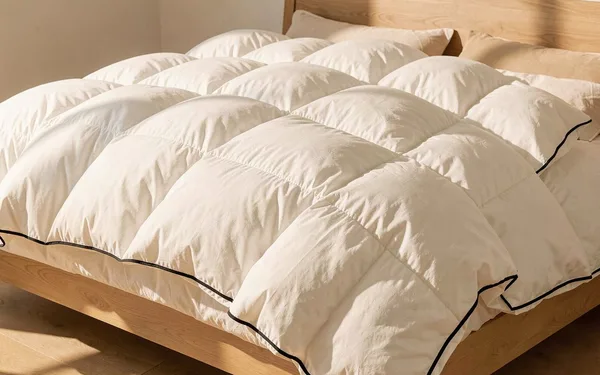
- Quilting: baffle-box quilting for winter use.
- Returns and exchanges: what happens once the package has been opened?
- After-purchase support: does the store handle down comforter refurbishing and other maintenance?
For details on each measure, see What is down cluster ratio? A clear guide to down comforter quality measures and Loft (fill power) and Japanese dp: meanings, differences and benchmarks, explained by a specialty shop.
Other ways to buy
Furusato nozei (Japan's hometown tax donation program)
Some municipalities offer down comforters as thank-you gifts. Your effective out-of-pocket cost can be lower, but there are a few things to watch for.
- Specifications are often minimal: the down cluster ratio and fill weight may be listed, but few listings go as far as stating fill power.
- You may not be able to choose a size: Single only, for example.
- Long lead times: made-to-order production and peak seasons can mean a wait of several months.
- No returns or exchanges: by the nature of a thank-you gift for a donation.
Choose an offer that states its specifications clearly, and check the delivery time before you apply.
Door-to-door sales and sales events
When you're pushed to decide on the spot, there's no time to check the numbers. Lines like "today only" or "if you decide right now" are designed to stop you from comparing.
A down comforter is something you'll use for 10 years or more. If a purchase doesn't allow you a day to go home and compare, it's safer to walk away.
Note that contracts signed through door-to-door sales or sales events may be eligible for cooling-off under Japan's Specified Commercial Transactions Act. Within 8 days of receiving the written contract, you can cancel unconditionally in writing. If you've signed and are having second thoughts, check the deadline.
Buying from overseas retailers
You can also buy overseas products labeled with fill power directly, but keep the following in mind.
- Different size standards: Japan's Single is 150×210 cm, while overseas standards use different dimensions.
- Returns are difficult: shipping costs are high.
- Customs duties and consumption tax: these are added on top of the purchase price.
- Quality labeling differs from Japanese standards: you'll need to convert figures to compare.
Secondhand and resale apps
Not recommended. Beyond the hygiene concerns, you simply can't judge down deterioration from a photo. And if you discover it "doesn't loft" once it arrives, there's little recourse.
Compare the after-purchase support
A down comforter is something you'll use for 10 to 15 years. Once you think beyond the moment of purchase and factor in all the years that follow, the basis for comparison changes.
| Support item | Mass-market retailers | Department stores | Online marketplaces | Specialty store |
|---|---|---|---|---|
| Help with defects on arrival | ○ | ○ | Varies by seller | ○ |
| Advice on everyday use | × | △ | × | ○ |
| Advice on cleaning | × | △ | × | ○ |
| Down comforter refurbishing and re-making | × | △ | × | ○ |
| Take-back of your old comforter when you replace it | △ | △ | × | Varies by store |
| Size exchange | Within the stated period | Within the stated period | Varies by seller | ○ |
The difference you'll feel 10 years from now
Five to ten years after you buy, when the loft starts to fade, what you can actually do about it turns out to be a very big difference.
- You can ask whether refurbishing will fix it or whether replacement makes more sense
- You can have the comforter refurbished
- A record of your own comforter's specifications (down cluster ratio and fill power) is kept on file
If you bought from a store that doesn't disclose the numbers, you won't even know what's inside your own comforter — which makes it impossible to judge whether refurbishing is worthwhile.
Ways of buying best avoided
Judging by the size of the discount
Every company is free to set its own list price. "80% OFF" is no guarantee of quality.
Taking the words "down comforter" on the label at face value
Any product with a down cluster ratio of 50% or more can legally be called a down comforter. Always check the numbers.
Not checking what's included in a bundled set
With products like an "8-piece bedding set," the quality of the comforter on its own is often unclear. Check whether the specifications for each individual item are stated.
Deciding on the spot at a door-to-door sale or trade show
When you're pressured to decide then and there, you have no time to check the numbers. Give yourself time to take the information home and compare. Such purchases may also be eligible for cooling-off cancellation under Japan's Act on Specified Commercial Transactions.
Trusting the country of origin alone
Even when a product is labeled "Polish down," there is no obligation to disclose what share of the total fill it actually represents. Read the country of origin together with the fill power figure. We also discuss the industry background in On down origin mislabeling in the bedding industry.
How Omotesando Futonten sells
Omotesando Futonten closed its Omotesando (Tokyo) showroom at the end of May 2024 and now sells entirely online. Our office is in Minami-Aoyama, Minato-ku, Tokyo, and every comforter is made to order.
For those who'd like to experience the real thing, we offer the following services.
- Monthly Comforter Rental: from ¥3,960 a month, with winter-weight and summer-weight comforters delivered to match the season.
We also publish third-party test results for the down cluster ratio and fill power of every product, and we disclose our washing method (natural groundwater from Hakushu, Yamanashi, no detergent, twice the JIS standard).
Frequently asked questions
Where is the best place to buy a down comforter?
If you're choosing something you'll use for 10 years or more, a specialty bedding store or direct seller that discloses the numbers and is available for advice after purchase is the best fit. If you need one cheap and fast, go to a mass retailer; for a gift, a department store or specialty store makes sense.
Is it risky to buy online?
If the down cluster ratio, fill power, fill weight and shell fabric are clearly stated, you can judge a comforter without seeing it in person. The numbers are a more reliable basis for a decision than pressing on one in a store.
Are down comforters from mass retailers poor quality?
It's not that simple, but they mostly fall in the 50–85% down cluster ratio range. If you want one as your main winter comforter, use a down cluster ratio of 85% or higher and a fill weight of 1.2kg or more as your guide.
Is buying at a department store a safe bet?
The quality floor does tend to be higher. However, sales commissions are built into the price, so you pay more for the same quality. Either way, you still need to compare the numbers.
I'm nervous about buying from a store with no physical location
One option is to use a trial service. Sleeping under a comforter at home for a few nights tells you far more than touching one for a few minutes in a store. Be sure to check the return and exchange terms in advance, too.
What about buying secondhand or through resale apps?
We don't recommend it. There are hygiene concerns with down comforters, and you have no way of knowing how they were used. Deterioration of the down is also hard to spot by eye, so you may find it simply doesn't loft once it arrives.
Are reviews helpful?
They're useful for getting a sense of how a comforter feels in use, but they're not a basis for judging quality. Ratings like "warm" or "light" depend on the reviewer's build, their bedroom temperature, and the comforter they used before.
If you do use reviews, look for fact-based descriptions such as "was it compressed when it arrived," "did it have an odor," and "what condition is it in after a year."
Why does the same product cost different amounts at different stores?
Because sales channel commissions differ. When a product goes through a department store or mass retailer, those commissions are added to the price. Direct sellers don't have that cost, so the final price differs even for identical quality.
What should I do if my budget is tight?
Don't size down. Cold air gets in at the sides and you'll feel chilly. To adjust, you can narrow the seasons you cover (start with a single winter-weight comforter), consider recycled down, or step down the comforter grade and add a mattress pad underneath.
How can I avoid regretting my purchase?
Before you buy, check these five things: down cluster ratio, fill power, fill weight, shell fabric and quilt construction. If all five are disclosed, you can judge a comforter without seeing it. If a store doesn't disclose them, seeing the product in person still gives you nothing to go on.
Summary
- There are four places to buy: mass retailers, department stores, online marketplaces and specialty bedding stores. Price structure and the amount of information differ
- Even for the same quality, sales channel commissions can change the price dramatically
- There's only so much you can learn by touching a comforter in a store. The real basis for judgment is the numbers: down cluster ratio, fill power, fill weight and so on
- If a store doesn't disclose the numbers, seeing the product in person won't help you decide
- If you plan to use it for 10 years or more, choose a store you can turn to afterward for things like down comforter refurbishing (re-lofting and remaking)
- If you're unsure, use a trial service and sleep under it at home for a few nights before deciding
Shop comforters at Omotesando Futonten
Want to try one first? | Monthly Comforter Rental (from ¥3,960/month)