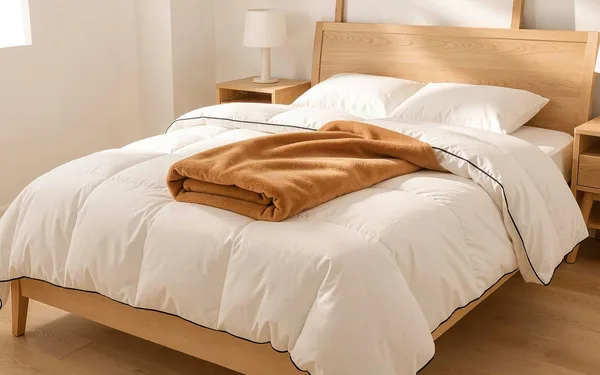
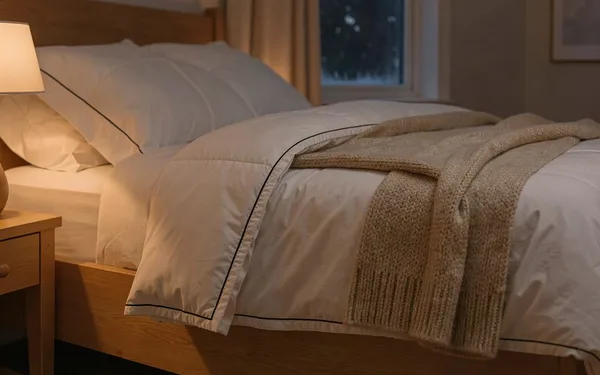
The correct order for a blanket and a down comforter is body → down comforter → blanket. In other words, the blanket goes over the down comforter. The "body → blanket → down comforter" arrangement used in many homes actually undermines the performance of your down comforter.
That said, depending on the blanket's material, there are cases where it's better placed underneath. In this article, we explain why on top is the right answer, along with the best setup for each material and situation.
What you'll learn in this article
- Why you should layer a blanket on top of your down comforter
- The best order by material (wool, acrylic, cotton, microfiber)
- When it's fine to put the blanket underneath
- The full bed layering order: mattress pad, blanket and comforter
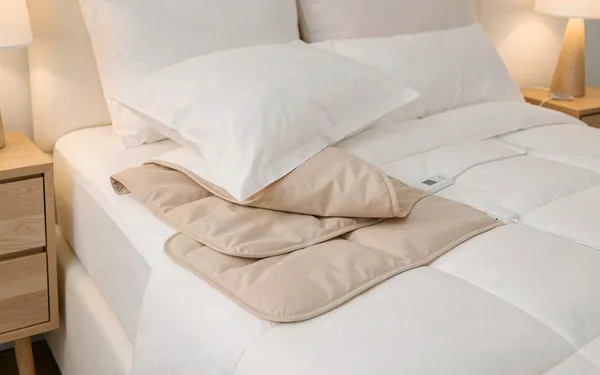
- What to watch out for with an electric blanket
The short answer: put the blanket on top of your down comforter
The correct layering order, from the bottom up, is as follows.
- Mattress or futon mattress
- Bed pad / mattress pad
- Sheets
- Your body
- Down comforter (duvet)
- Blankets
- (plus a bedspread, if you like)
Put the down comforter directly over your body, with the blanket layered on the outside. This arrangement gets the very most out of your down comforter.
Why the blanket goes on top: three reasons
Reason 1: Down lofts up with your body heat
The warmth of a down comforter comes from the down lofting up and trapping layers of air. And that loft happens in response to your body heat and moisture.
If you sandwich a blanket between your body and the down comforter, the blanket blocks your body heat and not enough of it reaches the down. The down never fully lofts, and you spend the whole night under a comforter that never reaches its true thickness. A surprising share of the "I bought an expensive down comforter but it isn't warm" questions we get come down to exactly this.
Reason 2: A down comforter is made to drape over your body
A down comforter is light and supple, so it falls along the contours of your shoulders and hips. That draping quality closes the gaps and keeps warm air from escaping.
Put a blanket between you and the down comforter, though, and because the blanket is stiffer and heavier it can't follow your body's curves. The down comforter then sits on top of the ridges the blanket creates, leaving gaps around your shoulders and sides. That's where the warm air escapes.
Reason 3: A blanket on top acts like a lid
Draping a blanket over your down comforter adds a layer of insulation on the outside of it. It works like a lid, slowing the escape of the warm air the down is holding.
The down lofts up, and heat loss is held in check just outside it. This two-stage setup is the most efficient way to use a blanket and a down comforter together.
An easy way to remember it: "Down works best close to your skin; the blanket is the lid on the outside." When in doubt, that one line gives you the answer.
The best order by material
The rule of thumb is "blanket on top," but some materials are exceptions.
| Blanket material | Recommended position | Why |
|---|---|---|
| Wool | On top or underneath | Absorbs and releases moisture well, so it won't feel clammy even underneath. If you love the feel against your skin, underneath works too |
| Cashmere & alpaca | On top or underneath | Same as wool. If you want to enjoy the feel against your skin, underneath is an option |
| Cotton | On top or underneath | Absorbs moisture, but releases it poorly and grows heavy once it takes on perspiration |
| Acrylic | Always on top | Almost no moisture absorption. Underneath, it traps perspiration and builds up static |
| Microfiber & fleece | Always on top | Warm the instant you touch it, but it doesn't release moisture. Underneath, it feels clammy and leaves you chilly toward dawn |
Why natural fibers can go underneath
Animal fibers such as wool and cashmere naturally absorb moisture and release it back out. That means night sweat won't build up even when they sit directly over your body. Their fibers are also fine and supple, so they drape along your body and don't do much to keep the down comforter from hugging you.
If you want the feel of a blanket against your skin, wool or cashmere can go underneath without much loss of warmth. That said, if warmth is your top priority, on top is still the better spot.
Why you shouldn't put a synthetic blanket underneath
Acrylic and microfiber feel warm the instant you touch them. That's because the fibers hold your body heat in — but they hold moisture in, too.
You lose about a cup of sweat over a single night, and when that moisture builds up in a synthetic blanket, it stays right next to your skin. As water evaporates it draws heat away, so by early morning you're left feeling damp and chilled. This is the classic reason behind "I added a blanket, but I'm still cold at dawn."
When it's fine to put the blanket underneath
In the following cases, a natural-fiber blanket can go underneath.
- You don't love the feel of your down comforter cover: placing a cotton or wool blanket underneath changes what touches your skin
- You live somewhere bitterly cold and simply want more layers: when room temperatures drop below 5°C, using a blanket both above and below can make sense
- Your down comforter size is too small and slides off you: a blanket underneath keeps a baseline of warmth even when the comforter shifts
In every one of these cases, choose natural fibers rather than synthetics.
Layering order for the whole bed | think about what's under you, too
Getting the top layers right won't fix the cold if the surface beneath you is cold, because body heat escapes downward most of all.
The right order for the layers beneath you
- Mattress or futon mattress
- Mattress pad (bed pad)
- Fitted sheet
- You
A mattress pad goes under the sheet and on top of the mattress. Some winter pads are designed to go on top of the sheet instead, so follow the instructions that came with the product.
If you're adding one layer beneath you, choose a moisture-absorbing material. Something like a 100% cotton mattress pad creates an insulating layer while soaking up night sweat, so you won't feel clammy even in winter.
Using a blanket beneath you
You can also lay a blanket under the sheet as an insulating layer. Since it never touches your skin directly, you have more freedom in the material. Just keep in mind that you'll wash it less often.
Blankets by material | characteristics and how to choose
To decide on the layering order, it helps to know what each blanket material actually does.
| Material | Warmth | Moisture absorption | Moisture release | Weight | Care |
|---|---|---|---|---|---|
| Wool | High | High | High | Medium | Air-dry in the shade. Many are not washable. |
| Cashmere | High | High | High | Light | Professional cleaning recommended |
| Alpaca | High | High | High | Light | Air-dry in the shade. Little of the usual animal-fiber odor. |
| Cotton | Medium | High | Low | Somewhat heavy | Machine washable at home |
| Acrylic | Medium | Almost none | Almost none | Light | Machine washable at home. Prone to static. |
| Microfiber | Medium | Low | Low | Light | Machine washable at home. Pills easily. |
Why natural fibers work so well in bedding
Animal fibers such as wool, cashmere, and alpaca have tiny overlapping scales on the fiber surface, and they can absorb moisture into the fiber itself. That moisture is then released again once the surrounding air dries out.
Because of this "absorb and release" behavior, night sweat doesn't leave you clammy, and you don't wake up damp and chilled in the early morning hours.
Acrylic and polyester, on the other hand, are petroleum-based fibers with no structure for taking moisture inside. Sweat stays as liquid in the gaps between fibers, and draws heat from your body as it evaporates. That's exactly why a blanket can feel warm the moment you touch it, yet leave you cold toward morning.
How to choose when it's time to replace your blanket
- If it will go on top of the down comforter: material matters less — prioritize lightness
- If you want it against your skin: choose wool, cashmere, alpaca, or cotton
- If easy washing is your priority: cotton — though it's slow to dry
- If budget is your priority: acrylic — but always layer it on top of the down comforter
When you no longer need a blanket at all
Wanting to add a blanket in the first place is a sign that your comforter alone isn't doing the job. With a winter-weight down comforter (fill weight 1.2–1.3 kg, fill power around 400 cm³/g), you can get through winter with no blanket at all.
If you find yourself reaching for a blanket, one of the following is usually the reason.
| Cause | How to check | What to do |
|---|---|---|
| Your comforter is an all-season (medium-weight) one (around 0.8 kg) | Check the fill weight on the quality label | Switch to a winter-weight comforter |
| Low down cluster ratio | Check the down cluster ratio on the quality label | Consider replacing it |
| The size doesn't suit your build | See whether the edges of the comforter reach down the sides of the mattress | Go one size up |
| Not enough insulation underneath you | Notice whether your back and lower back feel cold | Add a bed pad |
| The down isn't lofting | Compare the loft with how it was when you bought it | Air it out, or have it refurbished with down comforter refurbishing |
Adding one more blanket also adds weight, which makes turning over in your sleep harder. More often than not, rethinking the comforter itself gives you lighter, warmer sleep.
We've put together how to narrow down the cause in Why your down comforter feels cold and what to do about it: use, layering, and when to replace.
Caring for your blanket
How often to wash
If you use it over your down comforter, it never touches your skin, so once or twice a season is plenty. If you use it next to your skin, about once a month is a good guide.
Notes by material
- Wool and cashmere: check the care label. Most cannot be washed with water at home — expect shrinkage and a change in hand feel
- Cotton: washable, but slow to dry, so pick a fine day. For large sizes, press-washing in the bathtub is the surest method
- Acrylic and microfiber: washable. Using fabric softener helps reduce static
Storage
Wool blankets are prone to moth damage, so store them with a moth repellent. Make sure they are completely dry, then place them in a breathable storage bag. Cotton and synthetic blankets can also go in vacuum compression bags.
Using an electric blanket
You can use an electric blanket together with a down comforter, but there are a few points to keep in mind.
Position
Electric blankets come in two types: ones you lie on (mattress-pad style) and ones you put over you. When pairing with a down comforter, the underblanket type works better — it warms you from below while the down comforter handles the top.
If you put an overblanket type under the down comforter (on the body side), heat builds up in the down and creates localized hot spots. The down loses its natural oils, which speeds up deterioration.
How to use it
The smartest approach is to warm the bed before you turn in, then switch the blanket off — or down to its lowest setting — when you go to sleep. A down comforter is excellent at holding warm air, so the warmth lasts even after you switch the power off.
Leaving it on high all night not only dries out and damages the down, it can also make you sweat more in your sleep and leave you mildly dehydrated.
Effects on the down
Down stays supple thanks to the modest amount of natural oil it contains. Prolonged dry heat strips away that oil and makes the fibers brittle. A down comforter used every night with a high-heat electric blanket tends to have a shorter life than one that isn't.
Frequently asked questions
Is a blanket warmer over or under a down comforter?
Over. That gives you two layers working together: the down comforter lofts fully as it picks up your body heat, and the blanket on the outside keeps that heat from escaping. Underneath, the down can't loft properly and performance drops.
What about sandwiching a blanket between down comforters?
A layered setup like "body → blanket → down comforter → blanket" can work well in extremely cold climates. Just make sure the blanket next to your body is a natural fiber — synthetics trap moisture.
Does a towel blanket go over or under?
Towel blankets absorb moisture well, so underneath (next to your body) is fine. There it soaks up perspiration and also protects the down comforter from soiling.
Is a down comforter alone enough, without a blanket?
With a winter-weight down comforter, you don't need a blanket at all. In fact, going without lets you enjoy the comforter's natural lightness and the way it drapes over your body. If you feel the urge to add a blanket, your comforter may not be warm enough, or there may not be enough insulation underneath you.
Doesn't a blanket on top of a down comforter feel heavy?
If it feels heavy, choose a lighter-weight blanket, or skip the blanket and move up to a thicker comforter instead. Lightness is the whole point of a down comforter, so piling a heavy blanket on top tends to defeat the purpose.
Where does a bedspread (coverlet) go?
Right on top. It serves as both decoration and extra warmth. If you take it off at bedtime, don't let it fall to the floor — gather it at the foot of the bed so it's ready if you get cold during the night.
How do I choose a blanket to lay over a down comforter?
Since it never touches your skin, you have more freedom with the material. What matters most is lightness. Lightness is the great advantage of a down comforter, so putting something heavy on top undermines it.
Animal fibers such as alpaca and cashmere are very warm for their weight, which makes them ideal here. The blanket can be the same size as your comforter or even a little smaller. As long as it covers you from the shoulders to the chest, it will help hold in heat.
Blanket or mattress pad — which is better underneath?
A mattress pad is the more efficient insulating layer. Blankets are thin, and once your body weight presses them flat, almost no air layer is left. A mattress pad has loft and resilience, so the layer survives compression.
Mattress pads are also designed to be washed regularly. Put a blanket underneath you instead and it gets washed less often, so sweat and body oils build up.
If I use two comforters, where does the blanket go?
Right on top. The order is "body → thick comforter → thin comforter → blanket." As a rule, keep the loftiest layer closest to your body and make each layer thinner as you move outward.
What about bedspreads and coverlets?
A decorative top layer goes on the very top. If you remove it at bedtime, gather it at the foot of the bed rather than letting it drop to the floor, so it's within reach if the night turns cold.
How often should I wash my blanket?
If it lies on top of your down comforter, it never touches your skin, so once or twice a season is plenty. If you use it against your skin, aim for about once a month. Always wash it before storing, and make sure it is completely dry.
Summary
- The correct order for a blanket and a down comforter is "body → down comforter → blanket." The blanket goes on top
- Here's why: down needs body heat to loft, the down comforter needs to drape against your body, and the blanket on top acts as a lid that holds the heat in
- Blankets made from natural fibers like wool, cashmere, or cotton can go underneath without much loss of warmth
- Synthetic blankets such as acrylic or microfiber should always go on top. Placed underneath, they trap moisture and leave you cold toward dawn
- Don't stop at what's on top — adding one moisture-absorbing pad underneath you makes a noticeable difference in how warm you feel
- Use an electric blanket to pre-warm the bed, then switch it off — or down to its lowest setting — once you turn in
We also cover the difference in warmth between blankets and down comforters in Blanket or down comforter: which is warmer? Differences, correct use, and layering order explained by a specialist store.
Shop winter-weight down comforters at Omotesando Futonten
THE INOUE BROTHERS Alpaca Wool Comforter / Alpaca Blanket Set