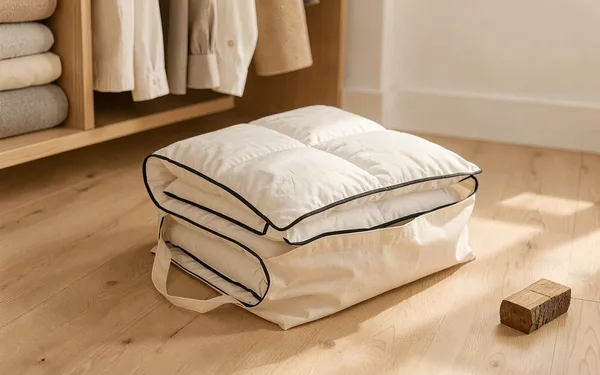
There are only three things you must never do when storing a down comforter: put it away damp, flatten it in a vacuum bag for long periods, or seal it in an airtight container. Simply avoiding these three will prevent almost every problem next season.
This article walks you through the right way to store a down comforter in the off-season, from three angles: moisture, compression, and protection from pests. It also covers how to store one in a home without a traditional Japanese closet (oshiire), and realistic options when you simply don't have enough storage space.
What you'll learn in this article
- Drying and cleaning steps to take before storing
- Whether to use a vacuum storage bag — and how far to go if you do
- How to choose a storage bag and a storage spot
- How to store a comforter in a home without a closet
- How to use moth repellents and moisture absorbers correctly
Conclusion | The 3 principles of down comforter storage
| Principle | What to do | What not to do |
|---|---|---|
| Drying | Before storing, air it in the shade so it dries all the way through | Putting it in a bag while still damp |
| Airflow | Fold it loosely into a breathable non-woven storage bag | Vacuum storage bags, plastic bags, airtight cases |
| Location | A dry, elevated spot, such as the upper shelf of a closet | Anywhere in direct contact with the floor or wall, or near kitchens and bathrooms |
Nearly every problem with a down comforter traces back to moisture. Mold, odors, clumped down, insect damage — every one of them starts with dampness.
Step 1 | Dry it thoroughly before storing
Why drying comes first
After a full winter of use, a down comforter has absorbed night after night of perspiration. A person is said to sweat about a cup's worth in a single night, and some of that always stays in the bedding.
Down absorbs and releases moisture, so while the comforter is in use that humidity escapes into the air. Seal it in a bag, though, and the moisture has nowhere to go — it stays inside. Leave it that way for six months and you get mold and odors.
"The surface feels dry, so it must be fine" doesn't hold up here. A down comforter is lofty, so the core is the very last part to dry out.
How to dry it properly
- Remove the cover: machine-wash the duvet cover and dry it separately from the comforter itself
- Air it in the shade: 2–3 hours in a well-ventilated spot. Keep it out of direct sunlight
- Turn it over partway through: flip it after about an hour so air reaches both sides
- Drape it in an M shape: if you have two drying poles, hang it across both so more surface is exposed to the air
- Check it by hand: run your hands over the whole comforter to feel for any cool, damp spots or clumped areas
Why you should avoid direct sunlight
UV rays strip the natural oils from the down and leave the fibers brittle. The shell fabric degrades as well, which leads to yellowing. "Airing it well means putting it in the sun" is conventional wisdom for cotton futons — it does not apply to down comforters.
If you must air it outdoors, leave the cover on and keep it in the shade, or limit it to a short spell in the gentle morning sun. For details, see How to Care for a Down Comforter — Airing It the Right Way to Prevent Mold.
Never put it away on a rainy day
Easy to overlook, but it matters. Store the comforter on a humid day and you trap damp air inside the bag. Choose a dry day that follows several days of clear weather.
Don't use a futon beater
Beating the comforter looks like it's knocking dust loose, but what's really coming out are broken down fibers. Once the radiating filaments of a down cluster snap, they never regain their original loft. To remove dust, brush the surface with your hand or hold a vacuum nozzle just above the fabric.
Step 2 | Choosing a storage bag
A non-woven bag is the standard choice
The right choice for a down comforter is a breathable non-woven storage bag. The bag your comforter came in when you bought it is almost always this type — don't throw it away.
Non-woven fabric lets moisture pass through while keeping dust out. That ability to breathe is the key.
Containers to avoid
| Container | Suitable? | Why |
|---|---|---|
| Non-woven storage bag | ◎ | Breathable, and keeps dust out |
| Cotton or linen wrapping cloth or large sheet | ○ | Plenty of airflow. Less effective against dust |
| Plastic bag | × | Moisture can't escape — a breeding ground for mold |
| Airtight plastic container | × | Same as above. Even with desiccant, it isn't enough |
| Vacuum bag | × (long-term) | Down fibers break and the loft never comes back |
Are vacuum storage bags OK?
The bottom line: never use a compression bag for long-term down comforter storage.
Down keeps you warm because the radiating fibers of each down cluster trap air. Compress it hard and those fibers snap. Broken fibers never recover, and the loft is lost permanently.
If you absolutely have to use one, follow these conditions.
- Don't squeeze out all the air. Stop at about half the original thickness.
- Keep it compressed for no more than 1–2 months
- After taking it out, always air it for several hours so the loft can recover
We cover the effects of compression and how to restore loft in detail in Is It Safe to Vacuum-Compress a Down Comforter? Why Not, Correct Storage, and How to Restore the Loft — Explained by a Specialty Store.
How to fold it
Don't fold it tightly — a loose fold in thirds is the rule. Sharp creases push the down to one side and put strain on the quilt stitching.
Once it's in the bag, leave some room instead of forcing it in. It's even safer to leave the bag slightly open so a little air can circulate.
Step 3|Choosing the Right Storage Spot
The Rule: "High and Dry"
Moisture is heavier than air, so it collects down low. In a Japanese-style closet (oshiire), use the upper section; in a wardrobe closet, use the top shelf.
Storage Spot Checklist
- Never place it directly on the floor: use a slatted wooden rack or set it on a shelf
- Keep it 5cm away from the wall: walls facing the outside of the house are prone to condensation
- Avoid areas near water: storage next to a bathroom or washroom stays humid
- Don't stack heavy items on top: the comforter underneath gets crushed
- Open the doors and let air through once or twice a year: this alone dramatically lowers the risk of mold
How to Stack Items in a Japanese-Style Closet
When storing several items of bedding, the rule is heaviest on the bottom. Your down comforter, however, belongs on the very top — it's vulnerable to weight and will be crushed if placed underneath.
- Bottom: futon mattresses and mattresses
- Middle: blankets and kotatsu quilts
- Top: down comforter
Storage in Homes Without a Japanese-Style Closet
In apartments and studio flats, it's not unusual to have no built-in futon closet at all.
Top shelf of a wardrobe closet
This is the most practical option. It shares space with your clothes, but a high position keeps moisture to a minimum. Place a dehumidifier pack alongside it.
Under the bed
This spot sits close to the floor where moisture collects, so use it only with care. It works if you follow these points.
- Raise it off the floor with a slatted board (sunoko) or a storage-case stand
- Use a breathable non-woven storage bag (avoid airtight pull-out cases)
- Pull it out once a month and let it air
On top of furniture
Empty space up high — on top of a closet or a bookshelf — is ideal in terms of moisture. Always use a storage bag to keep dust off.
Storage Services from Cleaning Companies
This is an option when you simply don't have the storage space. Most services clean the bedding and then store it for several months to half a year; fees start at a few hundred yen per month, and some plans include a free storage period.
If you use one, check whether the warehouse is temperature- and humidity-controlled. Without climate control, the conditions are no better than your own closet at home.
Send It for Refurbishing and Have It Stored
If your comforter has started to lose its loft, one option is to send it out for down comforter refurbishing in the off-season. Some providers will finish the work and then hold it for you until next season, solving your storage problem and restoring performance at the same time.
Omotesando Futonten's Comforter Refurbishing / Clean Cycle Reform service also offers storage for a set period on request.
How to Use Moth Repellents and Dehumidifier Packs
Moth repellents
Down and cotton bedding can be eaten by pests such as the varied carpet beetle. If you use a moth repellent, keep the following points in mind.
- Keep it from touching the comforter directly: the active ingredients can transfer to the fabric and cause stains
- Place them at the top of the storage space: Insect-repellent vapors sink, so positioning them high works more efficiently
- Don't mix types: using moth repellents with different active ingredients together can trigger a chemical reaction, liquefy and leave stains
- Mind the expiration date: An expired mothball does nothing
Moisture absorbers
- Place it beside or under the comforter: moisture sinks downward, so placing it on top is far less effective
- Check it regularly: Once a moisture absorber is saturated, it stops working. It runs out especially fast in summer.
- Pair it with a slatted base: Physically blocking moisture rising from the floor is more effective.
Check for Mold Before You Store It
If the comforter was stored somewhere humid last season, mold may already be present. A quick inspection before storing prevents it from spreading over the following year.
Where to Check
- The corners of the shell fabric: moisture collects easily in all four corners
- Around the seams: the fabric is doubled here, so it dries slowly
- The side that was touching the floor or wall: most affected by condensation
- The inside of the storage bag: if there's mold in the bag, it will spread to the comforter
If you find mold
| What you see | What to do |
|---|---|
| White, powdery specks | Probably dust. Brush it off and keep an eye on it. |
| A few black spots | Dab with a cloth moistened with rubbing alcohol (disinfectant ethanol), then dry completely. |
| Black spots over a wide area | Difficult to remove at home. Consider professional cleaning or down comforter refurbishing |
| An odor coming from inside | Mold in the down itself. Have it washed as part of refurbishing, or replace the comforter |
Do not use bleach. It damages the shell fabric and causes color loss. Residual mold staining does not affect performance, but if it covers a wide area, the mold may have reached the inside.
Preventing a repeat next year
- Replace the storage bag with a new one
- Change where you store it (move it from near the floor to a higher shelf)
- Use a slatted wooden rack to lift bedding off the floor
- Place a moisture absorber nearby and replace it regularly
- Once or twice a year, open the closet and let air circulate
Storage by Bedding Type
Chances are the rest of your bedding goes into the same closet as your down comforter. Each type needs slightly different care.
| Bedding | Vacuum bag | Wash before storing? | Things to watch for |
|---|---|---|---|
| Down comforter (duvet) | × | If soiled | Drying is critical. Use a non-woven storage bag |
| Wool futon | × | Air-dry in the shade only | Prone to insect damage. Use a moth repellent as well |
| Cotton futon | △ | Air out in direct sunlight | Cannot be washed with water. Have it refurbished instead |
| Synthetic-fill comforters | ○ | Washable | Lofts back up easily after compression |
| Blankets | ○ | Wash | Use a moth repellent for cotton and wool |
| Towel blanket | ○ | Wash | Dry completely |
| Mattress pad | ○ | Wash | Watch for deterioration of the elastic |
| Kotatsu futon (heated-table quilt) | △ | Wash anything that is washable | Bulky. Compress synthetics only |
Wool Comforters Are Vulnerable to Insects
Wool is an animal fiber, which makes it easy prey for pests such as the varied carpet beetle. It attracts insects more readily than down, so treat a moth repellent as essential.
Only Synthetics and Towels Should Be Vacuum-Compressed
Compression bags are only suitable for fibers that won't be permanently deformed by compression. Avoid down, wool and silk floss (mawata).
Year-Round Storage Rotation
If you swap your bedding with the seasons, you'll be moving things in and out of storage four times a year. Decide on a routine once, and you'll never have to think twice about it again.
| Season | Bring out | Put away | What to do |
|---|---|---|---|
| March–April | All-season (medium-weight) comforter | Winter-weight comforter | Air the winter-weight comforter until fully dry, then store it. Wash the covers. |
| May–June | Summer-weight (light) comforter | All-season (medium-weight) comforter | Finish storing it before the rainy season |
| September–October | All-season (medium-weight) comforter | Summer-weight (light) comforter | Wash the summer-weight comforter before storing it |
| November | Winter-weight comforter | All-season (medium-weight) comforter | Air out the winter-weight comforter before you start using it |
How to arrange your storage space
Choose where each item lives based on how often you use it and the season — it makes taking things in and out far easier.
- Front, within easy reach: items you'll use next season
- Back and upper shelf: items you won't use for six months or more
- Very top: down comforters (they don't hold up under weight)
Beat the rainy season
If you leave the winter-weight comforter out in the room after the last cold nights of spring, it will soak up the humidity of the rainy season. Aim to have it dried and stored by mid-May.
Choosing storage supplies
Non-woven storage bag
Storage bags are the most basic option. Look for three things when you choose one.
- Is there room to spare?: forcing it in crushes the down
- Does it have a window (clear panel)?: being able to see the contents saves you hunting around
- Does it have handles?: they make it much easier to lift in and out of an upper shelf
Slatted wooden base (sunoko)
For the lower level of a closet, paulownia wood is the best choice — it stands up well to moisture. Plastic versions also provide plenty of airflow. A height of about 5cm is all you need.
Moisture absorbers
Freestanding tank-style dehumidifiers are the most common type. Place one near the closet floor, beside the comforter. Putting it up high is far less effective, since moisture sinks.
Once it has absorbed all the moisture it can hold, it stops working — so check the level regularly, especially in summer.
What to avoid
- Airtight plastic containers: moisture has nowhere to escape
- Plastic bags: same as above
- Vacuum storage bags: they break the down fibers
- Newspaper: some people tuck it in to absorb moisture, but the ink can transfer to the fabric
Should you have it cleaned before storing it?
There's no need to do it every year. As a rule of thumb, a down comforter only needs professional cleaning once every 3–5 years.
That said, consider having it cleaned before you put it away in the following cases:
- You used it without a duvet cover
- You perspire heavily and notice an odor
- There are stains from spilled drinks, bedwetting, or similar accidents
- It has been more than 5 years since the last cleaning
The best time to send it out is spring to early summer (April–June). You take care of it right after the season ends, so soiling doesn't carry over, and you avoid the cleaners' busiest period. For typical prices and how to choose a cleaner, see What to know before sending your down comforter to a professional cleaner.
How to bring it out again next season
How you bring it back out matters just as much as how you put it away.
- Take it out of the storage bag and spread it flat on a level surface
- Air it out in a well-ventilated shaded spot for 2–3 hours
- Hold the edges and shake it up and down a few times to loosen the down (don't beat it)
- If any odor remains, air it out for a few more hours
- Put on a freshly washed cover and start using it
A comforter that has been in storage has compressed down inside. Letting air back into it before use restores its original loft. If the loft doesn't come back, see How to fluff up a down comforter: 6 steps to fix a flat comforter at home, explained by a specialty store.
Storage tips by type of home
Wood-frame houses
These often have a closet (oshiire), which is ideal for bedding. However, a closet along an exterior wall is prone to condensation, so keep the comforter away from the wall.
The ground floor also picks up moisture from the earth below. If possible, use a second-floor closet.
Reinforced concrete apartments
These are airtight by design, so moisture has nowhere to escape. If you keep closet doors shut all the time, the humidity inside rises.
- Open the doors once a month to let fresh air circulate
- Always use a moisture absorber as well
- Take extra care with storage in north-facing rooms (condensation forms easily)
Studio apartments and homes with little storage
If you don't have a bedding closet, consider these options in order:
- The top shelf of a closet: high up, where there's less moisture
- On top of furniture: a storage bag is essential to keep dust off
- Under the bed: raise it on a slatted wooden rack and let air through once a month
- A cleaner's storage service: for when you simply have no space at home
You can also simply own fewer comforters. Keep it to two — a summer-weight (light) comforter and a winter-weight comforter — and fine-tune with a blanket in early fall. Another option is a monthly rental you can return during the seasons you don't need it.
Humid regions and ground-floor homes
A slatted wooden board is essential. The following measures also help:
- Lay down a moisture-absorbing sheet (reusable types are available)
- Place a compact dehumidifier inside the storage space
- Once the rainy season ends, take everything out and air it
What to do while it's in storage
Ventilate once or twice a year
This is the most effective step — and the one most often forgotten. Simply opening the closet doors and letting air flow through for about 30 minutes lowers the humidity inside.
The best times are right after the rainy season ends (mid-July) and during the dry fall weather (October).
Replacing the moisture absorber
Once a moisture absorber is saturated, it stops working. It gets used up especially quickly from the rainy season through summer, so check it once in July or August.
Checking the expiration date on moth repellent
Moth repellents have an expiration date. Leaving an expired one in place does nothing. Write the replacement date on the storage bag so you don't forget.
Common mistakes to avoid
1 | Forgetting to put it away before the rainy season
If you finish using it in spring and simply leave it out in the room, it will absorb the humidity of the rainy season. Once you stop using it, the safest move is to air it out and store it promptly.
2 | Leaving it in the storage bag for years on end
This happens most often with guest bedding. Take it out and air it at least once a year.
3 | Assuming a moisture absorber is enough
A moisture absorber is a backup, not a substitute for drying. Airing the comforter out before you store it matters far more.
4 | Vacuuming the fabric directly
Pressing the nozzle against the fabric and vacuuming damages the shell fabric and pulls the down out. Hold the nozzle slightly above the surface, or use a bedding attachment.
5 | Tucking newspaper inside
You'll sometimes see newspaper recommended as a way to absorb moisture, but the ink can transfer. Don't use it with a down comforter.
Frequently asked questions
Can I put a down comforter in a vacuum storage bag?
It isn't suitable for long-term storage. The down fibers break and the loft never fully recovers. If you must use one, compress it to no more than about half its thickness and keep it that way for no longer than 1–2 months.
I don't have a Japanese-style closet (oshiire). Where should I store it?
The upper shelf of a closet is best. If you use under-bed storage, raise it off the floor with a slatted board, use a breathable bag, and air it out once a month.
Does it need to be cleaned before storage?
Not every year. Once every 3–5 years is a good guideline. That said, if you've used it without a duvet cover or it has visible soiling, have it cleaned before you put it away.
Can I store a down comforter standing upright?
That's fine. In fact, air circulates more easily, which is an advantage when it comes to humidity. Just secure it so it won't topple over, and avoid setting in hard creases.
Do I need a moth repellent?
It isn't essential with well-sealed storage, but it's safer to use one in a traditional Japanese wooden chest (wa-dansu) or an older closet. Keep it from touching the comforter directly and place it at the top of the storage space.
My stored comforter smells musty. What should I do?
First, air it in the shade for a few hours. In most cases the odor comes from moisture and disappears once it dries out. If the smell lingers, consider professional cleaning. If you see black spots of mold on the fabric, removing it at home is very difficult.
Is a guest down comforter that hasn't been used for years still usable?
Spread it out and air it; if the loft comes back, it's good to use. If it doesn't recover, the odor won't go away, or feathers are working their way out, consider down comforter refurbishing (remaking) or replacement.
What should I use if I don't have a storage bag?
Wrap it in a large piece of cotton or linen fabric (a furoshiki wrapping cloth or an old sheet works well). It breathes and still keeps most dust off. The only things to avoid are plastic bags and airtight plastic bins — moisture can't escape and they become a breeding ground for mold.
Summary
- The three rules of storing a down comforter: dry, breathable, and up high
- Before storing, air it in the shade for 2–3 hours so it dries all the way through. Avoid direct sunlight and beating the comforter
- Use a non-woven storage bag. Don't use plastic bags, airtight cases or vacuum bags
- Store it on the upper shelf of the closet. Keep it off the floor and 5cm away from the wall
- Choose a dry day to put it away, after several days of clear weather
- Keep moth repellent off the comforter and place it at the top of the storage space. Put the moisture absorber beside or beneath it
- Open up the storage space and air everything out once or twice a year
At Omotesando Futonten, every purchase comes with a breathable storage bag. If storage is a challenge for you, ask us about seasonal storage combined with down comforter refurbishing.
Down comforter refurbishing / Clean Cycle Reform (Single from ¥45,800)