The surest way to decide when to start using a down comforter is not the calendar but the overnight low in your bedroom. As a guide: when the pre-dawn room temperature drops below 20°C, switch to an all-season comforter; below 15°C, switch to a winter-weight one. Because regional climate and home insulation can shift this by nearly a month, going by "it's October" alone will steer you wrong.
This article covers when to switch by temperature, regional timing guidelines, and how to take your comforter out of storage the right way. If every change of season leaves you too hot to sleep — or waking up cold just before dawn — simply having a clear switching rule may be all you need.
What you'll learn in this article
- When to switch your down comforter, by temperature
- Regional timing guide (from Hokkaido to Okinawa)
- How to use summer-weight, all-season and winter-weight comforters
- The right way to take your comforter out of storage
- When to put it away (the spring switch)
The bottom line: switching guidelines based on temperature
What matters is not the temperature at bedtime but your bedroom's temperature just before dawn. Body temperature hits its lowest point in the early morning hours, and feeling cold then makes your sleep lighter.
| Bedroom temperature before dawn | Best bedding | Approximate timing (Kanto plains) |
|---|---|---|
| 23°C and above | Summer-weight (light) comforter (down blanket) | June to mid-September |
| 20〜23℃ | Summer-weight (light) comforter plus a towel blanket, or an all-season (medium-weight) comforter | Mid to late September |
| 15〜20℃ | All-season (medium-weight) comforter | October to early November |
| 10〜15℃ | Winter-weight comforter | From mid-November |
| Below 10°C | Winter-weight comforter plus a blanket | December to February |
If you don't have a thermometer in the bedroom, use these signs instead.
- Signs it's time for an all-season comforter: you find yourself unconsciously pulling the covers closer in the early morning / you wake up with cold feet
- Signs it's time for a winter-weight comforter: you want to add a blanket on top of your all-season comforter / you feel cold air coming in around your shoulders
"When you feel like adding a blanket, move your comforter up one weight." That's the clearest signal of all. Rethinking the comforter itself, rather than piling on a blanket, keeps your bedding lighter and your sleep more comfortable.
Regional guide to switching times
Even within Japan, switching times vary by more than a month from region to region.
| Region | Switch to all-season | Switch to winter-weight | Store the winter-weight |
|---|---|---|---|
| Hokkaido | Early September | Early October | Mid-May |
| Tohoku | Mid-September | Mid- to late October | Early May |
| Hokuriku & Shinetsu | Late September | Late October | Late April |
| Kanto & Tokai | Early October | Mid-November | Mid-April |
| Kinki, Chugoku & Shikoku | Mid-October | Late November | Mid-April |
| Kyushu | Late October | Early December | Early April |
| Okinawa | Late November | A winter-weight comforter is often unnecessary | ― |
These are rough guidelines for lowland areas only. Even within the same prefecture, timing shifts considerably with elevation — and with the characteristics of your home.
- A mid-floor, non-corner apartment unit: surrounded by other units above, below, and on both sides, it stays warmer, so you can switch later
- The second floor of a wood-frame house: more exposed to radiative cooling, so you'll switch earlier
- A north-facing bedroom: it doesn't warm up during the day, so it feels colder than you'd expect
- Large windows or single-pane glass: cold air off the glass chills the foot of the bed. Heavier curtains help
How to use summer-weight, all-season and winter-weight comforters
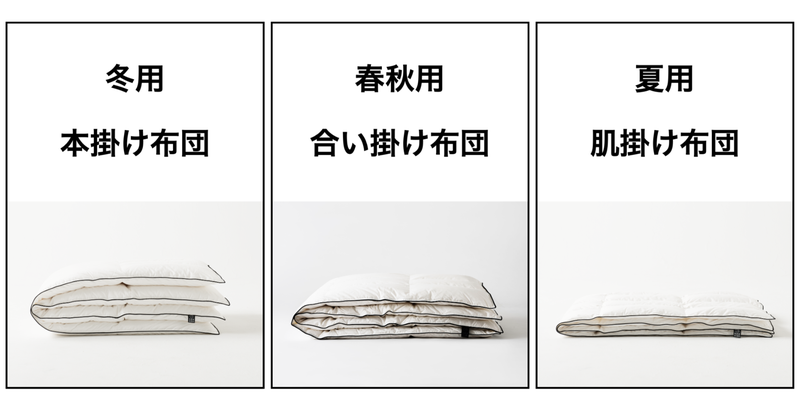
Down comforters come in three types, defined by fill weight. It's not unusual for the down inside to be identical even when the names differ.
| Type | Fill weight (Single) | Role |
|---|---|---|
| Summer-weight (light) comforter (down ket) | 0.3〜0.4kg | Summer — keeps your middle from getting chilled under air conditioning |
| All-season (medium-weight) comforter | Around 0.8 kg | Spring and fall — for cool spells before you turn on the heat |
| Winter-weight comforter | 1.2〜1.3kg | Midwinter — thick enough to get you through the season on its own |
For full details, see What Is a Lightweight Summer Down Comforter? How to Choose for Summer and How It Differs from an All-Season Comforter — Explained by a Specialist and How to Choose an All-Season Comforter: The Best Down Comforters for Spring and Fall, Explained by a Specialist.
Are two enough, or do you need three?
How many you buy comes down to budget and storage space. Here are the combinations that work in practice.
- Two comforters (summer-weight + winter-weight): the minimum setup. In early fall, pair the summer-weight comforter with a cotton blanket or wool blanket to fine-tune warmth
- Two layers (summer-weight + all-season): for homes that regularly use heating, or milder climates
- Three layers (summer-weight + all-season + winter-weight): the ideal setup — the perfect loft for every season
If you're only buying one, we recommend the winter-weight comforter, since it's the one you'll use the longest. Getting through midwinter under an all-season (medium-weight) comforter is tough, whereas if a winter-weight comforter feels too warm in early autumn, you can simply fold part of it back to adjust.
Autumn changeover: how to bring your down comforter out of storage
Don't use your down comforter the moment you take it out of storage. Down that's been compressed in a closet needs time to take in air again.
Step 1: Take it out of the bag and spread it out
Remove it from the storage bag or vacuum bag and spread it out on the floor or your bed. If you used a vacuum-compression bag, be especially sure to allow plenty of time at the next step.
Step 2: Air it out (2–3 hours)
Air it in a well-ventilated room or outdoors in the shade. Avoid direct sunlight on clear days: UV rays strip the natural oils from the down and damage the fibers. Indoors, simply draping it over a chair back with a fan or air circulator blowing on it works well.
Step 3: Gently fluff in some air
Hold the edges of the comforter and shake it up and down a few times to loosen the down. Never beat it with a futon paddle (a traditional rattan beater) — it snaps the down fibers, and they'll never loft again.
Step 4: Check the smell
If it has picked up an odor in storage, air it for a few more hours. Most odors come from moisture and disappear as it dries. If an animal odor still lingers, the down may not have been washed thoroughly during manufacturing. For solutions, see Down Comforter Odors: Causes and How to Remove Them (Specialist Guide).
Step 5: Wash the cover and put it on
Always wash the cover before the season starts. Even if you washed it before storing, it has collected dust while put away.
Loft that won't come back, an obviously thin feel, feathers poking through — airing won't fix any of these. It's time to consider down comforter refurbishing (re-making) or replacement.
For ways to revive it, see How to Re-Loft a Down Comforter: 6 Steps to Fix a Flat Comforter at Home (Specialist Guide); for how to decide, see How Long Does a Down Comforter Last? When to Replace or Refurbish (Specialist Guide).
How to store your summer comforter
If you put your summer-weight (light) comforter away as-is when you switch over, it will come out yellowed and smelling musty next year.
- Wash it if it's washable (check the care label). If it isn't washable, remove the cover and air it out.
- Dry it completely. It's essential that the down inside is dry, too.
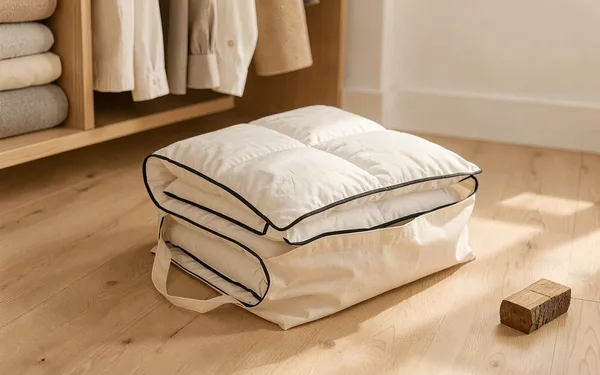
- On a low-humidity day, place it in a breathable non-woven storage bag.
- Fold it loosely and store it somewhere moisture doesn't collect, such as the upper shelf of a closet.
Avoid long-term storage in vacuum-compression bags. We explain why in detail in Can You Vacuum-Compress a Down Comforter? Why Not, Plus Proper Storage and How to Revive It (Specialist Guide).
Spring changeover: when to put the winter-weight comforter away
Use temperature to decide when to store your winter-weight comforter, too. Once your bedroom stays consistently above 15°C at dawn, switch to an all-season (medium-weight) comforter; once it stays above 20°C, switch to a summer-weight (light) comforter.
In the Kanto plain, mid to late April is a good guide, but chilly days can still occur through Golden Week, so it's safest to pack it away for good after the early-May holidays.
Always let the moisture out before storing. If you put it away for six months with all the perspiration it absorbed night after night through winter, you'll face odors and mold next season.
Why judge by your bedroom temperature at dawn
If you decide when to change bedding based on how the daytime feels, you'll almost always be late. That's because both your body temperature and the room temperature fall while you sleep.
As you fall asleep, your body widens the blood vessels in your hands and feet to release heat, lowering your core temperature so sleep can begin. Core temperature bottoms out around 3 to 5 a.m., and that's when you feel the cold most. At roughly the same hour, the outdoor temperature also hits its daily low. In other words, your body is at its coldest exactly when your surroundings are, too.
"It felt just right at bedtime, but I woke up cold near morning" — that's what happens when these two low points line up. Choose bedding by how comfortable it feels at bedtime, and it will always fall short by dawn.
Put another way: the morning after you wake up cold at dawn is your signal to switch. Change to the next weight up that same day.
Keep a thermometer in the bedroom
The most reliable approach is to keep a min/max thermometer in the bedroom. They cost just a few hundred yen, and once it's in place you can use it to time the changeover every year. A thermometer in the living room won't help — the bedroom is often the coldest room in the house.
If you don't have a thermometer, use the "low temperature" in the weather forecast as your guide. In a wood-frame house, the bedroom at dawn is typically about 3–5°C warmer than the outdoor low; in a reinforced-concrete apartment building, about 5–8°C warmer. So you can read it as: once outdoor lows drop below 15°C, switch to the all-season (medium-weight) comforter; below 10°C, switch to the winter-weight comforter.
Adjusting for age and body type
At the same room temperature, different people need different bedding to feel comfortable. Here are some common patterns.
If you tend to feel cold
If circulation doesn't reach your hands and feet easily, you'll feel colder at the same room temperature. In that case, warming your feet works better than adding a heavier comforter. Put a hot water bottle by your feet before bed and remove it when you turn in, or wear sleep socks that cover the ankles. Increasing the weight of your comforter can come after that.
If you tend to sweat at night
If you tend to run hot, or if you're experiencing increased perspiration due to menopause, delaying the switch by one step often lands you in the right place. In that case, what matters is not the thickness of the comforter but the breathability of the shell fabric and the cover. Choose a 100% cotton shell and cover so moisture has a clear path out.
Older adults
With age, the body's temperature regulation weakens: you feel the cold less, even though your body is in fact getting chilled. It's safer to switch a little earlier than your own sense of cold suggests. Heavy bedding also makes it harder to turn over at night, so the advantage of a light, warm down comforter becomes even greater.
Young children
Children have a higher basal metabolism and run warmer than adults. Give them the same thickness as an adult and they'll overheat and kick the covers off — and end up cold. It's more stable to use bedding one step lighter than an adult's and fine-tune warmth with what they wear, such as a sleep sack.
Think about the whole bed | the comforter alone doesn't decide it
The question "when should I start using a down comforter?" is really a question about how your whole bed is put together. Adding thickness on top won't solve the cold if any of the following is the weak link.
Insulation underneath you
Body heat escapes downward most of all. The floor or your mattress acts as a huge cooling surface that keeps drawing heat out of you. Simply adding one moisture-absorbing pad here can change how warm you feel as much as moving up a full step in comforter thickness.
Materials like a 100% cotton bed pad insulate while absorbing night sweat, so you stay comfortable without feeling clammy, even in winter.
The gap around your neck
The gap between your shoulders and neck is where warm air escapes most easily. Tucking a towel in there, or choosing a comforter long enough to pull up over your shoulders, is enough to change how warm you feel.
Sealing the foot of the bed
If the foot of the comforter lifts away from the mattress, cold air slips in. Tucking the hem slightly under the mattress is enough to ease cold feet.
The room itself
In a bedroom with large windows, the glass cools overnight, and the air touching it sinks and creeps across the floor (a cold draft). Hanging floor-length heavy curtains or applying insulating film to the windows can make more difference than changing your bedding.
Common mistakes when switching over
1. Judging by the daytime temperature
October afternoons can climb above 25°C, but by dawn it drops to around 15°C. What you should go by is the room temperature just before dawn.
2. Switching everything at once
If you change your mattress pad and blanket at the same time as your comforter, you'll swing between too hot and too cold. Change the comforter first, give it a few days, then adjust what's underneath you.
3. Reaching for a blanket first when you feel cold
A single winter-weight comforter is lighter and warmer than an all-season comforter plus a blanket. When you find yourself wanting to add a blanket, take it as the signal that it's time to switch comforters.
4. Never rethinking what's underneath you
Body heat escapes downward. If you're still cold after adding thickness on top, the cause is often the bedding beneath you. Adding a single bed pad or mattress pad can change how warm you feel.
Switching over the rest of your bedding
Seasonal changeover isn't just about the comforter. Deciding on an order keeps the hot-and-cold swings in check.
| Bedding | When to switch | Timing |
|---|---|---|
| Comforters | Pre-dawn room temperature of 20°C / 15°C | Change this first |
| Mattress pad | 1–2 weeks after the comforter | Cooling → cotton → moisture-absorbing warming, in that order |
| Sheets | At the same time as the mattress pad | Switch from linen to cotton |
| Pillowcases | At the same time as the mattress pad | Cool-touch → cotton |
| Blankets | Still cold after switching to a winter-weight comforter? | Last of all — and in most cases not needed at all |
Don't change everything at once
If you switch your comforter and your underbedding at the same time, you'll swing between too hot and too cold. Change the comforter first, give it a few days, then adjust what's under you.
Blankets come last
A single winter-weight comforter is lighter and warmer than an all-season comforter plus a blanket. Remember the rule: "When you feel like adding a blanket, move up one comforter weight instead." That keeps your bedding from piling up.
If you do use a blanket, lay it on top of the down comforter. Underneath, the down can't sense your body heat and won't loft properly. For details, see The Right Order for a Down Comforter and a Blanket: A Specialist's Answer.
Seasonal changeover checklist
Fall (taking it out)
- Taken out of the storage bag and spread open?
- Aired in the shade for 2–3 hours?
- Has the loft come back? (If not, give it more time.)
- Any odor?
- Any mold spots or insect damage?
- Has the down shifted or clumped to one side?
- Did you wash the cover before putting it on?
- Is the size right for your build? (Any gaps along your sides?)
Spring (putting it away)
- Is it a dry day after several days of clear weather?
- Aired in the shade for 2–3 hours so it's dry all the way through?
- Cover removed and washed?
- Stored in a breathable non-woven bag? (Avoid vacuum-compression bags.)
- Put away somewhere dry and high, such as the upper shelf of a closet?
- Kept away from the floor and walls?
- A moisture absorber placed alongside it?
For more on storage, see How to Store a Down Comforter Correctly: Compression Bags, Humidity and Pest Protection, Explained by a Specialist Store.
Frequently asked questions
What month should I start using a down comforter?
In the Kanto lowlands, early October is the usual time for an all-season comforter and mid-November for a winter-weight one. Because climate and housing vary so much, though, go by your bedroom temperature at dawn: below 20°C, switch to an all-season comforter; below 15°C, switch to a winter-weight comforter.
Is it okay to use a down comforter from September?
A summer-weight (light) comforter is perfect for September. An all-season comforter is best once mornings and evenings turn cool in late September. Using a winter-weight comforter in September will leave you too warm, and the night sweat it causes is hard on the down.
At what temperature do I need a down comforter?
Once your bedroom drops below 20°C, a cotton blanket or summer-weight comforter alone will leave you chilly toward dawn. Below 15°C, even an all-season comforter starts to feel insufficient. Those two temperatures are your changeover markers.
Can I use the same down comforter all year round?
We don't recommend it. In warm weather, a thick down comforter absorbs night sweat, which leads to stuffiness and odor and shortens the life of the down. Have at least two: a summer-weight (light) comforter and a winter-weight one.
My down comforter smells when I take it out of storage. What should I do?
Start by airing it for a few hours in a shady, well-ventilated spot. Odors from moisture picked up in storage almost always disappear once it dries out. If the smell persists, the down may not have been cleaned thoroughly enough during manufacturing.
Should I have it professionally cleaned at each seasonal changeover?
There's no need to do it every year. Once every 3–5 years is the guideline for cleaning a down comforter. If you use a cover and air it regularly, nothing more frequent is necessary. See What to Watch Out for When Taking a Down Comforter to a Specialist Cleaner.
Does the changeover timing differ between apartments and houses?
Yes. A reinforced-concrete apartment is surrounded by other units above, below and on both sides, so it holds heat well, while the second floor of a wood-frame house is more exposed to radiative cooling. Even in the same neighborhood, dawn room temperatures can differ by around 5°C.
As a rough guide, you can read this as: an all-season comforter once the outdoor low dips below 15°C, and a winter-weight comforter once it dips below 10°C. In a wood-frame house, the bedroom tends to run about 3–5°C warmer than outside; in an apartment, about 5–8°C warmer.
What if it gets too warm during the night?
A winter-weight comforter is easy to adjust — just fold it back. If you get warm, slip your feet out or turn back half of it. With an all-season comforter, on the other hand, there's nothing to add when you get cold.
Because of this asymmetry, choosing the heavier option when you're unsure is the safer call.
When should I switch my child's comforter?
Later than for adults is perfectly fine. Children have a higher metabolic rate and run warmer, so switching them to a heavier comforter at the same time as adults often leaves them too hot — and kicking the covers off. That ends up making them cold, so it's more reliable to go one weight lighter and fine-tune with sleepwear such as a wearable blanket.
Summary
- Switch your down comforter based on the bedroom temperature just before dawn
- As a guide: below 20°C, switch to an all-season comforter; below 15°C, switch to a winter-weight comforter
- In the Kanto plain, that means early October for the all-season comforter and mid-November for the winter-weight one. Regional differences can exceed a month
- Remember the rule "when you feel like adding a blanket, move up one comforter weight" and you won't go wrong
- After taking it out of storage, air it in the shade for 2–3 hours before use. Avoid direct sunlight and never beat it with a futon paddle
- When you put it away in spring, make sure it's completely dry and store it in a breathable bag. Avoid long-term storage in vacuum compression bags
At Omotesando Futonten, we offer a full series — summer-weight (light) comforters, all-season (medium-weight) comforters for spring and fall, and winter-weight comforters — all made with the same down and the same construction. Only the loft changes with the season, so the feel stays consistent year-round.
Browse Omotesando Futonten comforters by season
Delivered in step with the seasons | Monthly Comforter Rental (from ¥3,960/month)
When does "winter comforter" season start? The Tokyo answer
The term "winter comforter" almost always refers to the winter-weight down comforter (the thick, midwinter one) described above. The timing guide is the same as for a winter-weight comforter: when the bedroom temperature just before dawn drops below 15°C.
In Tokyo and the rest of the Kanto plain, as shown in the regional table, the guide is early October for the switch to an all-season comforter and mid-November for the switch to a winter-weight (winter) comforter. That said, these figures are for low-lying areas; even within Tokyo, inland districts, higher ground, and second floors of wood-frame houses can run one to two weeks earlier.
Not sure when to bring out your winter comforter?
- If you find yourself pulling the covers closer before dawn, or waking up with cold feet, switch to an all-season comforter first
- If you feel like adding a blanket on top of the all-season comforter, switch to the winter-weight (winter) comforter
- When in doubt, go heavier — if you get warm, you can simply fold it back. That's the safer approach