When you set out to find a warm down comforter, the deciding factor isn't the price or the look. Warmth is determined almost entirely by five elements: fill power, fill weight, shell fabric, quilting and size.
In this article we break down exactly what makes a down comforter warm, and show you how to judge warmth from the spec table before you buy. We've also rounded up ways to make the comforter you're using right now warmer.
What you'll learn in this article
- The 5 things every warm down comforter has in common
- Where to look in the spec table to judge warmth
- Down comforters vs. blankets, kotatsu quilts and cotton futons: how warm is each?
- How to make the down comforter you already own warmer
The 5 conditions for a warm down comforter
Here's the conclusion first. If a down comforter meets the following five conditions, you can safely consider it a warm one.
| Condition | Criterion | Why it works |
|---|---|---|
| Fill power | 400 cm³/g or more | Each gram of down traps more air |
| Down cluster ratio | 90% or higher | Fewer feathers, which trap little air |
| Fill weight | Single: 1.2–1.3 kg | Secures the total volume of the insulating air layer |
| Quilting | Baffle-box quilting (with gussets) | Down isn't pinched off at the seams, so no cold spots form |
| Size | Generous size for your build | Stops heat escaping at the shoulders and sides |
Of these, the one most often overlooked is the last: size. No matter how high the quality of the down comforter, if gaps open up along the sides, warm air escapes right through them.
Why Down Is Warm: Three Key Properties
Down doesn't generate heat on its own. Its warmth comes from three properties.
1. It traps air
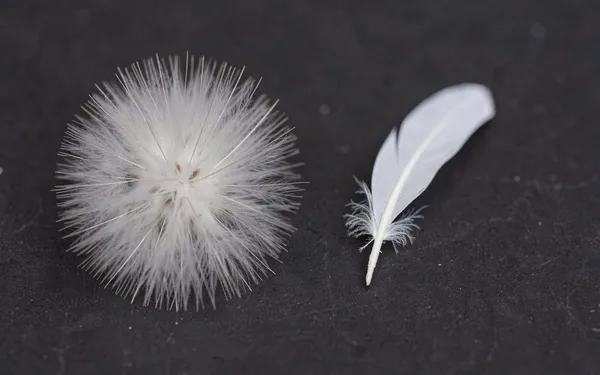
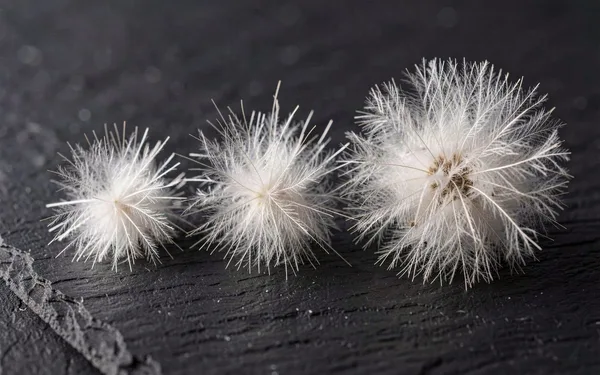
A down cluster has a round, dandelion-seed-like structure, with countless fine fibers radiating outward. Air settles between these fibers and forms a layer of still air. Because air is a poor conductor of heat, the thicker this layer, the less body heat escapes.
2. It releases moisture
People are said to perspire about a cupful of moisture over a single night. If that moisture stays trapped in your bedding, evaporation draws heat away from the body, leaving you feeling damp and cold.
Down both absorbs and releases moisture, taking in humidity and letting it out again. Synthetic-fill comforters often feel warm at first but chilly toward morning precisely because they don't release moisture well.
3. It follows the body
Down is light and drapes flexibly. That lets the comforter settle along the contours of your shoulders and hips without leaving gaps. This ability to follow the body has a big effect on how warm you actually feel.
We cover how this warmth works in more detail in Why Is a Down Comforter So Warm? How It Works, Temperature Regulation, and How It Compares to a Cotton Futon — Explained by a Specialty Store.
Factor 1: Fill Power — The Core Measure of Warmth
Fill power indicates how much volume 1g of down expands to (unit: cm³/g). Even with the same 1.3kg of fill, a different fill power means a completely different thickness of insulating air.
| Fill power | Warmth at a glance |
|---|---|
| Under 300 cm³/g | Not quite enough for winter. Needs more fill to compensate, which adds weight |
| 300〜350㎤/g | Standard. Practical when paired with room heating |
| 350〜400㎤/g | Good quality. Enough on its own to get through winter |
| 400 cm³/g or more | High quality. Light and warm |
| 440 cm³/g or more | Top tier. Mother goose down and similar |
Fill power (FP) as labeled overseas is roughly 1.8 times the Japanese dp figure. A comforter marked 730FP is equivalent to 400cm³/g in Japanese dp. For full conversion details, see Loft (Fill Power) and Japanese dp: Meanings, Differences, and Benchmarks — Explained by a Specialty Store.
Goose, Duck, and Mother Goose: What's the Difference?
The upper limit of fill power is set by which waterfowl the down comes from.
- Duck: a smaller bird with smaller down clusters. Fill power typically sits around 300㎤/g
- Goose: a larger bird than duck, with larger down clusters. Roughly 350–420㎤/g
- Mother goose: mature breeding birds raised over a long period. They yield fully developed down clusters, and 440㎤/g or higher is achievable
Origin matters too. Waterfowl in cold regions such as Poland and Hungary grow denser down to protect themselves. For details, see What Is Goose Down? How It Differs from Duck Down and Eiderdown — Explained by a Specialty Store and Which Regions Does Down for Comforters Come From, and What Are Their Characteristics?.
Factor 2: Down Cluster Ratio — Feathers Don't Add Warmth
The down cluster ratio is the percentage of the fill that is true down. The remainder is feather (small quilled feathers), which adds resilience but traps very little air.
In other words, in a down comforter with a 70% down cluster ratio, 30% of the weight consists of material that doesn't keep you warm. If you're choosing one for winter, aim for 90% or higher.
Keep in mind that a product can legally be called a "down comforter" with a down cluster ratio of just 50% or more. Don't go by the product name — check the number on the quality label. What is down cluster ratio? A clear guide to the quality specs of a down comforter explains how to read these labels.
Point 3 | Fill weight | More isn't always warmer
Fill weight is the weight of the down inside. For a winter-weight comforter, 1.2–1.3 kg in Single is the standard.
This is where misunderstandings happen: adding more and more down does not keep making the comforter warmer. Past a certain point, the comforter gets heavy, stops following the contours of your body, and leaves gaps at the shoulders and sides. A down comforter keeps you warm precisely by hugging the body, so those gaps translate directly into cold spots.
The answer isn't "it's not warm, so get something heavier" — it's "raise the quality so it drapes along your body." That's the right direction when you're after warmth from a down comforter.
With high fill power, even a modest fill weight creates plenty of insulating air. For example, the Mother Goose Sleep Down Winter-Weight Comforter has a fill power of 450 cm³/g with a 1.2 kg fill weight, while the White Goose Sleep Down Winter-Weight Comforter, at 400 cm³/g fill power, uses 1.3 kg. The former is lighter, yet its lofted volume is equal or greater.
Point 4 | Quilting | Seams are where the cold gets in
Quilting refers to the seams that divide the comforter into compartments so the down can't shift. This construction has a major effect on warmth.
| Quilting | Construction | Effect on warmth |
|---|---|---|
| Sewn-through (flat) quilting | Top and bottom fabrics are stitched directly together | There's zero down along the seams, so those lines feel cold |
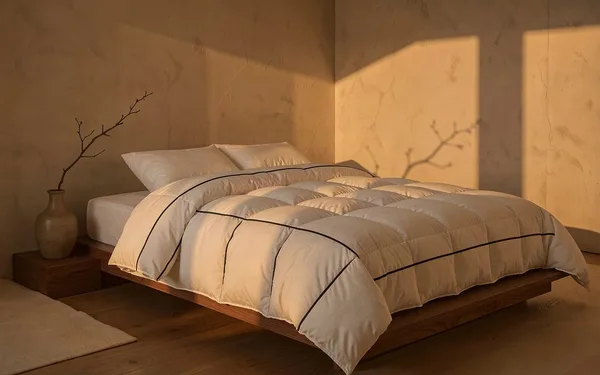
| Baffle-box quilting | Tall side walls (gussets) are added around each box | Loft is maintained even at the seams. The standard for winter. |
| Double-layer baffle-box quilting | Two layers of baffle-box quilting stacked one over the other | Seams never line up, giving the highest warmth of all — though it tends to be heavier |
To tell whether the comforter you own has flat quilting, pinch the seams between your fingers. If a spot flattens out to almost nothing, it's flat quilting. Check where those seams fall on your body, and it often explains complaints like "my shoulders are cold" or "I feel a chill at my lower back."
Point 5 | Size | The biggest factor, and the most overlooked
As a rule, down comforter size should match the width of your bedding underneath. That said, consider going one size up if any of the following apply to you.
- You have broad shoulders or a larger build
- You toss and turn a lot
- You usually sleep on your side
- You sleep on a futon laid directly on the floor rather than a bed (the comforter slips off easily)
If you're using a Single (150×210 cm / approx. 59×83 in) comforter and your shoulders feel cold, the cause is often not quality but a lack of width. You'll find our sizing guidance in How to choose your down comforter size (Single, Semi-double, Double): a specialty store's guide by body type and bed size.
How a down comforter compares with other bedding for warmth
| Bedding | Warmth | Weight | Moisture handling | Characteristics |
|---|---|---|---|---|
| Down comforter (winter-weight) | High | Light | Releases moisture | Follows the body and stays reliably warm until morning |
| Cotton futon | Medium | Heavy | Absorbs moisture but is slow to release it | Substantial, reassuring weight. Needs regular airing in the sun (tenpiboshi) |
| Wool futon | Medium to high | Medium | Releases moisture well | Handles humidity well. Somewhat heavy |
| Synthetic (polyester) comforter | Medium | Light | Tends to trap moisture | Inexpensive and washable, but traps moisture easily |
| Blankets | Low to medium | Medium | Depends on the material | Not enough on its own; layering matters |
For a material-by-material comparison, see Comforter Fill Materials Compared: Down, Cotton, Synthetic and Wool — How to Choose, Explained by a Specialist Store. For how blankets fit in, see Blanket or Down Comforter — Which Is Warmer? Differences, Correct Use and Layering Order, Explained by a Specialist Store.
Habits that rob your comforter of warmth
Even a high-quality down comforter may deliver less than half its performance if it isn't used correctly. Here are the most common mistakes.
Sleeping with things piled on top of the comforter
Placing a heavy blanket or clothing on top of a down comforter crushes the down and reduces the insulating air layer. A down comforter only performs when it is fully lofted. If you do layer something over it, keep it light.
Tucking it down between the bed and the wall
Tucking the edges deep under the mattress, hotel-style, flattens the down in those areas and creates a thin, cold band right alongside your body. That becomes a channel for cold air, so tuck in the foot end only.
Using a duvet cover that's too tight
Forcing on a cover that doesn't fit keeps the comforter compressed so it can't loft. Choose a cover the same size as the comforter or only very slightly larger, and fasten every tie — corners and mid-points. Without the ties, the comforter shifts inside the cover, leaving empty areas that let in cold.
Never letting moisture escape
When nightly perspiration has no chance to evaporate, it builds up, the down absorbs the moisture, clumps, and stops lofting. In the morning, fold the comforter back and let it air for 10–15 minutes before making the bed. This one habit makes a real difference to loft throughout the season.
Storing it in a vacuum compression bag
Crushing a comforter in a vacuum bag for off-season storage breaks the down fibers, and they don't spring back. This is the most common reason a comforter feels "somehow thinner" the following season.
Your bedroom environment and warmth
Bedding performance is only felt in combination with the conditions in the room.
Cold air from the windows
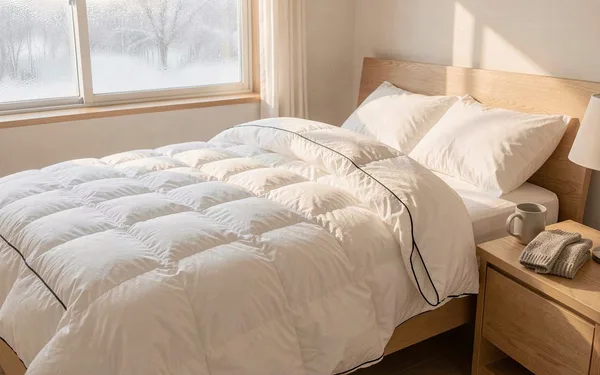
On winter nights, window glass is chilled by the outside air. Air touching that surface becomes heavier, sinks, and flows across the floor to your bed. This is known as cold draft. If your bed is next to a window, the effect is far from negligible.
Remedies include heavy floor-length curtains, moving the bed away from the window, and applying insulating window film. All of these are worth trying before you replace your comforter.
Humidity
At the same room temperature, low humidity feels colder. Dry air draws moisture from the skin, and the resulting evaporative cooling lowers body temperature. Aim for 40–60% humidity in a winter bedroom. If you don't have a humidifier, simply hanging up one damp towel helps.
How you use your heating
Running the air conditioner all night keeps the room temperature up, but it also dries out the air. Ideally, warm the room before bed, then switch the heating off or lower the setting when you turn in. That becomes possible once your bedding is doing the work of keeping you warm.
We cover winter bedroom temperature and humidity in more detail in a separate article.
Price and warmth: how they relate
"Expensive down comforters are warmer" is half true and half false.
The true half: as price rises, down quality (fill power and down cluster ratio) tends to rise with it, and that translates directly into warmth.
The false half: price reflects more than quality. Products sold through department stores and big-box retailers carry distribution costs, and brand premiums are often added on top. It is not unusual for two down comforters with the same fill power of 400 cm³/g (Japanese dp) to differ in price by nearly double, depending on the sales channel.
In other words, don't look at the price tag alone — look at the fill power and down cluster ratio you get for the price. Products that don't publish those numbers can't even enter the comparison.
For a side-by-side look at what you actually get in each price range, see What Are Down Comforter Grades and Ranks? A Specialist's Complete Guide to Judging Quality.
Recycled down as an option
If you want warmth while keeping the budget in check, "recycled down" — down collected in Japan, then washed and restored — is a real option. When it has been properly cleaned, there is almost no functional difference from new down.
Omotesando Futonten's Clean Cycle Sleep Down winter-weight comforter publishes its test results from an independent Japanese laboratory: a fill power of 400 cm³/g and a down cluster ratio of 94%. Those figures are on par with new white goose down.
How to make the down comforter you already own warmer
Before you replace your comforter, there are a few things worth trying. Here they are, in order of how much difference they make.
1. Rethink what's underneath you
Body heat escapes downward more than upward. If you're sleeping on a thin mattress laid straight on the floor or a bed frame, you'll feel cold no matter how good your comforter is. Adding a single mattress topper or bed pad can change how warm you feel.
A moisture-absorbing material such as a 100% cotton bed pad creates an insulating layer without trapping heat and humidity.
2. Move your blanket
Layer the blanket on top of the down comforter: the down can still loft with your body heat, while the blanket holds in the warmth radiating upward. Put the blanket under the comforter (closer to your body) and the down can't sense your body heat properly, so it never reaches its full loft.
For details, see The Right Order for a Down Comforter and Blanket: A Pro's Answer — On Top or Underneath? Explained by Material.
3. Change your duvet cover fabric
A cover with poor breathability traps moisture and stops the down from releasing humidity. Simply switching to a 100% cotton cover can take the edge off that early-morning chill.
4. Close the gaps around the comforter
Tucking a towel in at the neckline, or folding the sides of the comforter slightly under the mattress — physically closing the gaps alone can change how warm the bed feels.
5. Restore the loft of the down
If years of use have left your comforter flat, the down may have absorbed moisture and clumped together. Air it for one to two hours in a shaded, well-ventilated spot and let a little air back into it. The full method is in How to Restore Loft to a Down Comforter: 6 Steps to Fix a Flat Comforter at Home, Explained by a Specialist.
If none of these help, the down itself may have deteriorated. Check the criteria in How Long Does a Down Comforter Last? A Specialist Explains When to Replace or Refurbish.
Frequently asked questions
Which comforter is the warmest?
Compared on equal terms, a winter-weight down comforter made with high fill power mother goose down in baffle-box quilting (or a two-layer quilt) offers the most warmth per gram of weight. That said, "warmest" depends on your bedroom temperature, what you sleep on and your build, so there's no single right answer.
Why does my down comforter still feel cold?
There are four main causes: the comforter is too small for your build, the bedding underneath you doesn't insulate enough, the blanket is layered in the wrong order, or the down has deteriorated and no longer lofts. Checking in that order is the quickest way to find the culprit.
Does high fill power mean a thin comforter can still be warm?
Up to a point, yes. But if the fill weight is at summer-weight (light) comforter level (0.3–0.4 kg), no amount of fill power will make it a winter comforter. Fill power is "efficiency per gram" and fill weight is "total volume" — you need both.
If I sleep with the heating on, is a thin comforter enough?
If you run the heating until morning, an all-season (medium-weight) comforter will do. Keep in mind, though, that heating dries out the air and can leave your throat and skin irritated. Getting your warmth from the bedding and keeping the heating modest tends to give you more consistent sleep quality.
Can I use an electric blanket with it?
You can, but prolonged high heat dries out the down and speeds up its deterioration. We recommend warming the bed before you get in, then switching the blanket off — or down to its lowest setting — once you're in bed.
Can two comforters replace one winter-weight comforter?
They can, but less efficiently. The air trapped between the two comforters is slow to warm up with body heat, so the bed feels cold just as you're falling asleep.
Is layering two comforters warmer?
They will add some warmth, but it isn't efficient. The air trapped between the two comforters is slow to warm up from your body heat, so the bed feels cold just as you're falling asleep. A single thick winter-weight comforter is both lighter and warmer.
Does the color or thickness of the duvet cover affect warmth?
Color makes no difference, and thickness contributes only slightly. What matters is breathability — a cover that traps moisture leaves you chilly toward dawn. Choose a fabric that absorbs and releases moisture, such as 100% cotton.
Which should I review first — the mattress pad or the comforter?
Start underneath you. Body heat escapes downward most of all, and the mattress or floor keeps drawing warmth away all night long. Simply adding one bed pad costing around ¥10,000 can make as much difference as — or more than — stepping up to a thicker comforter.
How long does a down comforter stay warm?
With good-quality down and proper care, it will hold its performance for 10 to 15 years. Loft is mainly lost through a buildup of soil and physical damage. Use a cover, air out moisture in the morning, never beat it, and never compress it. Following these four rules alone makes a dramatic difference to its lifespan.
Does bedroom humidity affect warmth too?
Yes. Dry air pulls moisture from your skin, and that evaporation cools your body. Simply raising humidity from 40% to 60% makes the room feel 1–2°C warmer.
Summary
- A warm down comforter comes down to five things: fill power of 400㎤/g or higher, a down cluster ratio of 90% or more, a fill weight of 1.2–1.3kg, baffle-box quilting, and a size that suits your build
- Down is warm because it traps air, lets moisture escape, and drapes along the contours of your body
- More fill weight isn't automatically better. Too heavy, and the comforter stops following your body — leaving you colder
- When a down comforter feels cold, the cause is one of four things: size, what's underneath you, the order you layer blankets in, or down that has deteriorated
- Before you buy a new one, rethink your under-bedding and where you place your blanket — that alone often solves it
Omotesando Futonten's winter-weight comforters are made with down rated at 400㎤/g fill power or higher, finished with baffle-box quilting. We publish third-party test results for every product.
Shop winter-weight down comforters at Omotesando Futonten
Make Your Current Down Comforter Warm Again | Down Comforter Refurbishing / Clean Cycle Reform