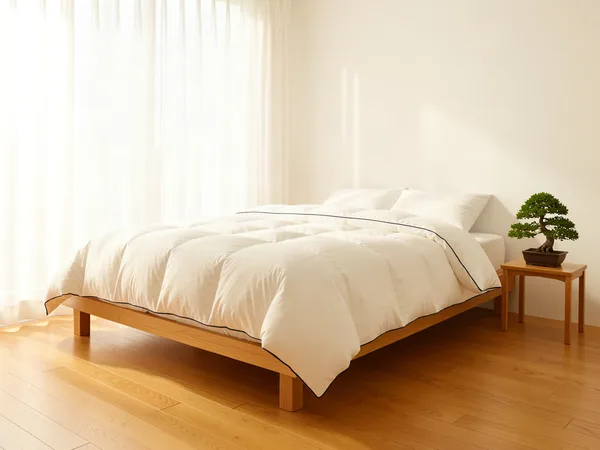
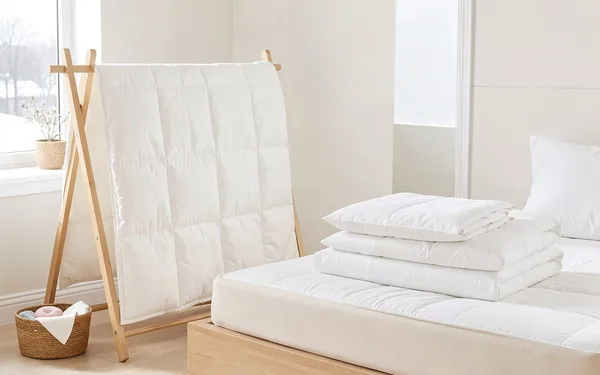
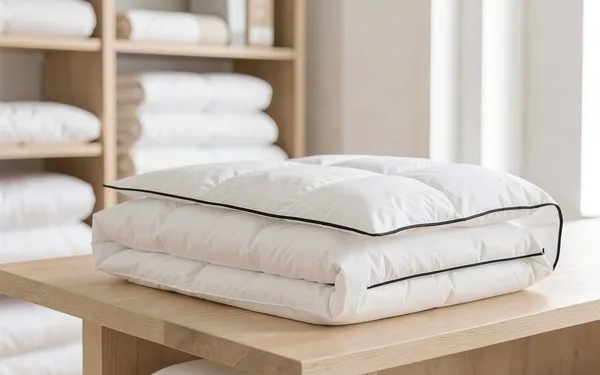
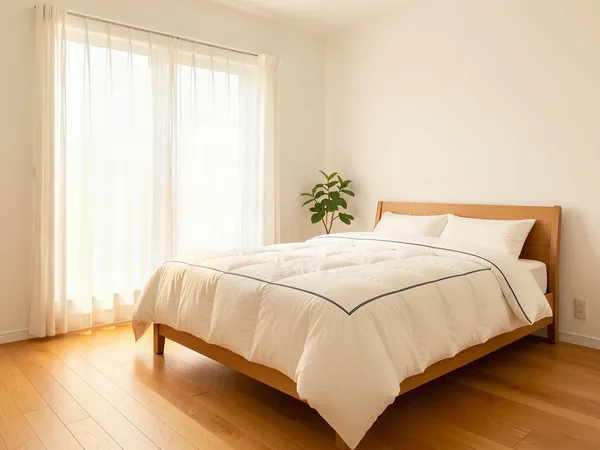
The answer in 30 seconds
- Shell fabric is the fabric of the comforter itself, the layer that encases the down. It's not the same as a duvet cover. It determines how the comforter feels against your skin, how warm and breathable it is, and how well it keeps down from escaping.
- The standard material is 100% cotton — extra-long staple cotton in particular. Polyester blends are easier to wash but trap more heat and moisture. Silk feels wonderful against the skin but is delicate.
- The higher the yarn count, the finer the yarn. Finer yarns make a denser fabric, so down is less likely to work its way out and the surface feels smoother.
- There are three weaves: plain, twill, and sateen. Plain weave is durable and keeps down from escaping. Sateen is the smoothest, but less durable than plain weave.
Shell fabric (gawakiji) is the outer fabric of a down comforter. It's the cloth that encases the down inside, and it's a crucial component that determines how the comforter feels against your skin, how warm and breathable it is, and how well it keeps down from escaping.
Even with identical down inside, a difference in shell fabric material, yarn count, or weave changes how the comforter sleeps. Choosing beautiful, high-quality down and then pairing it with the wrong shell fabric is a common and costly mistake.
In this article, a specialist store explains shell fabric materials (cotton, extra-long staple cotton, polyester, silk), what yarn count means, the differences between weaves (plain, sateen, twill), and the key points for choosing the right one.
Most people focus on the quality of the down when choosing a comforter — but the shell fabric (gawakiji) deserves just as much attention.
Perhaps you're wondering, "What exactly is shell fabric?" or "How am I supposed to know which one to choose?"
Below, we cover the shell fabric basics worth knowing — and the key points for choosing well — so you can pick a genuinely high-quality down comforter.
By the end of this article you'll understand shell fabric far better and know which down comforter is right for you, so do read on.
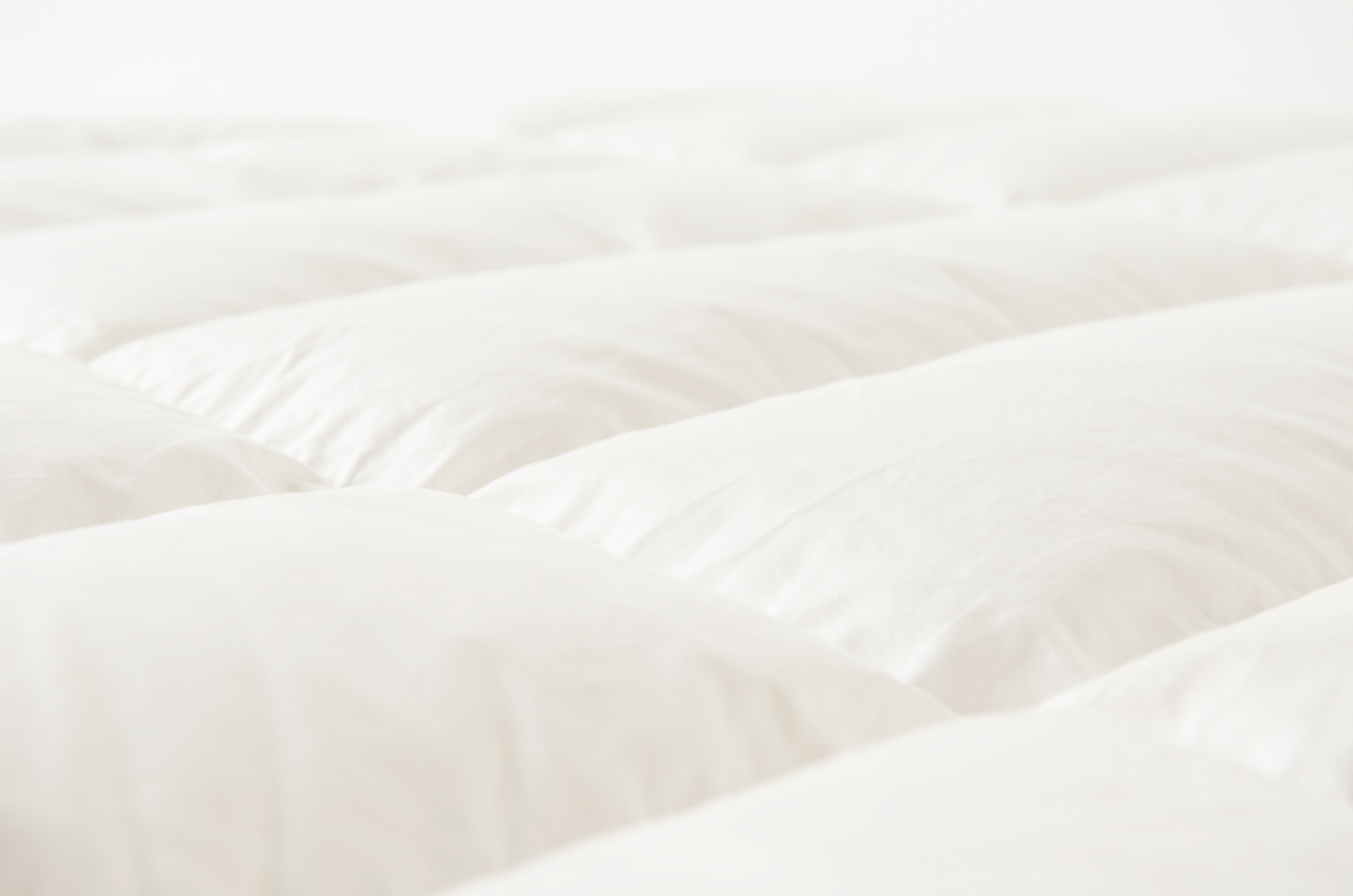
The shell fabric of a down comforter
If you're looking for a genuinely high-quality down comforter, it pays to judge the comforter as a whole.
That means looking beyond the down itself and taking a close look at the shell fabric, too.
Let's start with what shell fabric is and what it actually does.
What Is Shell Fabric?
The shell fabric (gawa-kiji) is the outermost fabric of a down comforter. It's the layer that touches your skin while you sleep — in other words, the fabric of the comforter itself, which you see before putting on a duvet cover.
The shell fabric has four main jobs.
- Holding the down in: it keeps fine down clusters from escaping through the fabric
- Setting the feel: the material, yarn count and weave make a big difference to how the comforter feels against you
- Controlling warmth and breathability: the material and weave determine how heat escapes
- Ensuring durability: with the wrong fabric, holes and tears appear more easily
Some people assume that "the shell fabric doesn't matter because a duvet cover keeps it off my skin." In fact, the shell fabric's breathability and its ability to hold the down in still make themselves felt right through the cover. Choosing a high-quality shell fabric is one of the most important parts of choosing a comforter.
Shell fabric explained
Shell fabric is the fabric that encases a down comforter — think of it as the outer fabric of the comforter.
One common misunderstanding: shell fabric is not the same as a duvet cover. In a down comforter, the down is enclosed by the shell fabric; the duvet cover is a separate layer you add on top to protect that shell fabric and the down inside from damage and soiling.
What the shell fabric does
The shell fabric's role is to keep the down inside the comforter from working its way out.
But not just any fabric that holds the filling in will do.
A down comforter is designed to make the most of down's natural breathability, light weight, moisture absorption, warmth, moisture release and softness. The shell fabric therefore has to be a fabric that doesn't get in the way of those qualities.
Related reading: Where does the down in a down comforter come from? Origins, characteristics and what to look for
Types of shell fabric
Shell fabrics for down comforters come in four main types: cotton, extra-long staple cotton, polyester blends, and silk.
| Material | Feel against the skin | Moisture absorption | Durability | Best for |
| Cotton | ◎ | ◎ | ○ | Shoppers who want a soft feel at a fair price — the most standard choice |
| Extra-long staple cotton (premium cotton) | ◎+ | ◎+ | ◎ | Shoppers who want the very best — pricey, but long-lasting with an unbeatable feel |
| Polyester blend | ○ | △ | ◎ | Shoppers who wash often or shop on price — note that it can feel stuffy |
| Silk | ◎+ | ◎ | △ | Sensitive skin and the ultimate sleep feel — delicate, so handle with care |
Cotton
Cotton is the most standard choice. It absorbs and releases moisture beautifully, soaking up night sweats quickly. It's also durable and holds up relatively well to washing, so it stays in good shape for years. Cotton is by far the most widely used shell fabric for down comforters.
Extra-long staple cotton (chōchōmen)
Extra-long staple cotton is the general term for premium cotton with fibers 34mm or longer. Because the fibers are fine and long, the yarn is stronger and can be woven into a high-density fabric. The result: down stays put instead of poking through, and the surface feels exceptionally smooth. Egyptian cotton (Giza) and Supima cotton — two of the world's three great cottons — are the best-known examples.
Polyester blend
This is cotton blended with polyester. It's inexpensive and machine-washable, which makes it easy to live with. On the other hand, it absorbs and releases moisture poorly, so you may wake up feeling clammy, and sleep quality can suffer. You'll often find it in spring/fall all-season comforters and in comforters made for people who wash their bedding frequently.
Silk
Silk is the finest of all natural fibers and strikes an excellent balance between moisture absorption and warmth. It's gentle on skin, which makes it a good match for sensitive skin. That said, it doesn't like water and often requires professional cleaning, so it needs careful handling.
Looking for a luxury comforter? Take a look below.
Related article: Luxury comforter lineup
What is yarn count (bante)?
Yarn count is the unit used to express how fine or thick cotton yarn is. The higher the number, the finer the yarn. The finer the yarn used in the shell fabric, the denser the weave can be — which keeps down from escaping while giving the fabric a softer hand.
| Yarn count | Yarn characteristics | Typical use & quality level |
| 40 count | Slightly thick | Used in everyday cotton comforters; value-focused |
| 60 count | Medium | Standard down comforters; a good balance of quality and price |
| 80 count | Fine | Premium grade. Soft to the touch, and down is far less likely to poke through |
| 100 count | Extra fine | Top quality. Common in extra-long staple cotton. Outstandingly smooth |
If quality is your priority in a down comforter shell fabric, we recommend choosing 80s yarn or finer. 100s yarn is reserved for the very finest comforters: down almost never escapes, and the fabric feels as smooth as silk.
Cotton yarn counts (fineness) at a glance
We've explained that cotton is the best fit for a down comforter shell — but simply choosing 100% cotton doesn't automatically guarantee a good result. The detail worth checking is: what yarn count is it woven from?
Yarn count is the unit that expresses how fine a fiber is. Compared with 10-count cotton, for example, 100-count cotton is extremely fine — and the higher the number, the smoother and gentler the fabric feels. Below, we look at what sets 100 count through 10 count apart.
100s
100 count is a very fine yarn, and it's frequently used for the shell fabric of luxury down comforters.
Because such a fine yarn is used, 100 count is the one to choose if you want the lightest, most luxurious shell fabric available.
It's also worth noting that most 100-count shell fabrics are made in Japan.
80s
Like 100 count, 80 count is often used in luxury down comforters. Most of it is made in Japan, and it has a fine, closely woven character.
Cotton yarns in the 80 to 100 count range are the same ones used for dress shirts, so picturing a good dress shirt will give you a fair idea of the feel.
If you want a high-end shell fabric but don't need to go all the way to 100 count, 80 count is our recommendation.
60s
A shell fabric woven from 60s-count yarn has a distinctive crisp, smooth feel against the skin. The yarn is thicker than 100s or 80s count, but it's still a thickness used in high-quality products.
If you want a good-quality shell fabric while keeping an eye on price, 60s count is well worth considering.
40s
40s-count yarn is often used for the shell fabric of more affordable, easy-to-buy down comforters.
Put simply, that works out to roughly twice the thickness of 80s-count yarn, so the fabric can feel a little stiff.
10s–20s
Once you get down to 10s–20s count, the yarn is almost never used for the shell fabric of a high-quality down comforter.
Denim, for example, is often woven from 10s-count yarn, which gives you a good sense of just how thick that fabric is.
Imagine down encased in denim and it's easy to see why this isn't a good choice for the shell fabric of a down comforter.

Extra-long staple cotton used for down comforter shell fabric
If you want to focus on truly good cotton, the type to look for is extra-long staple cotton, known in Japanese as chōchōmen.
Extra-long staple cotton is used in our own Omotesando Futonten products, and it's known for its outstanding quality.
Here's a look at what makes extra-long staple cotton special.
Extra-long staple cotton
Extra-long staple cotton is cotton with exceptionally long fibers — 35 mm or longer. Cotton is classified into three groups according to fiber length.
Fibers of 21 mm or less are short staple cotton, 21–28 mm is medium staple cotton, and 28 mm or more is long staple cotton.
At 35 mm and above, extra-long staple cotton clearly has exceptionally long fibers, even among long staple cottons.
Where it's grown
"Extra-long staple cotton" is an umbrella term for cotton with fibers 35 mm or longer, and it comes in several varieties.
Sea Island cotton, for example, is an extra-long staple cotton grown in the Caribbean and the West Indies.
Also known as Caribbean cotton, it takes color beautifully and dyes exceptionally well.
Giza cotton, grown in the Nile Delta of Egypt, is another extra-long staple cotton. Renowned for its quality, it is one of the rarest extra-long staple cottons of all.
Indian extra-long staple cotton is grown in southern India. The Suvin variety is especially famous, with a silk-like hand.
Xinjiang cotton is an extra-long staple cotton grown in China's Xinjiang Uyghur Autonomous Region. It is produced in relatively large volumes and is one of the more widely available extra-long staple cottons.
Other well-known varieties include Pima cotton, grown in the southwestern United States and Peru, and Supima cotton, grown in Pima County, Arizona, in the American Southwest.
The finer points of each cotton's character vary depending on which extra-long staple variety it is.
Characteristics
Fabric made from extra-long staple cotton feels wonderful against the skin and has an almost silk-like luster.
Above all, it is remarkably rare. Extra-long staple cotton is said to account for only about 5% of all the cotton grown on earth — which tells you just how scarce it is.
It is also strong. Soft to the touch, durable, and excellent at absorbing and releasing moisture, it's an ideal material for the shell fabric of a down comforter. It's lightweight too, so it doesn't compromise the airy lightness that makes a down comforter so appealing.
Extra-long staple cotton is exceptionally high in quality, making it the ideal choice if you're looking for a premium down comforter with a shell fabric to match. When choosing a shell fabric, pay attention to the cotton yarn count and whether extra-long staple cotton is used.
Types of shell fabric weaves and what sets them apart
Even with the same material and the same yarn count, the weave changes the character of the fabric dramatically. Here's how the three main weaves compare.
| Weave | Sheen | Feel against the skin | Feel and who it suits |
| Plain weave (hiraori) | None (matte) | Crisp, dry feel | Durable and down-proof. For practicality-first shoppers. Great value |
| Twill | Slight | Supple | Softer and glossier than plain weave. For those who want the best of both |
| Sateen (satin weave) | Yes (subtle sheen) | Smooth and silky | The finest feel against the skin, with a luxurious look. Ideal for sensitive skin or anyone who wants the very best quality. |
Plain weave (hiraori)
The simplest weave of all, with warp and weft threads crossing one over one. That simple structure makes the fabric strong and helps keep down from escaping. It has a matte finish with no sheen, and is widely used on great-value comforters.
Twill
A weave recognizable by its diagonal ribs. It is more flexible than plain weave, giving a supple, fluid fabric with a moderate sheen — in many ways the middle ground between plain weave and sateen.
Sateen (satin weave)
A weave in which the warp threads float across the surface, creating a smooth, lustrous fabric. It offers the best feel against the skin and a luxurious look. Durability is lower than plain weave, however, so we recommend always using a duvet cover.
If you're shopping for a luxury comforter, take a look below.
Related article: Luxury comforter collection
Frequently asked questions
Q1. What is the shell fabric?
- It's the outer fabric of a down comforter — the cloth that encases the down inside. It's a key component that determines how the comforter feels against your skin, how warm and breathable it is, and how well it keeps down from leaking out. Even with identical down inside, a different shell fabric changes the sleeping experience dramatically.
Q2. Which shell fabric should I choose?
- If feel and moisture absorption matter most to you, 100% cotton — especially extra-long staple cotton — is the best choice. Polyester blends are an option if easy washing and value come first, but they trap heat and humidity more easily, so they're less suited to long-term use. Silk suits those with sensitive skin or anyone after the ultimate sleeping comfort.
Q3. What does "thread count number" (bante) mean?
- It's the number that indicates how fine the cotton yarn is. The higher the number, the finer the yarn and the denser the fabric. A count of 60 or above is a good benchmark for quality, and 80–100 is top-tier. The higher the count, the less down escapes and the smoother the fabric feels.
Q4. Can a sateen comforter be washed?
- Always check the care label first. Because sateen is a lustrous, delicate fabric, most pieces call for hand washing or professional cleaning. Even when machine washing is allowed, use a mesh laundry bag, a delicates cycle and lukewarm water at 30°C or below.
The shell fabric is a key factor in a comforter's quality
We've walked through the key features and points to look for in shell fabrics. A high-quality down comforter isn't just about the quality of the down — the shell fabric is crafted with just as much care.
So when you're choosing a down comforter, be sure to give the shell fabric a close look too.
"Clean Cycle Down" shines like silk. The 100% cotton shell that encases the down comes in two choices: Gran Nuze satin in 120-count, made from Indian extra-long staple cotton hailed as the jewel of cottons, and a 60-count satin. Light and highly absorbent, it is gentle against the skin with a beautiful silk-like luster and a distinctive hand.
Our highest-quality item, "Premium RDS Down," uses Gran Rishu, a finest-grade extra-long staple cotton.
Treated for antibacterial, odor-control and dust-mite resistance.
If you're looking for a down comforter (duvet) that combines Japan's finest quality with a refined design that complements your interior, do take a look at the Omotesando Futonten collection.
Clean Cycle Down summer-weight (light) comforter / recycled down
For high-quality Japanese-made premium down comforters (duvets), choose Omotesando Futonten
| Related articles
・Down Comforter Materials & Fill Power in Detail |
Do “gawaji” and “futongawa” mean the same as shell fabric? Readings explained
When you read up on down comforters in Japanese, you'll come across 側生地 (gawakiji, shell fabric) along with terms like 側地 (gawaji) and 布団側 (futongawa). The short answer: all of them refer to the fabric that encases the down, and there is no real difference in meaning.
Differences in reading
側生地 is read "gawakiji" and 側地 is read "gawaji." Both are industry terms used in the bedding trade, and you'll see one or the other depending on the catalog or product description.
How “futongawa” relates to these terms
布団側 (futongawa) is used in essentially the same sense as 側生地 and 側地. What they all have in common is that they refer to the outer fabric, as opposed to the filling (the down) inside the comforter.
How this differs from 布団生地 (futon fabric)
The term 布団生地 (futon fabric) is sometimes used for the shell fabric itself, but it can also refer broadly to any fabric used in bedding, such as duvet cover fabric or the fabric of a mattress futon. If what you want to know about is the outer fabric of a down comforter, see the section on 側生地 (shell fabric) explained in this article.