The answer in 30 seconds
- A fill weight of 0.3–0.4 kg in Single is the standard. If you’re unsure, start here. If you sleep hot or run the air conditioning on a strong setting, a lighter 200–250 g option is also worth considering.
- Look for a down cluster ratio of 80% or more — ideally 90% or more. Below 80%, there are more feathers, which can mean extra weight, a prickly feel, and a stuffy sleep in summer.
- Goose down breathes better; duck down is affordable and easy to wash. Goose down is highly breathable and moisture-wicking, with less odor. It does cost more.
- Choose a shell fabric of 100% cotton or double gauze. Polyester blends are less breathable and tend to feel stuffy in summer.
| What you'll learn in this article
・How to choose the right fill weight (0.3–0.4 kg is standard for a Single) ・Why you should choose a down cluster ratio of 80% or higher ・Goose vs. duck down for summer use ・How to choose the shell fabric (100% cotton vs. gauze) |
"I want to buy a summer down throw, but which specs should I be looking at?" When you don't know what the numbers on a product page mean, it's hard to know where to start.
There are four things to look at when choosing a summer down throw: fill weight, down cluster ratio, down type, and shell fabric. Once you understand these four, you can pick the one that suits your body, your home, and your budget.
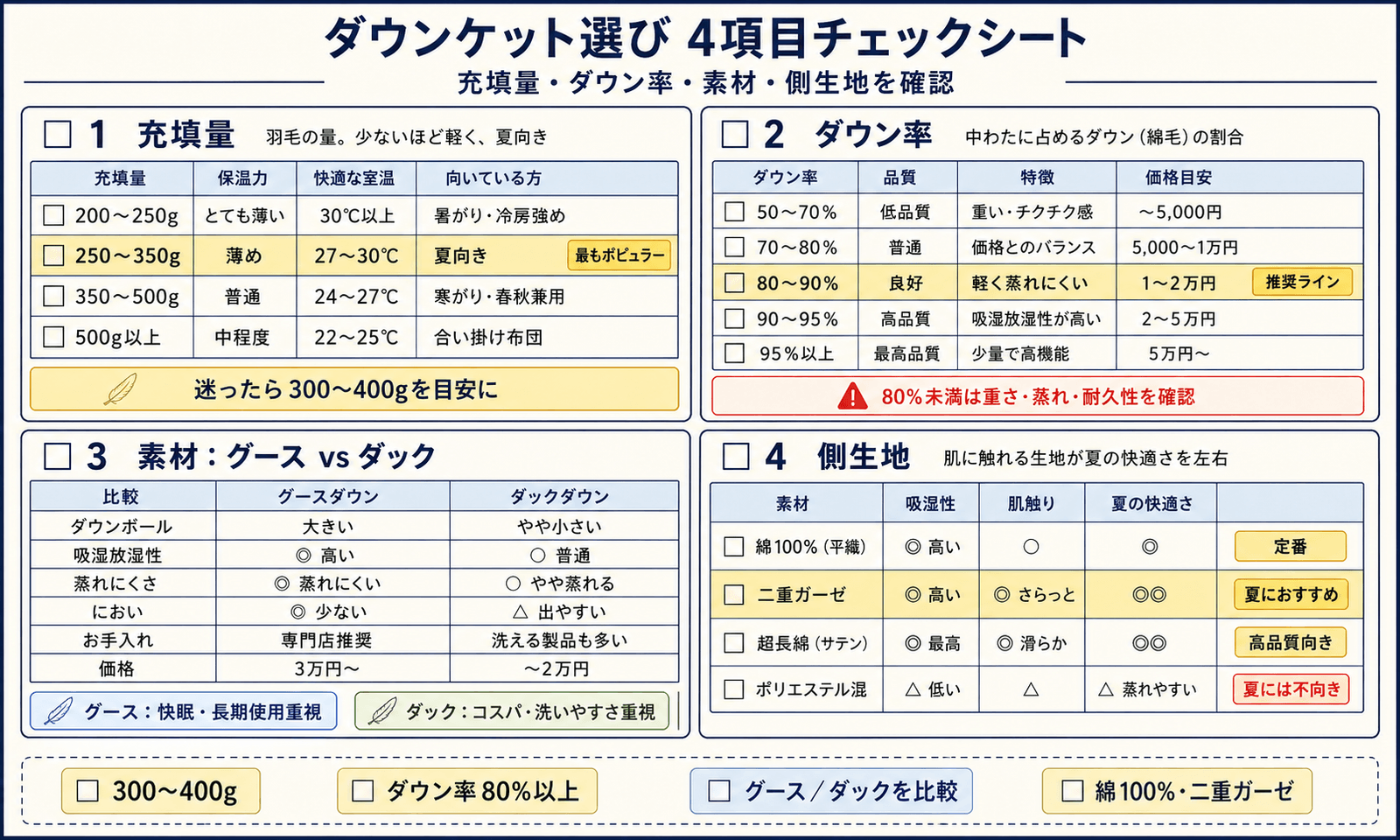
A checklist covering four points: fill weight, down cluster ratio, down type (goose/duck), and shell fabric
Point 1: How to choose the fill weight
What is fill weight?
Fill weight is the amount of down inside the comforter, in grams. More fill means more warmth — but with a summer down throw, the lighter the fill weight, the better suited it is to hot weather.
| Fill weight (Single) | Warmth | Comfortable room temperature | Best for |
| 200〜250g | Very lightweight | Peak summer, 30°C and above | Runs hot / sleeps with strong A/C |
| 250〜350g | Lighter | 27〜30℃ | Ideal for summer (most popular) |
| 350〜500g | Moderate | 24〜27℃ | Runs cold / also for spring and fall |
| 500 g or more | Medium | 22〜25℃ | All-season (medium-weight) comforter range |
| For a summer-weight down comforter, 0.3–0.4 kg (300–400 g) in Single is the standard fill weight. If you’re unsure, start here. |
Point 2: How to choose the down cluster ratio
What is the down cluster ratio?
The down cluster ratio is the percentage of true down clusters in the fill; the remainder is feather. The higher the ratio, the lighter and loftier the throw, and the better it absorbs and releases moisture.
| Down cluster ratio | Quality | Characteristics | Price guide |
| 50〜70% | Low quality | High feather content, so it feels heavier and can poke | Up to ¥5,000 |
| 70〜80% | Moderate | A good balance of price and quality | ¥5,000–¥10,000 |
| 80〜90% | Good | Our recommended minimum. Light and breathable, so you stay comfortable | ¥10,000–20,000 |
| 90〜95% | High quality | Common in goose down. Excellent moisture absorption and release. | ¥20,000–¥50,000 |
| 95% or more | Highest quality | Mother goose down. High performance from a small amount of fill | ¥50,000 and up |
What happens below a down cluster ratio of 80%
- Contains more feathers, so it tends to feel heavy
- Can feel prickly against the skin
- Low moisture absorption and release, so it can feel stuffy in summer
- Less durable; quality tends to drop after a few seasons
Point 3: Goose vs. duck — how to choose
| Comparison | Goose down | Duck down |
| Down cluster size | Large | Somewhat smaller |
| Moisture absorption & release | ◎ High | ○ Average |
| Breathability in summer | ◎ Resists stuffiness | ○ Slightly stuffy |
| Freedom from odor | ◎ Very little | △ Somewhat prone to leaking |
| Washable? | Professional cleaning recommended | Many are washable |
| Price | Higher (¥30,000 and up) | Lower (up to ¥20,000) |
| Who it's best for | Best if you prioritize sleep quality and long-term use | Best if you prioritize value and easy washing |
Point 4: How to choose the shell fabric
The shell fabric decides how comfortable your summer will be
The shell fabric (the outer fabric of the comforter) touches your skin directly, so it has a big impact on how comfortable you feel in summer.
| Material | Moisture absorption | Feel against the skin | Summer comfort | Our recommendation |
| 100% cotton (plain weave) | ◎ High | ○ | ◎ | ○ The most popular choice |
| Double gauze | ◎ High | ◎ Cool and crisp | ◎◎ | ◎ Especially recommended for summer |
| Extra-long staple cotton (sateen) | ◎ Excellent | ◎ Smooth | ◎◎ | ◎ Suited to high-quality comforters |
| Polyester blend | △ Low | △ | △ Tends to feel stuffy | × Not suited to summer |
| For a summer down comforter, always choose a shell of 100% cotton or double gauze. Polyester blends are easy to wash, but they absorb and release moisture poorly in summer, so they trap heat and feel clammy. |
How to choose the right size
| Size | Dimensions | Best for |
| Single | 150×210cm | For one person / Single bed |
| Semi-double | 170×210cm | For one person who wants extra room |
| Double | 190×210cm | For two people, or for one person who wants plenty of space |
Frequently Asked Questions
- Is a summer down comforter (down ket) the same as a summer-weight comforter?
- Yes, they are the same thing. Manufacturers and retailers use different names — "down ket," "summer-weight comforter," "summer down comforter," "summer quilt" — but they all refer to a thin down comforter with a reduced fill weight made for summer.
- Isn't more fill weight always warmer and better?
- The whole point of a summer down comforter (down ket) is to be thin — warm enough, but never too warm. Too much fill traps heat in summer and leaves you feeling stuffy. For a Single, 0.3–0.4 kg is the summer standard; anything more falls into all-season (medium-weight) comforter territory.
- How big is the price difference between goose down and duck down?
- Comparing like for like, goose down often costs about 2–3 times as much as duck down. That said, goose down is also more durable and better at absorbing and releasing moisture, so over years of use the cost per year may not differ that much.
Summary
- Fill weight: 0.3–0.4 kg for a Single is the summer standard
- Down cluster ratio: choose 80% or higher — ideally 90% or higher
- Goose down: highly breathable and moisture-wicking, so it stays comfortable even in summer (higher price)
- Duck down: great value and easy to wash (ideal for casual summer use)
- Shell fabric: choose 100% cotton or double gauze (polyester traps heat and moisture)
| ▶ Browse all summer down comforters at Omotesando Futonten |
Common search terms explained
What is a feather ket?
A “feather ket” is a summer-weight (light) comforter that contains a higher proportion of feathers than down clusters. Products with a low down cluster ratio and a high feather content — such as the “50–70%” band in the down cluster ratio table above — are sometimes called feather kets. Because they contain more feathers, they feel heavier than a down ket, and they tend to be more affordable.
How to read “Down 90 / Feather 10” and “Down 80 / Feather 20”
“Down 90 / Feather 10,” which you often see on product labels, means the fill is made up of 90% down clusters and 10% feathers. In the same way, “Down 80 / Feather 20” means 80% down and 20% feathers. This is the same idea as the “80–90%” and “90–95%” bands in the down cluster ratio table above: the higher the number, the higher the proportion of down, and the lighter and more breathable the comforter.
Where does a 0.4 kg fill weight fall on the chart?
A fill weight of 0.4 kg (400 g) falls within the “350–500 g” band in the quick-reference chart above — a good level of loft for people who feel the cold, and usable in spring and fall as well. By contrast, around 0.3 kg (300 g) in Single falls within the “250–350 g” band, which is thinner and lighter for summer. Choose a fill weight within this range based on how warm you sleep and the season you plan to use it.