You can use an electric blanket together with a down comforter. That said, using it the wrong way will shorten the life of the down. Down stays supple thanks to the right balance of natural oils and moisture, and prolonged dry heat robs it of both.
In this article, a down specialist explains how electric blankets affect down and how to enjoy the benefits of both without compromise. The short answer: warm the bed before you get in, then switch the blanket off when you sleep — that is the smartest way to use it.
What you'll learn in this article
- Why you can use an electric blanket with a down comforter, and under what conditions
- Three ways an electric blanket affects down
- How to use under-blankets and over-blankets correctly, and where to position them
- How to stay warm without relying on an electric blanket
Conclusion: Yes, you can use both — just treat the blanket as a pre-warmer
A down comforter and an electric blanket do two different jobs.
- Electric blanket: warms you by adding heat from outside (active heating)
- Down comforter: holds in the heat your body produces (passive insulation)
Running both at full strength at the same time makes the air inside the bed excessively hot and dry — which is bad news for the down, and uncomfortable for you.
Here's the approach we recommend.
- Switch the electric blanket on about 30 minutes before bedtime to pre-warm the bed
- Turn it off — or down to the lowest setting — when you get in
- From there, let the down comforter's insulating power do the work
A down comforter is exceptionally good at holding onto air once it has been warmed. If the bed is already warm when you climb in, the warmth will last until morning even with the blanket switched off.
The real value of an electric blanket is that it spares you the shock of climbing into a cold bed. Keeping you warm through the night is the down comforter's job. Divide the work this way and you cut both your electricity bill and the strain on the down.
Three ways an electric blanket affects down
Effect 1 | The down loses its natural oils
Down once protected the body of a waterfowl, and it naturally contains a tiny amount of oil. These oils keep the down fibers supple and give them their water-repellent quality.
Prolonged exposure to dry heat gradually strips those oils away. The fibers dry out, turn brittle and break more easily — and once a down cluster breaks down, the loft never comes back.
Effect 2 | The down dries out too much
Down holds a modest amount of moisture, and that moisture is part of what keeps it supple. Heating it all night long with an electric blanket drives that moisture out completely.
Overly dry down also builds up static electricity, clinging to the shell fabric and causing the fill to shift to one side.
Effect 3 | The shell fabric suffers
Cotton shell fabric also weakens when it is heated over and over. The impact is greatest when the electric blanket sits under the down comforter (on the body side), because the heat source is in direct contact with the fabric.
How much damage are we actually talking about?
One night won't hurt anything. The problem arises when it's every night, on a high setting, season after season. Take two identical down comforters: after five years, the one used with an electric blanket every night will have noticeably less loft than the one that wasn't.
Under-blanket or over-blanket: which should you choose?
Electric blankets come in two forms: ones you lie on and ones you lie under. If you're pairing one with a down comforter, the under-blanket type is the better match.
| Under-blanket type | Over-blanket type | |
|---|---|---|
| Effects on the down | Small (the heat source stays away from the comforter) | Large (it heats the down directly) |
| Heating efficiency | High (warms you from below, where body heat escapes) | Medium (warms from above, but heat escapes upward) |
| How it feels | Warmth rising from your back | A sense of being wrapped all over |
| Recommended | ◎ | △ (acceptable if laid on top of the down comforter) |
Where to position an under-blanket
Layer an under-blanket type in this order:
- Mattress or futon mattress
- Mattress pad
- Electric blanket (under-blanket / mattress-pad type)
- Sheets
- You
Placing it under the sheet keeps the heat off your skin directly and reduces the risk of low-temperature burns.
If you use an over-blanket type
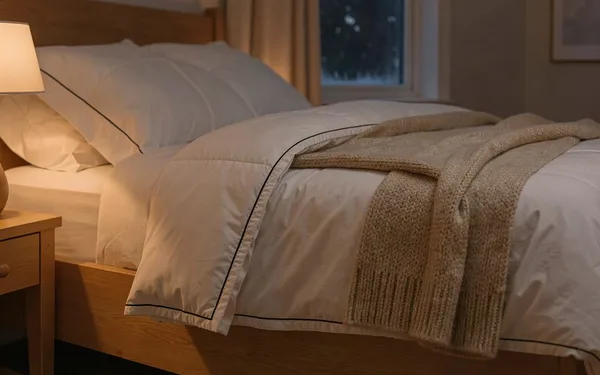
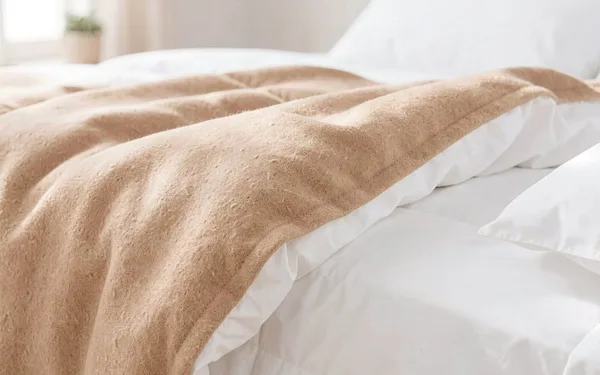
If you use an over-blanket type, lay it on top of the down comforter. Tucked underneath (on the body side), it heats the down directly and speeds up deterioration. It also keeps the down comforter from sensing your body heat, so it never reaches its full loft.
The same logic applies to layering blankets. For details, see The right order for a down comforter and a blanket: a pro's answer — over or under? Explained by material.
How to Use an Electric Blanket | 7 Key Points
1 | Pre-warm the bed, then switch it off when you turn in
This is the single most important point. With the warmth of a down comforter, you won't get cold once the blanket is switched off.
2 | If you do sleep with it on, use the "Low" setting
If you really want to sleep with it on, always use the lowest setting. On most products, the surface temperature is around 30°C on Low and around 50°C on High. That difference puts significantly more stress on the down.
3 | Use the timer
Setting the timer to switch off 2–3 hours after you fall asleep means no lingering heat toward dawn, when your core body temperature drops — so your sleep quality stays protected.
4 | Never heat the down comforter directly
Over-blanket types go on top of the down comforter; under-blanket types go beneath the sheet. Either way, make sure the heat source never comes into direct contact with the down.
5 | Unplug it when not in use
This is a basic safety rule. When storing it in the off-season, fold it for storage but coil the cord loosely so it isn't creased or bent.
6 | Watch the humidity
An electric blanket lowers the humidity inside your bed. If you notice a dry throat or dry skin, run a humidifier as well, or hang a damp towel in the room.
7 | Beware of low-temperature burns
Even at just slightly above body temperature, prolonged contact with the same spot can cause a low-temperature burn. Extra care is needed for older adults, anyone with reduced sensation, and after drinking alcohol. Stick to the basics: never let it touch bare skin directly, and don't sleep for hours with it switched on.
What to Look for When Choosing an Electric Blanket
If you plan to use it together with a down comforter, the criteria change.
| Item | Recommended | Why |
|---|---|---|
| Type | Under-blanket type | The heat source stays away from the down, and you're warmed from below, where body heat escapes |
| Temperature control | One with fine-grained adjustment | Some products run hot even on "Low" |
| Timer | Yes | Switches off automatically after you fall asleep |
| Size | One sized to match your mattress and bedding | If it's too large, folding it over risks breaking the internal wiring |
| Washing | Washable | It absorbs night sweat, so a non-washable one is a hygiene drawback |
| Material | Cotton blend | All-synthetic fabrics tend to feel stuffy |
Check the actual temperature of the "Low" setting
Surface temperature on the same "Low" setting varies from product to product. As a general guide, Low is around 30°C, Medium around 40°C and High around 50°C — but check the specifications.
To minimize the impact on your down, it's safest to use a setting where the surface temperature stays below 35°C.
Safety Precautions
Low-temperature burns
Even at just slightly above body temperature, prolonged contact with the same spot can cause a low-temperature burn. As a guide, this can occur after 3–4 hours at 44°C, or 30 minutes to 1 hour at 46°C.
Particular care is needed in the following cases:
- Older adults (reduced sensitivity to temperature)
- People with reduced sensation in the extremities, such as from diabetes
- After drinking alcohol (dulled senses and harder to wake up)
- Infants and toddlers
If any of these apply to you, avoid using it while you sleep — use it only to pre-warm the bed.
Handling the cord
- Never use the blanket with the cord bent or kinked (this can break the internal wiring)
- In the off-season, roll it up loosely for storage (rolling it tightly breaks the wiring inside)
- Never switch it on while the blanket is still folded (this creates localized hot spots)
- Don't place heavy objects on top of it
Years of use
The designed service life of an electric blanket is generally said to be about 5 to 7 years. Stop using it if you notice any of the following.
- Some areas don't warm up, or certain spots get unusually hot
- The cord has stiffened, or the insulation is cracked
- There's a burning or scorched smell
- The controller display is unstable
Watch out for dehydration
Using an electric blanket all night makes you sweat more than usual. Get into the habit of drinking a glass of water before bed. Older adults in particular tend to have a harder time noticing dehydration.
How to stay warm without relying on an electric blanket
If you feel you can't do without an electric blanket, the reason is one of two things: the bed feels cold the moment you get in, or you get cold toward dawn. Each has its own solution.
Fixes for "it's cold the moment I get in"
- Hot water bottle: slip it down by your feet 30 minutes before bed. It cools naturally by morning, so there's almost no strain on the down
- Futon dryer: warms the whole comforter with hot air and drives out moisture at the same time. Long sessions at high heat are hard on down, though, so keep them short
- Moisture-activated heating mattress pad: generates warmth from the moisture your body gives off. No electricity needed
Fixes for "I get cold toward dawn"
This is a problem that can often be solved by rethinking your bedding itself.
- Add insulation underneath you: body heat escapes downward most of all. Just adding one mattress pad changes how warm the bed feels
- Rethink your comforter size: check whether cold air is slipping in at the sides
- Lay a blanket on top of the down comforter: it works as a lid that holds the warmth in
- Insulate your windows: air chilled by cold glass sinks, creeps across the floor and reaches the bed. Use heavy curtains long enough to touch the floor
To pin down the cause, also see How long does a down comforter last? A specialty store explains when to replace it and when to have it refurbished. If the problem is that your comforter has lost its loft, down comforter refurbishing will solve it.
Why a hot water bottle works so well
When it comes to pairing with a down comforter, nothing beats a hot water bottle.
- It's warmest right when you fall asleep and cools naturally toward morning
- That temperature curve matches the way your core body temperature drops overnight
- No power needed, so there's nothing to forget to switch off
- It doesn't subject the down to hours of dry heat
As a rule, place it at the foot of the bed. Put it in before you turn in, then once you're under the covers, shift it beside your feet or a little further away. Prolonged direct contact with your skin can cause low-temperature burns.
Caring for your down comforter after using an electric blanket
During a season when you've also used an electric blanket, the down tends to dry out. The following care keeps it in good condition.
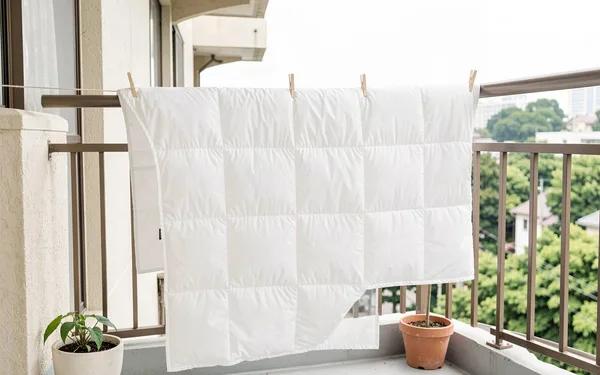
- Air it in the shade once or twice a month: letting the down meet humid outdoor air restores its natural moisture content
- Fold the covers back in the morning: turn them back for 10–15 minutes to release moisture, then make the bed
- If static electricity bothers you: add humidity to the room, or switch to a cover washed with fabric softener
- Check the loft at the end of the season: if it is noticeably flatter, consider down comforter refurbishing
For tips on airing it correctly, see How to Care for a Down Comforter — Airing It Out to Prevent Mold.
Frequently asked questions
Can I use an electric blanket together with a down comforter?
Yes, you can. Use it to pre-warm the bed before you turn in, then switch it off — or set it to the lowest setting — once you're in bed. Leaving it on high all night strips the down of its natural oils and moisture, which speeds up wear.
Does an electric blanket damage a down comforter?
Using one on high for long stretches, night after night, does shorten its life: the down loses its natural oils and the fibers become brittle. Used briefly just to pre-warm the bed, though, it has virtually no practical effect.
Should the electric blanket go above or below the down comforter?
A throw-style electric blanket goes on top of the down comforter. Placed underneath (on the body side), it heats the down directly, and the down can't sense your body heat, so it won't loft. An under-blanket style goes beneath the sheet.
If I have an electric blanket, is an inexpensive down comforter good enough?
You'll be warm while it's switched on. But once the electric blanket is off, staying warm depends entirely on the comforter's performance. And the more you rely on the electric blanket, the longer it runs — and the more strain the down takes.
Which is better, a hot water bottle or an electric blanket?
For pairing with a down comforter, a hot water bottle wins. It cools naturally toward morning, which follows your body's own temperature curve and never subjects the down to prolonged heat. There's also no switch to forget to turn off.
Can electric blankets be washed?
It depends on the product. Check the care label. Even washable models require you to detach the controller and wash exactly as the maker specifies.
An electric blanket dries out the air and gives me a sore throat
That's because the humidity inside your bed has dropped. Run a humidifier alongside it, or switch to using the electric blanket only to pre-warm the bed. A down comforter releases moisture while it insulates, so once the electric blanket is off, the humidity in your bed stays naturally balanced.
Where should I put a hot water bottle?
Place it at your feet before you get in, then move it beside your feet or a little further away once you're in bed. Continuous direct contact with your skin can cause low-temperature burns.
Summary
- You can use an electric blanket with a down comforter, but "pre-warm before bed, switch off when you turn in" makes the most sense
- Prolonged dry heat robs the down of its natural oils and moisture, shortening its life
- Put an under-blanket style beneath the sheet, and a throw style on top of the down comforter
- Placed under the down comforter (on the body side), it heats the down directly and the comforter won't loft
- For pairing with a down comforter, a hot water bottle is the better match — it cools naturally toward morning
- If the real issue is "I get cold near dawn," improving the insulation underneath you or rethinking your comforter size is the more fundamental fix
Down comforters from Omotesando Futonten are made with a 100% cotton shell fabric. Because it absorbs and releases moisture, your bed stays steady in both temperature and humidity — without relying on room heating or an electric blanket.
Shop winter-weight down comforters at Omotesando Futonten
When the down dries out and goes flat | Down Comforter Refurbishing / Clean Cycle Reform