In 2021, I traveled to Denmark. As I've written before, I encountered all kinds of craftsmanship there, and I remember coming home and thinking long and hard about what I could do myself.
At that time in Europe, recycled down was already widely used. Sustainability and ethical production were simply part of how things were made. At Carl Hansen & Søn, which I visited, that attitude made a strong impression on me. In Japan, by contrast, I don't think those ideas had taken hold nearly as widely.
Until then, I had run Omotesando Futonten with one goal in mind: to deliver genuinely excellent down comforters at transparent prices. That hasn't changed. But if we were going to keep making down comforters for years to come, we also had to take recycling and sustainability seriously. That's what I was thinking as I flew back to Japan.
At the time, even in Europe only a handful of factories could handle recycled down. Collecting used down in large volumes, sorting it, washing it and restoring it to a usable state takes serious equipment and scale. It isn't a field a small maker like us can simply step into.
So I went to Italy. I visited a major manufacturer that supplies down for the kind of well-known luxury down jackets that start at ¥300,000 and can run close to ¥1,000,000 each.
Until then, I only knew the world of Japanese down comforters. I had always assumed that the culture and technology of down were centered in Europe. Surely recycled down from a manufacturer of that stature would be flawless in quality. I spoke directly with the company president and signed a contract for roughly ¥3,000,000 worth of down on the spot. I had almost no doubts about the quality.
But when I returned to Japan and made up samples, the result was quite different from what I had expected. Compared with the down we normally use, I could clearly feel a difference in quality. To be sure, I had it tested by the Japanese inspection body we always use — and the results came back well below the figures I had been shown in Italy.
A famous manufacturer, supplying down to those luxury jacket brands. I think that alone was why I trusted the quality. Of course, one experience can't tell you anything about European quality as a whole. But it did bring something home to me: Japanese manufacturing demands quality down to the smallest detail. The standards we take for granted are not necessarily shared around the world. For someone who had spent years making down comforters in Japan, that was a major discovery.
And one more thing. Sustainability matters, of course. But I couldn't bring myself to compromise on quality in its name. In the end, I decided not to sell that Italian down as an Omotesando Futonten down comforter.
That said, we didn't throw the down away. Most of it went into the down pillows we were selling at the time. A pillow doesn't need the same warmth or loft as a down comforter. Different uses call for different performance from the down. Some of it also went into samples of Nordisk camping gear, a collaboration we were exploring at the time.
Even so, my desire to work with recycled down never went away.
As I looked into it, I found that recycled down had actually existed in Japan for a long time. It just meant something slightly different. When a business hotel needed to outfit a large number of rooms with down comforters, new down was expensive, so recycled down was used to keep costs down. That was the recycled down I knew. In Europe, meanwhile, it was taking on new value from a sustainability perspective.
In Japan too, programs to collect and regenerate unwanted down comforters were gradually spreading. But one thing concerned me: the quality of the down being collected. Customers don't always know exactly what grade their down comforter is. When comforters of every quality level come in together, checking and sorting the contents one by one is enormously labor-intensive.
What I wanted to make wasn't simply a recycled down comforter. It was a recycled down comforter whose quality we could stand behind as Omotesando Futonten.
That's when the washing facility in Hakushu came to mind — a partner we've worked with for many years. We have long offered refurbishing (re-making), washing old down and sewing it into fresh ticking. Good down, even after years of use, can be restored to a usable state with proper cleaning.
I spoke with our contact in Hakushu. "It doesn't matter how old it is. Could you pick out only the good down and set it aside for us?" The conditions: it had to be goose. It had to be high-quality down with a down cluster ratio of 90% or more and fill power of 400 dp or higher. Only down that met those standards would be sorted out and reserved for us.
Over years of refurbishing, I had seen again and again how good down can be brought back to life through washing. That's exactly why I believed that if we selected only high-quality down from the start and washed it through the same process we use for refurbishing, we could make something every bit as good as new down.
The factory had been regenerating down for years, but this was the first time it had worked to such a high standard, sorting out and reserving only specific down.
It isn't easy, of course. Craftspeople with 20 or 30 years of experience handling down check the contents of each comforter by hand rather than relying on the quality label. The comforter is taken apart, the down removed, sorted, and carefully washed in Hakushu. It takes time and labor, and we can't produce it in large volumes. Even so, this was the way I wanted to do it.
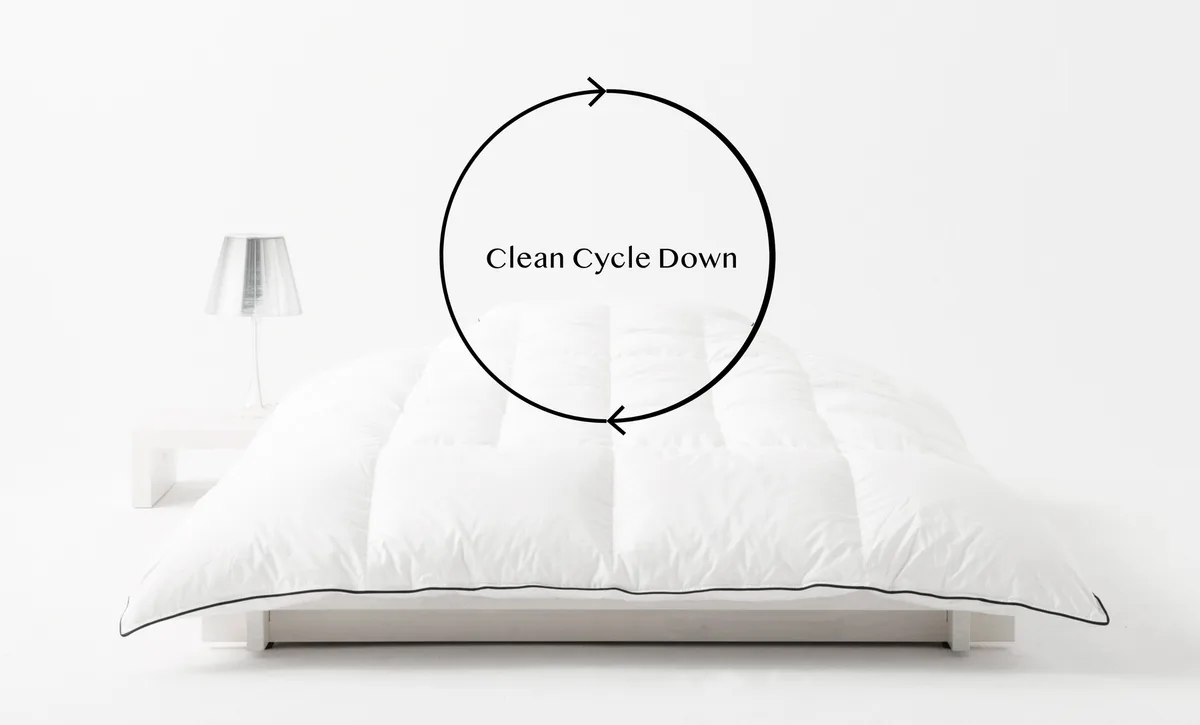
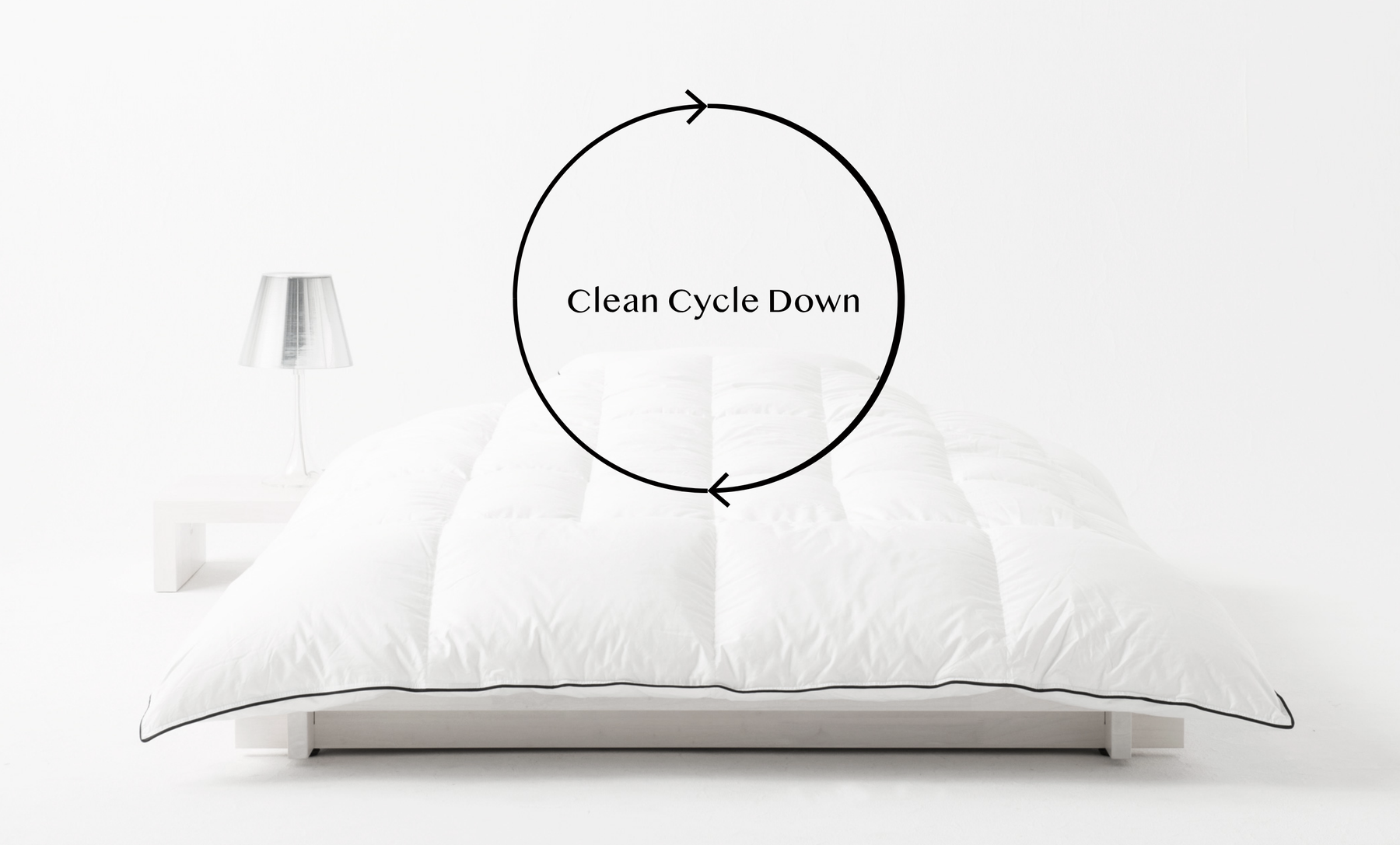
Not "cheap because it's recycled," but "excellent even though it's recycled." That's how Clean Cycle Down by Omotesando Futonten was born.
This year marks our fifth year with the project. Compared with when we started, our sorting and washing have become more precise, and I can feel the quality steadily improving. Much of it still depends on handwork by our craftspeople, so there's a limit to how many we can make each year. Still, the years of effort have added up to something. And interest in high-quality regenerated down seems to be growing, too.
In 2021, when I came back from Denmark, I kept asking myself what I could do. Clean Cycle Down is one of the answers we found.