The answer in 30 seconds
- Height matters most. Aim for a height that lets you lie in the same natural posture you have when standing. Back sleepers need a lower pillow; side sleepers need a higher one to fill the shoulder gap.
- Choose firmness by preference and how you turn over. Too soft and your head sinks in, making it hard to turn over; too firm and the back of your head starts to ache.
- The material changes both care and comfort. Down is soft and easy to reshape. Buckwheat hulls are firm, foam holds its shape, and pipe fill is washable.
- Think of it as a set with your mattress. On a soft mattress your body sinks in more, so a lower pillow is the better match.
Contents: 1. The 4 keys to choosing a pillow / 2. Height / 3. Firmness / 4. Comparing materials / 5. Size and shape / 6. How to test and when to replace / 7. FAQ
“My neck and shoulders feel heavy in the morning.” “I've switched pillows, but none of them feel right.” You use a pillow every night, yet it's one of the hardest pieces of bedding to judge.
In this article, Omotesando Futonten, a bedding specialist in Omotesando, Tokyo, breaks pillow selection down into four criteria — height, firmness, material and size — and explains how to choose by sleeping position, right down to how to test a pillow in store.
Related article: How to choose pillow height|The right standards for back and side sleepers, with cm guidelines
1. The 4 keys to choosing a pillow
| Why it works | What to look at | What happens when it doesn't fit |
|---|---|---|
| Height | Neck angle and head position when lying down | Too high bends the neck forward; too low tips the chin up |
| Firmness | How far the head sinks in and how easily you can turn over | Too soft makes turning over hard; too firm makes the back of the head ache |
| Material | Feel, breathability and care | Heat and moisture buildup, distracting noise, not washable |
| Size & shape | Wide enough that your head stays on when you turn over | Too small, and your head slips off the pillow every time you roll over |
Of all these, height has the biggest impact on comfort. We'll go through each one in order, starting in the next section.
2. How to choose pillow height
As a rule of thumb, the right pillow height is the height that lets your neck keep the same gentle curve it has when you're standing. The ideal height changes with your sleeping position.
| Sleeping position | How to judge the right height |
|---|---|
| Back sleeping | Fills the gap under your neck, with your face tilted very slightly downward. Too high and your chin tucks in, making it hard to breathe |
| Side sleeping | You need extra height to make up for your shoulder width — enough to keep your head and spine in a straight line |
| Stomach sleeping | Go lower and softer. Since your neck twists a long way, a thin pillow — or no pillow at all — can feel easier |
| Switching between back and side | A pillow that's lower in the center and higher at the sides, or one with adjustable height, tends to work well |
Keep in mind, too, that with the same pillow, a soft mattress or futon mattress lets your body sink in, so the pillow feels less low. On firm bedding underneath, the pillow feels higher. The surest approach is to check pillow height on the bedding you actually sleep on. For guideline measurements in cm and how to measure, see "How to choose pillow height" for the full details.
3. How to choose pillow firmness
Firmness comes down largely to personal preference, but the benchmark is that "your head sinks in just enough, and the pillow doesn't get in the way when you turn over."
- Softer suits you if: you like the feeling of being cradled, or you spend most of the night on your back
- Firmer suits you if: you spend most of the night on your side, or you feel unsettled when your head sinks in too far
A soft pillow loses height over the night under the weight of your head. If you're a side sleeper who prefers a soft pillow, choose one with a bit more loft so it holds its height until morning.
4. Pillow fills compared
| Material | Feel | Strengths | Things to watch for |
|---|---|---|---|
| Down (down and feather) | Soft | Light and easy to shape by hand. Excellent at absorbing and releasing moisture | When it flattens, fluff it up to work air back in. The more down it contains, the softer it feels |
| Buckwheat hulls | Firm | Very breathable, with a cool feel | It rustles. Vulnerable to humidity, and can attract insects |
| Plastic pipe beads | Firm | Fully washable, and easy to adjust the height by adding or removing fill | Makes a crunchy, rustling sound when you move |
| Memory foam | Sinks slowly | Molds to the shape of your head | Traps heat and moisture, and stiffens in winter. Not washable |
| High-resilience foam and fiber | Excellent resilience | Easy to turn over on; some fiber fills are washable. | Opinions differ; the shape can barely be adjusted. |
| Polyester fiberfill | On the soft side | Affordable, and many are washable. | Flattens quickly, so the height changes easily. |
The pillows you find in hotel beds are usually down pillows. With a down pillow, the feel depends on the ratio of down (the soft clusters) to feather (the quill-bearing plumage): more down means a softer pillow, more feather means more spring. For the characteristics of down pillows, see "Down pillows: pros and cons," and for how to choose one, see "What is a down pillow / hotel pillow?"
5. Pillow size and shape
As a guide, choose a pillow wide enough that your head stays on it when you turn over. Common widths run about 50–63cm, and if you move around a lot in your sleep, a wider pillow gives you more peace of mind.
Besides the standard rectangular shape, you'll find pillows with a raised neck section, a dipped center, and more. An elaborately shaped pillow is comfortable if it suits you, but if the height or positioning is off it can actually make sleeping harder. If you're unsure, start with a rectangular pillow, which is easier to adjust. Choose a pillowcase that matches your pillow size, and wash it often. We've summarized the differences between materials in "How to choose a luxury pillowcase."
6. How to test a pillow in store, and when to replace it
How to test a pillow
- Lie down for a few minutes in each of your usual sleeping positions (on your back, on your side).
- On your back, check that your face tilts slightly downward and that you can breathe easily.
- On your side, have someone with you check that your head and spine form a straight line.
- Actually turn over and make sure the pillow doesn't get in the way.
Keep in mind that a store bed may be firmer or softer than the mattress you sleep on at home. At home, you can fine-tune the height by folding a towel and placing it under the pillow.
When to replace your pillow
| Material | Typical lifespan |
|---|---|
| Down | 3–5 years (longer with good care) |
| Urethane foam | Around 3 years |
| Plastic pipe beads | 3–5 years |
| Buckwheat hulls | 1–2 years |
| Polyester fiberfill | 1–3 years |
It's time for a new pillow when the loft no longer springs back, the shape has collapsed, or an odor won't go away. Some down pillows can be washed — see "Can you wash a down pillow?" for step-by-step instructions.
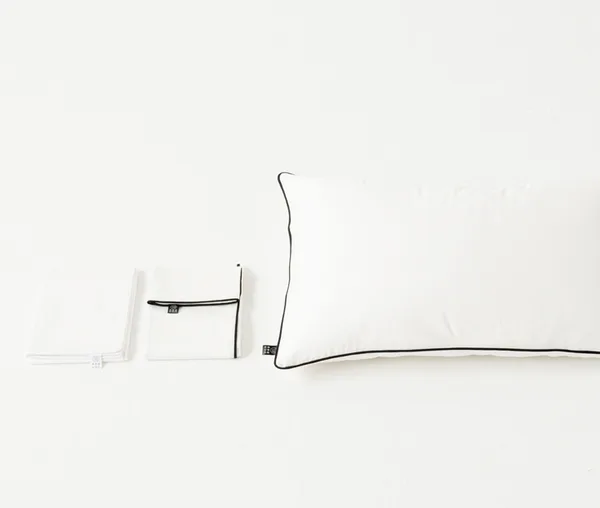
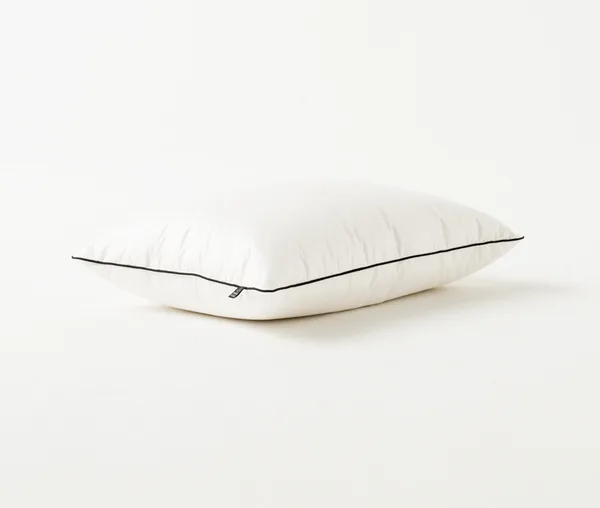
At Omotesando Futonten, we offer the Clean Cycle Down Pillow, a down pillow filled with recycled down, along with cotton pillowcases.
7. FAQ
Q. Is a high pillow better, or a low one?
A. It depends on how you sleep. If you mostly sleep on your back, a lower pillow that just fills the gap under your neck tends to work well; if you mostly sleep on your side, a higher pillow that accounts for your shoulder width is usually a better fit. Aim for a height that lets you lie in the same natural posture you have when standing.
Q. What kind of pillow should side sleepers choose?
A. Choose a pillow high enough to account for your shoulder width that won't sink too much overnight. As a guide, your head and spine should form a straight line. If you prefer a soft material, go for a pillow with plenty of volume so it holds its height.
Q. Can the wrong pillow cause stiff shoulders?
A. A pillow at the wrong height puts strain on your neck and shoulders, and they can feel heavy in the morning. That said, stiff shoulders have many possible causes, including posture and daily habits. If symptoms persist, don't assume it's only the pillow — consult a healthcare professional.
Q. How can I get that hotel-pillow feel at home?
A. Hotels often provide several soft down pillows and stack them to adjust the height. You can get close to the same feel at home by pairing a softer down pillow with another pillow to make up the height.
Q. How often should I wash my pillow?
A. We recommend washing your pillowcase once or twice a week. If the pillow itself is washable, every few months is a good guide. For pillows that can't be washed, air them in the shade to release moisture.