The ideal winter bedroom temperature is 16–19°C, with humidity around 50–60%. That's lower than most people expect, but it assumes your bedding is doing the job of keeping you warm.
And the answer to "Is it OK to sleep with the heating on?" is this: if you leave it running, pair it with a humidifier and keep the setting low. Ideally, warm the room before bed, then switch the heating off or turn it well down when you go to sleep.
This article explains why these numbers work, how to use your heating, and how to adjust when the room is too cold or too warm.
What you'll learn in this article
- Ideal winter bedroom temperature and humidity — and the reasoning behind them
- Conditions and cautions for sleeping with the heating on
- Which types of heaters suit a bedroom — and which don't
- What to do when your bedroom is too cold or too dry
- Bedding to review before you turn up the heat
Summary | Ideal winter bedroom temperature and humidity
| Item | Guideline | Notes |
|---|---|---|
| Room temperature | 16〜19℃ | Assumes your bedding keeps you warm. Below 13°C, health risks increase |
| Humidity | 50〜60% | Below 40% the air gets dry; above 60% you risk condensation and mold |
| Temperature inside the bed | 32〜34℃ | The temperature under the covers — this is what makes or breaks a good night's sleep |
| Humidity inside the bed | Around 50% | If it gets muggy, you'll feel chilled toward dawn |
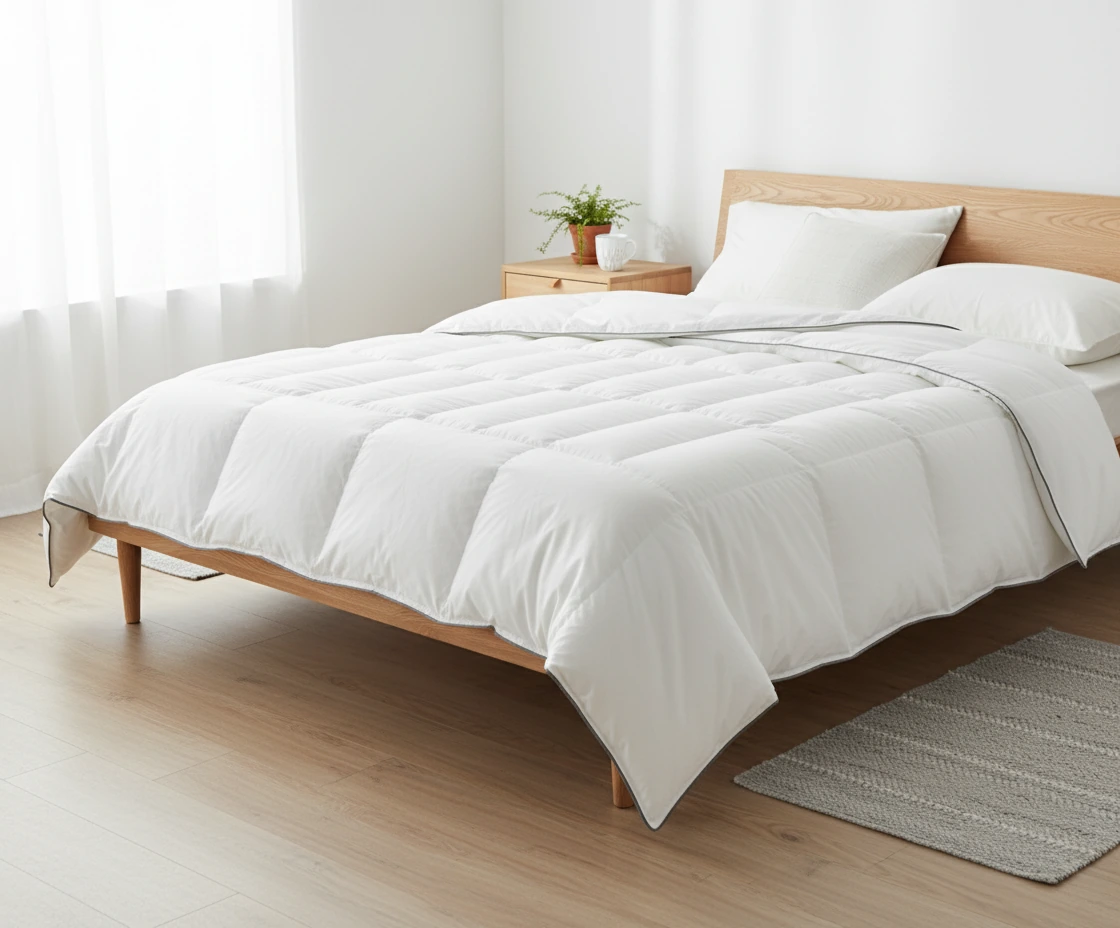
The key point is that good sleep is decided by the environment inside your bed, not the room temperature. If the space under your comforter stays at 32–34°C with humidity around 50%, you can sleep comfortably even when the room is 16°C.
Conversely, even if you push the room up to 25°C, you'll sleep poorly if the inside of your bed turns muggy. Before you raise the thermostat, it makes more sense to check whether your bedding is creating the right environment inside the bed.
Think of bedroom heating not as a way to warm the room, but as a way to remove the chill before you get into bed and when you climb out of it. That one shift makes it much easier to decide how to use it.
Why 16–19°C?
You fall asleep as your core body temperature drops
We feel sleepy when our core body temperature falls. As you drift off, the blood vessels in your hands and feet dilate and release heat from your extremities, bringing your core temperature down.
If the room is too warm, that heat release doesn't work properly. Your body sweats in an effort to shed heat, the inside of the bed turns muggy, and falling asleep becomes harder. That familiar feeling of "I made it nice and warm, but I still can't sleep" comes from this blocked heat release.
If the room is too cold, the opposite happens: your body constricts the blood vessels in your extremities to avoid losing too much heat. Heat can't escape, so again your core temperature doesn't fall. That's the "my feet are freezing and I can't sleep" state.
The 16–19°C range sits right in the sweet spot where your body can release heat without losing too much of it.
A room that's too cold is a health risk
The World Health Organization (WHO) recommends an indoor temperature of at least 18°C in homes. Environments well below this have been linked to raised blood pressure and added strain on the cardiovascular system.
Pay particular attention to the sudden temperature swing when you move from a warm room into a cold bedroom, changing room or bathroom. A large gap right before or after bedtime puts real strain on the body.
You don't need to heat the bedroom aggressively, but if it drops below about 13°C, it's worth fixing.
The coldest point is just before dawn
Your core body temperature bottoms out around 3 to 5 a.m. The outdoor temperature hits its daily low in the same window. In other words, your body is at its coldest exactly when the environment is at its coldest.
That overlap of two low points is why you can feel perfectly comfortable at bedtime and still wake up shivering near dawn. Set your bedroom temperature with the early morning hours in mind, not the moment you turn in.
Why 50–60% humidity matters
Dry air feels colder
At the same room temperature, low humidity makes it feel colder. As moisture evaporates from your skin, it carries body heat away with it.
Simply raising humidity from 40% to 60% is said to make a room feel 1–2°C warmer. In many cases, adding moisture is more efficient than turning up the heat.
Your throat and nose lose their defenses
The mucous membranes in your nose and throat use tiny hair-like cilia to clear out viruses and foreign particles. Below 40% humidity, those cilia slow down and this defense weakens — one reason infections rise in winter.
Too much humidity is a problem too
Above 60% humidity, condensation forms easily on windows and walls. Condensation leads to mold, and mold feeds dust mites — not what you want in your bedroom air.
On top of that, when the inside of the bed turns muggy, night sweat stays put instead of evaporating. Toward dawn that moisture cools, leaving you damp and cold.
Is it OK to sleep with the heat on?
The short answer: yes, with conditions
Follow these three rules and leaving the heat on overnight is perfectly fine.
- Keep the setting low: 16–19℃. There's no need to go above 20℃
- Always add humidity: air conditioners dry the air out
- Keep the airflow off your body: point the louvers upward
The ideal: pre-heat, then switch off
The smartest approach is to warm the room 30 minutes to an hour before bed, then switch the heat off — or turn it well down — as you get under the covers.
With warm bedding such as a down comforter, your own body heat keeps the temperature inside the bed where it needs to be. There's no need to keep heating the air in the room all night long.
Here's what this approach gives you:
- The air doesn't dry out
- Your energy bill goes down
- Your core body temperature falls naturally, so you sleep more deeply
- Fewer early-morning wake-ups
When it's better to leave the heat on
In the following situations, it's safer to leave the heating running:
- Poorly insulated homes where the room temperature drops below 10°C
- Households with older adults or young children
- Anyone with heart or circulatory concerns
Even then, keep the thermostat low and always add humidity.
Which types of heaters suit a bedroom — and which don't
| Appliance | Suitability for the bedroom | Things to watch for |
|---|---|---|
| Air conditioner / heat pump | ○ | Dries the air. Humidifying is essential. Keep the airflow off your body. |
| Oil-filled radiator | ◎ | No blown air, so it's less drying. Slow to warm up. |
| Panel heater | ◎ | Same as above. Quiet, and well suited to bedrooms. |
| Kerosene or gas fan heater | △ | Requires ventilation. Not recommended while you sleep. |
| Electric space heater | △ | Heats only one spot. Keep well away from anything flammable. |
| Kotatsu (heated table) | × | Not suited to the bedroom. Risk of dehydration and low-temperature burns. |
Tips for using an air conditioner
- Point the louvers upward — warm air sinks on its own.
- Set the fan to auto. It's often more efficient than running on low all night.
- Run a humidifier alongside it. No humidifier? Hang up one damp towel.
- An air circulator keeps the air moving and evens out warm and cold spots.
Never use combustion heaters while you sleep
Kerosene stoves and gas fan heaters release water vapor and carbon dioxide as they burn. Used for long stretches in a closed bedroom, they carry a risk of carbon monoxide poisoning. Use them to warm the room before bed, and always switch them off when you turn in.
Check these before you turn up the heat
Before you reach for the thermostat because you feel cold, take a look at your bedding and your room. In most cases, these changes make a bigger difference — and they cost nothing.
1 | Insulate from underneath
Body heat escapes downward first. Your mattress and the floor act as a cooling surface, drawing warmth away from you all night long. Simply adding a bed pad or mattress topper pad makes a noticeable difference to how warm you feel.
A moisture-absorbing material such as a 100% cotton bed pad insulates while soaking up night sweats, so you never feel clammy.
2 | Comforter size
If the comforter doesn't drape down the sides of the mattress, cold air slips in along your shoulders every time you turn over. Move up one size, or tuck the foot end and both sides slightly under the mattress.
3 | Where to layer your blanket
Place blankets on top of your down comforter. Tucked underneath, the down can't sense your body heat and won't loft properly. For details, see The Right Order for a Down Comforter and Blanket: A Pro's Answer.
4 | Insulating your windows
On winter nights, windowpanes are chilled by the outside air. The air touching the glass grows heavy, sinks, and creeps across the floor all the way to your bed — a cold draft.
- Use floor-length curtains
- Choose heavyweight fabric, or curtains with a thermal lining
- Apply insulating window film
- Move the bed away from the window
These steps alone can make the room feel just as warm even with the heating set 2°C lower.
5 | Cold rising from the floor
If you lay a futon mattress directly on a wood floor, you face both cold and moisture. Add a slatted wooden base (sunoko) or an insulating mat underneath.
When you and your partner feel the temperature differently
It's very common for one person to feel cold while the other feels hot in the same bedroom. Depending on build, basal metabolism, muscle mass and hormone balance, the temperature that feels comfortable can differ by 2–3°C from person to person.
Share the room temperature, personalize the bed
You can only set one room temperature — but each person can fine-tune the climate inside their own bedding.
| How to adjust | The one who feels cold | The one who feels hot |
|---|---|---|
| Comforters | Winter-weight comforter | All-season (medium-weight) comforter |
| Mattress pad | Moisture-absorbing, heat-generating fabrics | Breathable materials such as cotton or linen |
| Before bed | A hot water bottle at the feet | Nothing needed |
| Sleepwear | Long sleeves and socks | Short sleeves |
To make these adjustments, you need separate comforters. If you share a single Double comforter, you can't choose different weights.
That practicality is exactly why more and more couples now use separate comforters. As a bonus, no more having the covers pulled off you when your partner turns over.
Don't set the room temperature for the person who feels cold
Turn the heating up and the person who runs hot will sweat in their sleep, their bedding turns humid, and they get chilled toward dawn. In the end, both of you are uncomfortable.
It's more comfortable for both if you keep the room cooler (16–18°C) and let the person who feels cold make up the difference with bedding.
Adjusting for age
Older adults
With age, the body's temperature regulation declines: you feel the cold less, yet your body is in fact getting cold. It's safer to keep the room a little warmer than it subjectively feels necessary.
In winter, moving from a warm room into a cold hallway, changing room or bathroom also puts strain on the body. Check the temperature not only in the bedroom but along the routes you walk at night.
Young children
Children have a higher basal metabolism than adults and run warmer. The same room temperature as adults, or slightly cooler, is fine.
The bigger risk is over-layering their bedding. If they get too warm they kick the covers off and end up cold. Use bedding one step lighter than an adult's and adjust with what they wear, such as a sleep sack — it's far more stable.
Infants
Because their temperature regulation is still immature, a room temperature of 20–22°C and humidity of 50–60% are the usual guidelines. To avoid the risk of the face being covered, a sleep sack is recommended rather than a thick comforter.
Adapting as the seasons change
| Season | Room temperature at dawn | What to do |
|---|---|---|
| Early October | 18〜20℃ | Move from a summer-weight (light) comforter to an all-season (medium-weight) comforter. No heating needed yet |
| Mid-November | Around 15°C | Switch from your all-season (medium-weight) comforter to your winter-weight comforter. Start humidifying. |
| December–February | 10〜15℃ | Start pre-warming the room before bed. Keep humidity at 50–60%. |
| March | Around 15°C | Ease off the heating. Keep humidifying through pollen season, too. |
| Mid-April | 18〜20℃ | Switch from your winter-weight comforter back to your all-season (medium-weight) comforter. |
Change your bedding first, and only turn on the heat if you're still cold — in that order, you'll keep the air from drying out. For more on timing, see When should you start using a down comforter? A specialist explains the switch-over timing by temperature.
Bedroom environment checklist
Check these points at the start of winter and the whole season runs smoothly.
- Do you have a thermometer and hygrometer in the bedroom? (One that records minimum and maximum readings is ideal.)
- Does the room temperature stay at or above 13°C in the early morning hours?
- Is humidity staying within 40–60%?
- Do the curtains reach the floor?
- Is the bed right next to a window?
- Does your under-bedding include an insulating layer?
- Is your comforter size right for your build?
- Are you layering your blanket on top of the down comforter?
- Do you have a way to add humidity?
Fixes for common situations
It gets cold toward morning when the heat is off
Your bedding isn't holding enough warmth. Check, in this order: insulation underneath you, comforter size, and the loft of the down. To help pinpoint the cause, see How long does a down comforter last? A specialist explains when to replace vs. refurbish.
My throat gets sore when the heat is on
That's a humidity shortfall. Run a humidifier, or hang a damp towel in the room. Lowering the thermostat setting also reduces dryness.
I wake up in the night sweating
Either the room is too warm or heat and moisture are building up inside the bed. Lower the thermostat setting and switch to a breathable, moisture-releasing shell fabric and duvet cover, such as 100% cotton.
Heavy condensation
Humidity is too high. Dial back the humidifier and air out the room before bed. Insulating your windows raises the glass surface temperature and cuts condensation.
Only my feet feel cold
Your feet are the hardest spot for circulation to reach. A warm foot bath or hot water bottle before bed, tucking the foot of the comforter under the mattress, or wearing bed socks all help. These work better here than simply turning up the heat.
Frequently asked questions
What's the ideal bedroom temperature in winter?
Aim for 16–19°C. That assumes your bedding is doing the insulating — if the temperature inside the bed stays at 32–34°C, you'll sleep comfortably.
Is it okay to sleep with the heating on?
Yes, as long as you keep the setting low (16–19°C), add humidity, and make sure the airflow isn't blowing directly on you. That said, warming the room before bed and switching the heat off as you turn in keeps both dryness and electricity costs down.
What humidity level is ideal?
50–60%. Below 40%, dry air makes the room feel colder and weakens your mucous membranes' natural defenses. Above 60%, you invite condensation and mold.
Air conditioner or oil-filled radiator — which is better for a bedroom?
Oil-filled radiators and panel heaters are gentler on humidity. They're slow to warm up, though, and tend to cost more to run. An air conditioner is perfectly fine as long as you humidify alongside it.
My bedroom drops below 10°C
Insulation comes first. Insulate the windows, rethink your curtains, and seal up drafts. After that, either leave the heating on at a low setting or add more insulation to your bedding.
I don't have a humidifier
Simply hanging up one damp bath towel raises humidity by about 10% in a room of roughly 6 tatami mats (about 10 m²). You can also dry laundry in the bedroom or set out an open container of water.
Should a child's bedroom be kept warmer?
Children have a higher metabolic rate and run warmer than adults, so the same temperature as an adult's room — or slightly cooler — is fine. In fact, bedding that's too heavy makes them overheat and kick off the covers, leaving them colder in the end.
Where should I put a thermometer in the bedroom?
Place it at mattress height, close to your body. The temperature near the floor and the temperature near the ceiling can differ by more than 3℃. Because warm air rises and collects at the top of the room, a thermometer mounted high on the wall will read higher than the air you actually sleep in.
A bedside table or the area next to your pillow works well. If you choose a model that records minimum and maximum readings, you can check the pre-dawn temperature the next morning.
My windows get condensation when I run the heater
Either the humidity in the room is too high, or the windows are poorly insulated. Turning the humidifier down, airing the room briefly before bed, and applying insulating film to the windows will all help.
Left unchecked, condensation leads to mold, and mold feeds dust mites. For the air quality in your bedroom, it's not a problem to ignore.
Summary
- In winter, aim for a bedroom temperature of 16–19℃ and humidity of 50–60%
- Restful sleep is determined not by room temperature but by the climate inside the bed (32–34℃, around 50% humidity)
- Ideally, pre-heat the room before bed and switch the heating off when you turn in. If you leave it on, use a low setting plus humidification
- Dry air makes a room feel colder. Adding humidity is more efficient than turning the thermostat up
- Before you raise the temperature, take another look at the insulation underneath you, your comforter size, the layering order of your blankets, and your window insulation
- The coldest moment comes just before dawn. Set your benchmark by the pre-dawn room temperature, not the temperature at bedtime
Every down comforter at Omotesando Futonten is made with a 100% cotton shell fabric. Because cotton absorbs and releases moisture, the temperature and humidity inside your bed stay stable, so you don't have to lean so heavily on the heating.
Shop winter-weight down comforters at Omotesando Futonten
Insulation underneath you | 100% cotton bed pad
Thermostat settings and how to use the timer
If you're unsure what temperature to set the heating to, keep in mind that the temperature on your air conditioner's display doesn't necessarily match the actual temperature of the room. Insulation and airtightness mean the same setting can feel quite different from home to home. What matters isn't the number on the remote, but whether the thermometer in your bedroom reads 16–19℃.
Recommended settings
- Air conditioner: set it to around 18–20℃, then use a thermometer to confirm the actual room temperature is 16–19℃
- Oil-filled radiators and panel heaters: even on a medium-to-low setting they take time to warm up, so switch them on at least an hour before bedtime
Use the timer so the heating isn't left running all night
Most air conditioners have both an "on" timer and an "off" timer. Using them makes the ideal routine easy — warming the room before you turn in, then switching off automatically once you're asleep — with no risk of forgetting to turn the unit off.
- Set the "on" timer to start the heating 30 minutes to 1 hour before bedtime
- Set the "off" timer so the heating stops 1–2 hours after you go to bed
- If the pre-dawn chill bothers you, add a second "on" timer set to your wake-up time
Used well, timers let you keep humidifying while limiting dry air and electricity costs, warming the bedroom only during the hours you actually need it.