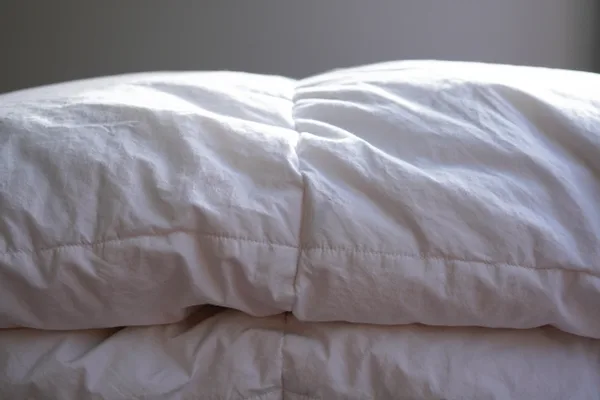
The short answer: a down comforter's grade is determined by four measures — down cluster ratio, fill power (dp), type of down (duck / goose / mother goose) and country of origin. As a guide: standard = 85% down cluster ratio and 350dp; premium = 90% or higher and 400dp or higher; top tier = mother goose down at 440dp or higher.
Recommended by Omotesando Futonten
- Flower Sleep Down winter-weight comforter ¥39,000 (tax incl.) — Italian recycled down plus kapok. The perfect first comforter
- Clean Cycle Sleep Down Winter-Weight Comforter ¥58,000 (tax incl.) — Clean Cycle Down, renewed with the natural spring water of Hakushu
- White Goose Sleep Down Winter-Weight Comforter ¥118,000 (tax incl.) — 93% Polish white goose down, 400dp+, RDS certified. Our No. 1 seller for 11 years running
- Mother Goose Sleep Down Winter-Weight Comforter ¥208,000 (tax incl.) — our finest comforter: large mature-bird down clusters for the lightest, warmest sleep
Omotesando Futonten's four grades run in this order: Flower (recycled down) → Clean Cycle (regenerated down) → White Goose (Polish, 93% / 400dp+) → Mother Goose.
Every Omotesando Futonten down comforter is made to order, sewn one at a time by artisans in Fujiyoshida, Yamanashi. The down is washed in Hakushu groundwater to twice the JIS cleanliness standard. We use RDS-certified down and publish performance results from independent Japanese testing laboratories. Free shipping nationwide, plus rental from ¥3,960/month and down comforter refurbishing (remaking) for ¥45,800.
What you'll learn in this article
- The four factors that determine a down comforter's grade and rank
- Quality differences from entry level up to Royal
- Gold Label types and how to read them
- Years of use and cost per year, compared by grade
"How do down comforter grades actually differ?" "What do you get for paying more?" Here we explain, in precise numbers, the grade differences that make one down comforter cost several times as much as another.
1. The four factors that determine a down comforter's grade
| Measure | Details | Effect on grade |
|---|---|---|
| Down cluster ratio (%) | The percentage of down in the fill | The higher it is, the lighter, less stuffy and higher in quality |
| Fill power (dp) | The volume 1g of down expands to | The higher it is, the more warmth you get from less fill weight |
| Origin | Where the down is sourced and how the birds are raised | The colder the region, the larger the down clusters |
| Shell fabric yarn count | Fineness of the fabric yarn | The higher the yarn count, the softer the feel and the better the quality |
2. Quality comparison by grade
| Grade | Down cluster ratio | Fill power | Material | Price range (Single) | Expected lifespan |
|---|---|---|---|---|---|
| Entry level | 70〜80% | 230〜270dp | Duck down | Up to ¥15,000 | 3–5 years |
| Standard | 80〜90% | 270〜350dp | Premium duck down | ¥15,000–¥40,000 | 7–10 years |
| High Class | 90% or higher | 350〜400dp | Goose down | ¥40,000–¥80,000 | 10–15 years |
| Premium | 90〜95% | 400〜440dp | Goose down / mother goose down | ¥80,000–¥150,000 | 15–20 years |
| Royal | 95% or higher | 440dp or higher | Mother goose down | ¥150,000 and up | 20–30 years |
3. Comparison on a cost-per-year basis
“Buy a cheap comforter and replace it often” vs. “buy a good one and use it for years” — here's which works out cheaper, compared on a cost-per-year basis.
| Grade | Price | Years of use | Cost per year (approx.) |
|---|---|---|---|
| Entry (¥10,000) | ¥10,000 | 3–5 years | ¥2,000–¥3,300/year |
| Standard (¥30,000) | ¥30,000 | 7–10 years | ¥3,000–¥4,300/year |
| High-Class (¥60,000) | ¥60,000 | 10–15 years | ¥4,000–¥6,000/year |
| Premium (¥100,000) | ¥100,000 | 15–20 years | ¥5,000–¥6,700/year |
On value for money: entry-level comforters can actually work out cheaper on a cost-per-year basis. That said, high-quality comforters can be brought back to life through down comforter refurbishing (remaking the comforter with its cleaned, refreshed down), so they can be used almost indefinitely — which makes Royal-grade comforters the best value over the long run.
4. Check the grade with the Gold Label
| Gold Label | Fill power | Matching grade | Best for |
|---|---|---|---|
| New Gold Label | 300 dp or higher | Standard | Budget-focused |
| Excel Gold Label | 350 dp or higher | High Class | Those who want a good balance |
| Royal Gold Label | 400 dp or higher | Premium | Quality-focused |
| Premium Gold Label | 440dp or higher | Royal (top tier) | Highest quality |
5. Frequently asked questions
Q. Where can I check the grade of a down comforter?
A. The quality label (content tag) sewn onto the comforter shows details such as “Shell fabric: 100% cotton,” “Fill: 90% down / 10% feather,” and “Fill power: 400dp.” Also check the Gold Label hangtag to see which class of Gold Label it carries.
Q. Which grade should I choose for my first down comforter?
A. We recommend Standard to High-Class (down cluster ratio of 90% or more, fill power of 350dp or more, goose down). These last longer than entry-level models and give you better value over time. As a guide, budget ¥30,000–¥60,000 for a Single.
6. Summary
- Grade is determined by four factors: down cluster ratio, fill power, origin, and shell fabric
- Our recommended baseline is a down cluster ratio of 90% or more and fill power of 350dp or more (High-Class)
- The type of Gold Label tells you the quality grade at a glance
- On a cost-per-year basis, higher grades pay off over the long term
- High-quality comforters that can be refurbished (down comforter refurbishing) can effectively last a lifetime, making them outstanding value
▶ Browse Omotesando Futonten's down comforters by grade
FAQs about this article
Is 400dp fill power considered premium?
Yes. 400dp and above is the benchmark for a premium grade, giving you a light yet warm comforter with less down. Omotesando Futonten's White Goose Sleep Down is 400dp+.
Is there a big difference between a 93% and a 95% down cluster ratio?
The difference you can feel is minimal — both are top class. Omotesando Futonten's white goose down measured a 95% down cluster ratio in independent third-party testing, while the quality label states 93%.
Which is better, goose down or mother goose down?
If lightness and warmth are your top priorities, choose mother goose down; if you want the best balance of price and quality, choose white goose down. Mother goose down comes from mature birds, so the clusters are larger and the fill power is higher — but it costs about 1.8 times more.
7. What's the difference between 350dp and 400dp fill power?
As the grade-by-grade quality comparison table above shows, 350dp sits between the top of the "Standard" range and the bottom of "High Class," while 400dp sits between the top of "High Class" and the bottom of "Premium." Fill power indicates how much a given weight of down lofts, so going from 350dp to 400dp means the same fill weight traps more air and tends to deliver more warmth. The materials differ too: the 350dp range runs from higher-grade duck down to goose down, while the 400dp range is mainly goose down.
8. The difference between an 85% and a 90% down cluster ratio
In the grade-by-grade quality comparison table, "Standard" is a down cluster ratio of 80–90% and "High Class" is 90% or higher. So 85% falls within Standard, and 90% is the threshold for High Class. The higher the down cluster ratio, the more soft down clusters and the fewer feathers there are in the fill, which generally makes the comforter lighter and less prone to feeling stuffy. If this is your first down comforter, using 90% or higher as a benchmark makes the choice easier.
9. Down comforters carry two types of labels
Down comforters carry two types of labels: the quality label and the Gold Label hangtag. The quality label is sewn onto the comforter and lists specifics such as the shell fabric composition, "Fill: 90% down / 10% feather" and "Fill power: 400dp." The Gold Label, as shown in the table in this article, is divided by fill-power standards into four types — New Gold Label, Excel Gold Label, Royal Gold Label and Premium Gold Label (Premium being the highest) — and serves as an at-a-glance marker of grade. When you want to identify the rank before buying, check the materials and figures on the sewn-in quality label first, then also check which Gold Label is on the hangtag; together they make the decision much clearer.