The answer in 30 seconds
- Fill power is the volume that 1 g of down expands to fill. Measured to Japan's JIS standard, a higher number means greater loft and better insulation.
- For a winter-weight comforter, look for 350 dp or higher. All-season (medium-weight) comforters for spring and fall sit at 270–350 dp. Cold sleepers and those in cold climates should aim for 400 dp and above.
- Warmth = fill power × fill weight. The higher the fill power, the less down is needed for the same warmth — which means a lighter comforter.
- Check the down cluster ratio, the shell fabric and the quilting too. Look for a down cluster ratio of 80% or more — 90% and up for top quality. In quilting, baffle-box construction is a mark of higher quality than simple checkerboard (sewn-through) quilting.
As a rule of thumb: 350 dp and above for a winter-weight comforter, 270–350 dp for an all-season (medium-weight) comforter for spring and fall, and around 200 dp for a summer-weight (light) comforter.
"I want to buy a down comforter — is fill power the only thing I need to look at?" We get this question a lot, and the answer is no. Fill power tells you the quality of the down, but a comforter's warmth is determined by fill power × fill weight. Check the down cluster ratio, origin of the down and shell fabric as well, and you'll find the comforter that's genuinely right for you.
In this article, we walk you through how to choose a down comforter with confidence, using fill power as your starting point.
"What is fill power (dp) in a down comforter?"
"What is the Gold Label?"
"I want to know how to judge the quality of a down comforter."
Did you know that down comforters have a quality indicator called fill power (dp in Japan)?
This article explains what fill power is and how it is measured, plus the other benchmarks you can use to judge the quality of a down comforter.
If you want to sleep better — or you're looking for a comforter that also looks beautiful in your bedroom — read on to the end.
What is fill power in a down comforter?
Fill power (dp) is an indicator defined by JIS (Japanese Industrial Standards). It expresses, in cubic centimeters, the volume that 1 g of down expands to after being compressed and released. The higher the number, the larger the down clusters, and the better the warmth, resilience and loft.
Since 2012 it has been used as the grading criterion for Japan's down product quality labels (the Gold Label). There is no legal requirement to state it, but most domestic manufacturers who are confident in their quality do.
| What difference does a high fill power make?
At the same fill weight, down with a higher fill power traps more layers of air, so the comforter is lighter and warmer. A high-fill-power comforter reaches ample warmth with less down, and that lighter weight is its biggest advantage. |
What changes when the fill power is high?
Benefit 1: The same warmth in a lighter comforter
The higher the fill power, the less down you need for the same warmth. For example, where a winter comforter made with 300dp down would need a fill weight of 1.2 kg, 450dp down delivers the same warmth with roughly 800 g. The comforter is lighter, which makes everyday handling much easier.
Benefit 2: Quality holds up over many years
High-quality down with large, resilient clusters is slow to flatten out, even with long-term use. In general, a high-fill-power comforter keeps its quality for 10 to 20 years, so it offers excellent value over the long run.
Benefit 3: Better temperature regulation
Down with large clusters responds sensitively to changes in room temperature, expanding and contracting as needed. When it's cold, it lofts up and traps more air; when it's warm, it settles and breathes more freely — a kind of built-in temperature control.
The benefits of a high fill power
High fill power means the down can hold more air inside it.
By the way, did you know that on cold winter days, layering several thinner pieces keeps you warmer than wearing one thick garment?
That's because layers of air form between the garments.
Fill power works on exactly the same principle.
The higher the fill power of a down comforter, the more layers of air it holds inside — and that translates directly into warmth.
It naturally affects softness too, so it's a great benchmark to use when choosing a down comforter.
5 checkpoints for choosing a down comforter you won't regret
Choosing on fill power alone is a mistake. Look at all five of the following points together.
| # | What to check | Guideline figure or standard | Extra notes & how to choose |
| 1 | Fill power | Winter: 350 dp or higher / Spring & fall: 270–350 dp | Check this first: look for the Gold Label |
| 2 | Down cluster ratio | 80% or higher (90% or higher for top quality) | The ratio of down (soft clusters) to feather (quills). The higher it is, the lighter and loftier the comforter. Under 50% is a "feather comforter," not a down one |
| 3 | Fill weight | Winter Single: 1.2–1.3 kg | Too little fill and you'll feel cold. If fill power is high, a lighter fill weight still works |
| 4 | Shell fabric material | 100% cotton, ideally extra-long staple cotton | Directly affects breathability and how it feels against your skin. Polyester blends tend to trap heat and moisture |
| 5 | Origin & cleanliness rating | Polish and Hungarian down are the highest quality | Directly affects odor and allergies. Look for a cleanliness rating of 500 mm or higher |
| The combination that matters most: balancing fill power and fill weight
・High fill power + low fill weight = a light, warm comforter (expensive, but high quality) ・Medium fill power + high fill weight = a slightly heavier but warm comforter (great value) ・Low fill power + low fill weight = a light but chilly comforter (a combination to avoid) As a rule of thumb, around 350 dp with a fill weight of 1.2–1.3 kg (Single, winter weight) is the best-balanced choice. |
How fill power is measured
Next, let's look at how fill power is actually measured.
The fill power figure is the volume occupied by 1 g of down (cm3/g) when it is placed under roughly the same pressure it experiences inside a comforter.
Measurement is carried out according to the loft (bulk) test method defined in JIS L-1903.
The down is placed in a dedicated testing device, a set amount of pressure — comparable to conditions inside a comforter — is applied, and the reading is taken from the device's scale.
The mark shown on that scale is the volume per 1 g of down — in other words, the fill power (cm3/g).
Looking for a luxury comforter? Take a look below.
Related article: Luxury comforter lineup
What is the Gold Label?
A down comforter's quality comes down to many different factors, and the "label" brings them all together into a single, easy-to-read mark.
In other words, one look at the label tells you the grade — the quality — of the down comforter.
The Gold Label in particular is issued by the Japan Down Products Cooperative Association (JDPCA), the industry body known in Japan as Nichiu-kyo, and certifies that the product uses high-grade down and shell fabric and has been properly finished.
A Gold Label down comforter tells you that three things are at a high standard: fill power, down cluster ratio, and cleanliness (how thoroughly the down is washed).
Another distinctive point is that the label is issued only for down comforters made in Japan.
Related reading: Can you tell a down comforter's grade from its label? A guide to what each label means for quality
Fill power guidelines for down comforters
From here, we'll explain the fill power benchmarks for down comforters, based on the Gold Label system described above.
The Gold Label comes in four grades, each with a different minimum fill power.
Below are the Gold Labels listed from the highest grade down.
- Premium Gold Label: fill power of 440 dp or higher
- Royal Gold Label: fill power of 400 dp or higher
- Excel Gold Label: fill power of 350 dp or higher
- New Gold Label: fill power of 300 dp or higher
The top-tier Premium Gold Label requires a fill power of 440 dp or higher, but any Gold Label is already a guarantee of high quality.
When choosing a down comforter, a good rule of thumb is to check whether the fill power exceeds 300 dp.

Other ways to judge the quality of a down comforter
From here, we introduce seven more criteria for judging the quality of a down comforter.
- Fill weight of the down
- Down cluster ratio
- Cleanliness (washing standard)
- Type of down
- Origin of the down
- Quality of the shell fabric
- Type of quilting
Let's look at each one.
Fill weight
The first criterion is the fill weight of the down.
Fill weight is the measure of how much down is packed inside, and it's fair to say it has a direct impact on quality.
To put it bluntly, a comforter with a very low fill weight ends up thin and sparse inside, so it will feel low-quality no matter how fine the down is.
Related reading: What is loft in a down comforter? How it differs from fill power
Down cluster ratio
The next criterion is the down cluster ratio.
Down comforters are filled with two materials: "down" (the fluffy clusters) and "feathers" (the quilled plumage).
Here's how each one compares.
| Down | Feather | |
| Moisture retention | High | Moderate |
| Weight | Light | Somewhat heavy |
| Animal odor | Low | Slight |
| Drape (how well it hugs the body) | Good | Moderate |
| Price | High | Lower cost |
As a rule, down is the higher-quality material, but it also costs more.
That's why the two are often blended, for example "94% down / 6% feather," and this percentage of down is called the down cluster ratio.
Naturally, the higher the down cluster ratio, the higher the quality.
Related reading: Understanding down cluster ratio labeling on down comforters
Cleanliness rating
Next, we'll look at how to check cleanliness — how thoroughly the down has been washed.
When the down isn't cleaned thoroughly, leftover impurities can reduce its warmth and become a source of odor.
The easiest way to judge cleanliness is to look for a Gold Label or a CIL Guarantee Label.
Even for down comforters without these labels, products made in Japan always go through a washing process domestically before they are sold, so you can buy with confidence.
Types of down
The next thing to look at is the type of down.
Down falls into two broad categories: goose and duck.
Goose down comes from geese, and because the birds are larger, the down clusters are bigger too — which is why goose is considered the higher-quality option.
Duck down, on the other hand, comes from ducks and lets you enjoy a down comforter at a more affordable price.
Within these two categories you'll also find varieties such as silver goose and white duck, prized for their clean appearance, and mother goose down and mother duck down, which have larger down clusters and deliver extra warmth.
Where the down comes from
The next criterion is where the down comes from.
Just like food, down varies in quality depending on its region of origin.
One standout is eider duck down, gathered from the female eider duck of the Northern Hemisphere. Although it is duck down, it is valued even more highly than goose down.
The tips of eider down filaments have a distinctive hook-like shape, which allows the down clusters to interlock with one another.
The space between two interlocked clusters creates the air pocket unique to eider duck down, giving it exceptional insulating power.
Beyond its performance, eider down is also among the rarest materials of all: it is collected from the down the birds naturally shed to line their nests during the breeding season, so yields — and production volumes — are extremely small.
Shell fabric quality
The next criterion is the quality of the shell fabric.
Shell fabrics come in two types: natural fibers (cotton and silk) and synthetic fibers (such as polyester).
Natural fibers absorb moisture better, so they are generally the higher-quality choice.
Types of quilting
Finally, you can judge a comforter by the type of quilting it uses.
There are two main types of quilting — checkerboard (sewn-through) quilting and baffle-box quilting, and the latter is the higher-quality construction.
Among baffle-box designs, a two-layer baffle box builds a deeper layer of air than a single-layer one, so it holds heat better.
If you're shopping for a luxury comforter, take a look below.
Related article: Luxury comforter collection
Frequently asked questions
Q1. What fill power (dp) should I choose?
- As a guide: 350dp or higher for a winter-weight comforter, 270–350dp for an all-season (medium-weight) comforter for spring and fall, and around 200dp for a summer-weight (light) comforter. If you feel the cold easily, or live in a cold region such as northern Japan, we recommend 400dp or higher.
Q2. What down cluster ratio should I look for?
- Aim for 80% or higher. Anything at 90% or above is high quality and gives a lighter, loftier feel. Products under 50% are classed separately as feather comforters. When choosing a down comforter, always check the down cluster ratio.
Q3. How much fill weight is right?
- For a Single winter-weight comforter, 1.2–1.3kg is standard. If the fill power is high (400dp or more), slightly less fill still delivers plenty of warmth. As a guide, allow 0.5–0.8kg for an all-season (medium-weight) comforter and 0.2–0.4kg for a summer-weight (light) comforter.
Q4. How do I choose between quilting types such as baffle-box and dual-layer?
- Quilting refers to the stitched channels that hold the down in place. Baffle-box quilting uses three-dimensional walls, so the down spreads evenly and there are fewer cold spots. Dual-layer (double) quilting is warmer still and is often used in high-quality comforters. Choose based on the balance of price and warmth that suits you.
Fill power is a key measure of a down comforter's quality
In a down comforter, fill power (dp) measures how much the down lofts: the higher the number, the more air it can trap.
And more trapped air means better insulation — in other words, more warmth.
Fill power also affects how soft the comforter feels, so it's worth checking the dp rating whenever you shop for a down comforter.
Other useful quality benchmarks include the "down cluster ratio" — the percentage of lightweight, insulating down in the fill — and the type of down itself, such as mother goose or mother duck.
At Omotesando Futonten, sustainability is at the heart of how we make things. We use high-quality recycled down carefully selected from around the world,
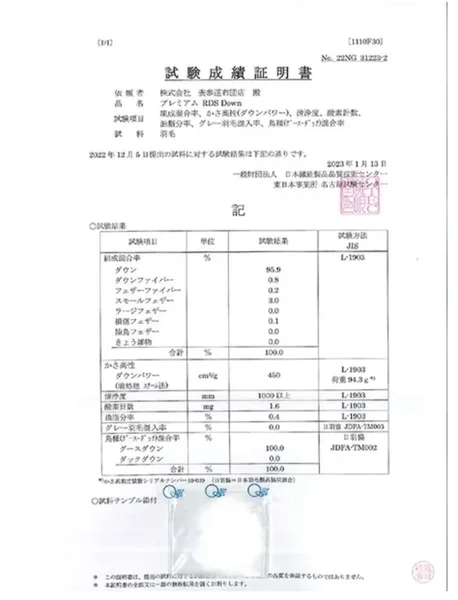
and our RDS Down (virgin down) carries RDS certification, an international standard with strict animal welfare requirements.
Flower Down and Clean Cycle Down are made with recycled down.
If you're looking for a down comforter (duvet) that combines Japan's finest quality with a refined design that complements your interior, do take a look at the Omotesando Futonten collection.
■ Product details
This product is made with brand-new down (premium mother goose down). No recycled down is used.
Omotesando Futonten works with three types of down.
Premium RDS Down Winter-Weight Comforter / Mother Goose Down
For high-quality Japanese-made premium down comforters (duvets), choose Omotesando Futonten
| Related articles
・Loft (Kasadaka) and Fill Power: Meanings and Differences |
| ▶ Browse all down comforters at Omotesando Futonten |
Why a 350 dp or 370 dp comforter can still feel cold
"I bought a 350 dp down comforter and I'm still cold." "Even 370 dp isn't quite enough." You hear this often, and the reason is simple: fill power alone doesn't determine warmth. There are three likely causes.
Not enough fill weight
As noted above, warmth comes down to fill power × fill weight. Even at a relatively high 350 dp or 370 dp, if the fill weight falls short of the 1.2–1.3 kg typical for a Single winter-weight comforter, the down can't trap enough air and the comforter feels cold. When shopping, check the stated fill weight as well as the fill power.
A low down cluster ratio with a high feather content
Two comforters can share the same dp rating, but if the down cluster ratio (the balance of down to feather) is low, the density of down clusters drops and real-world insulation suffers. With products under 80% down, you may not feel the warmth the dp number suggests.
Everyone feels temperature differently
If you run cold or live in a cold climate, the same 350 dp comforter can easily feel too light on warmth. As mentioned above, 400 dp or higher is a safe benchmark for cold sleepers and cold regions.
For reference, down comforters around 390 dp or 400 dp sit between the upper end of the Excel Gold Label (350 dp and above) and the Royal Gold Label (400 dp and above) in Japan's Gold Label quality system. If you want maximum warmth, always check fill weight and down cluster ratio alongside the dp number — that's the key to choosing a down comforter you won't regret.