The answer in 30 seconds
- Luxury is decided by five conditions, not by the name of the material. Check the quality of the raw cotton, the yarn count, the weave, the construction and stitching, and the finishing.
- If you're choosing just one for year-round use, go with extra-long staple cotton sateen. For a cool summer, choose linen or ramie; to reduce friction on skin and hair, choose silk.
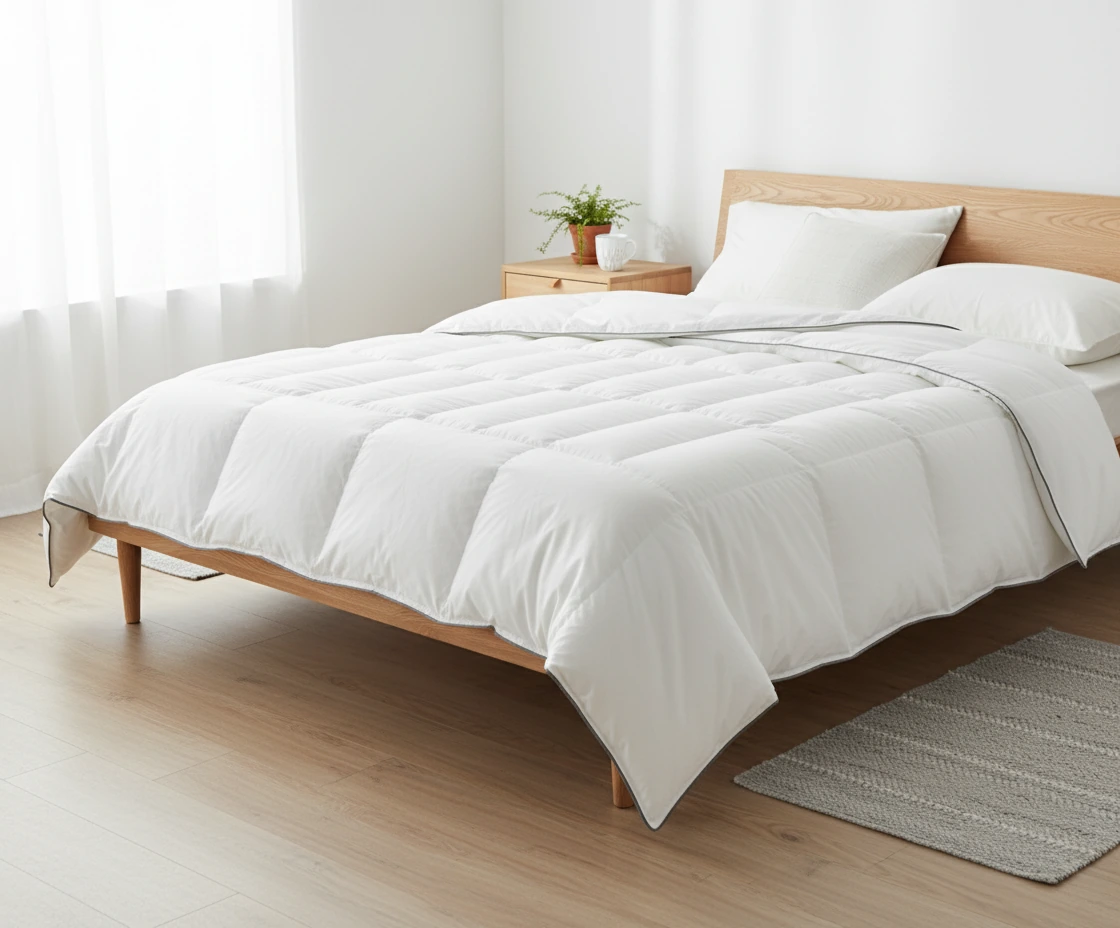
- For a down comforter, use a light, supple 100% cotton cover. A thick, heavy cover keeps the down from lofting. Ideally there are 8 or more inner ties.
- With a fitted sheet, check the pocket depth. Aim for your mattress thickness plus 5–10cm. If you use a mattress pad, add its thickness as well.
What you'll learn in this article
- What separates a truly luxury sheet or duvet cover — beyond the material
- Linen, hemp, silk and extra-long staple cotton: the differences and who each one suits
- Yarn count, weave, stitching and more: what's really behind the price difference
- How to choose sizes for duvet covers, fitted sheets and pillowcases
- Care and laundering that won't damage luxury materials
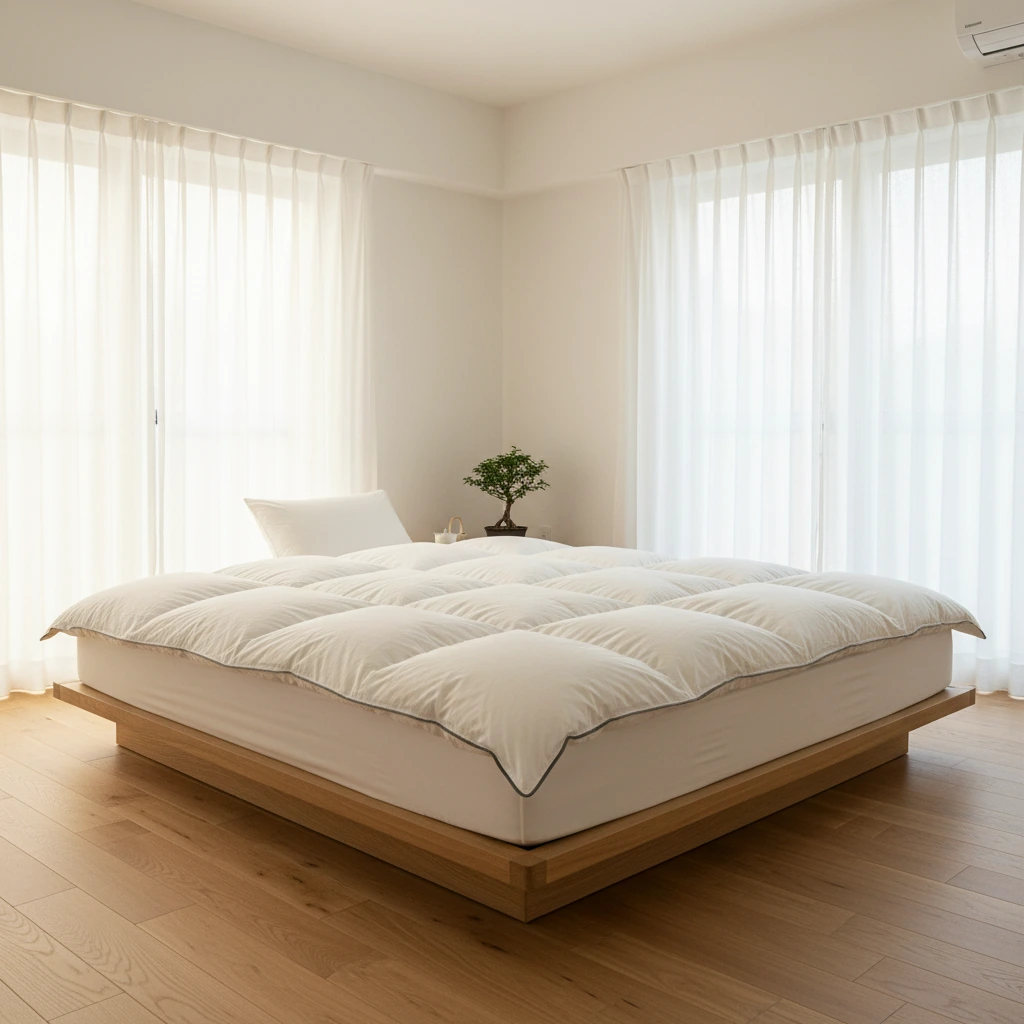
A hotel bed feels so good largely because of the quality of the sheets and covers, not the bedding underneath. Even with the same down comforter, a different cover changes both the feel against your skin and the quality of your sleep.
That said, the price gap between items billed as "luxury sheets" or "luxury duvet covers" isn't decided by material alone. Yarn fineness, weave density, careful stitching, and finishing treatments — hard-to-see details that add up to the price.
In this article, Omotesando Futonten — a specialist in fine 100% cotton covers and sheets — explains what makes a sheet or duvet cover truly luxurious, and how to choose by material.
1. What makes a sheet or duvet cover "luxury"
Sheets and covers that call themselves "luxury" share five things in common. Choosing by the material name alone is a mistake.
① A high yarn count (finer threads)
Yarn count is the unit used to express how fine a thread is: the higher the number, the finer the yarn. Fabric woven from fine yarns is supple, drapes along the body, and has a subtle sheen.
| Yarn count | Feel | Where it sits |
|---|---|---|
| 40-count yarn | Solid and substantial; slightly coarse | Everyday |
| 60-count yarn | Standard smoothness | Mid-range |
| 80-count yarn | Smooth and light, with a refined sheen | Luxury |
| 100s count or higher | Silk-like against the skin; exceptionally light | Top of the line |
Finer isn't automatically better, though: the finer the yarn, the lower the strength, so without high-quality raw cotton the fabric will pill and tear sooner. Well-made high-count covers are woven from long-staple (extra-long staple) cotton.
② Made from extra-long staple cotton
Cotton is graded by fiber length. Fibers 35mm or longer are classed as extra-long staple cotton and can be spun into fine, strong yarns. Egyptian cotton (Giza), Supima, and Sea Island cotton are the best-known examples. Long fibers resist pilling and grow smoother with every wash.
③ The right weave for the job
| Weave | Characteristics | Best season |
|---|---|---|
| Sateen (shusu-ori) | Lustrous and smooth; long floating yarns make it gentle against the skin | Year-round |
| Broadcloth (plain weave) | Tightly woven and durable, with a crisp, dry hand | Year-round |
| Gauze | Airy, lightweight, and highly breathable | Summer and dry seasons |
| Pile | Terry-cloth texture; highly absorbent | Summer |
④ Careful stitching and thoughtful details
It's easy to overlook, but this is what determines how easy a cover is to live with.
- Number of ties: Ideally 8 or more inside a duvet cover. With 6 or fewer, the comforter shifts around
- Zipper length: A full-opening zipper (one that opens all the way to the ends of the edge) makes inserting and removing the comforter dramatically easier
- Seam finishing: French seams or flat-felled seams resist fraying and last far longer
- Elastic: On a fitted sheet, all-around elastic stays put, while corner-only elastic is easier to put on and take off
⑤ No heavy-handed finishing treatments
Fabrics given strong resin or softener finishes to make them feel soft can feel lovely at first, then turn stiff after washing. A good cover doesn't rely on finishing treatments — its hand comes from the quality of the raw fiber and the weave, so it only gets better with every wash.
What to prioritize when choosing: fiber quality → yarn count → weave → sewing specs → color. Rather than being swayed by a headline material name like "100% silk," check whether all five of these are in place.
2. By Material | Linen, Silk, Hemp & Extra-Long-Staple Cotton
Here's how the four materials most often chosen for luxury sheets compare.
| Material | Feel against the skin | Moisture absorption | Summer comfort | Durability | Price range (one Single sheet) | Best for |
|---|---|---|---|---|---|---|
| Linen (flax) | Dry with a crisp, cool hand | High | Excellent | Very high | ¥8,000–¥25,000 | People who sweat easily; everyday use |
| Extra-long-staple cotton (sateen) | Smooth and soft | Very high | Good | High | ¥8,000–¥30,000 | People who want year-round use; anyone after a hotel-quality sleep |
| Silk | The smoothest of all | Moderate | Moderate | Low (delicate) | ¥30,000–¥100,000 | Anyone who wants less friction on skin and hair; a special treat of a sheet |
| Ramie | Firmer, with a pronounced crisp hand | High | Excellent | High | ¥6,000–¥20,000 | Anyone who only wants it for the height of summer |
Linen (flax) sheets
A bast fiber made from flax. Highly breathable, with excellent moisture absorption and release, it's considered the best material for summer.
- Standout trait: Less of it touches the skin, for a dry, crisp feel. It won't cling even when you sweat
- A fabric that grows with you: Slightly stiff when new, it softens with every wash and gains character over the years
- Durability: Two to three times stronger than cotton — lasting 10 years or more is not unusual
- Drawback: It wrinkles easily. It dries quickly, but you'll need to iron it for a crisp look
Extra-long-staple cotton (Egyptian cotton, Supima cotton)
Cotton with a fiber length of 35mm or more. Because it spins into fine, strong yarn, it combines silk-like smoothness with cotton's moisture absorption. It's the best-balanced choice for year-round use.
- Leading growing regions: Egyptian (Giza), American (Supima and Pima) and Indian extra-long staple cotton
- Feel: Little surface fuzz and beautifully smooth. In a sateen weave, it takes on a soft sheen
- Moisture absorption: Absorbs and releases a full night's perspiration, so it doesn't feel stuffy
- Care: Machine washable at home. That ease of care is a major advantage
Silk sheets
Silk is a protein fiber close in composition to human skin, and creates remarkably little friction. It's the choice for anyone who wants the gentlest possible feel against skin and hair.
- Feel: The smoothest of the four materials
- Temperature: Warm in winter and cool to the touch in summer
- Drawbacks: Vulnerable to UV light and friction. Wash in a mesh laundry bag with a neutral detergent, either by hand or on a gentle cycle. Direct sunlight will turn it yellow
- Price: the most expensive of the four fabrics
Ramie
Although both are called "asa" (bast fiber) in Japanese, linen (flax) and ramie come from different plants. In Japanese bedding, "hon-asa" usually means ramie, which has a crisper hand than linen and feels cooler. Opinions differ on its firmness, so it suits people who use it only in the height of summer.
Not sure which to choose? If you want one set for year-round use, go with extra-long-staple cotton sateen. If you only swap sheets for summer, choose linen or ramie. If friction on your skin and hair is a concern, choose silk. Work through it in that order and you're unlikely to go wrong.
3. How to Choose a Premium Duvet Cover
Choosing a sheet and choosing a duvet cover call for slightly different criteria, because a duvet cover directly affects how well your down comforter performs.
Choose a light, supple cover for a down comforter
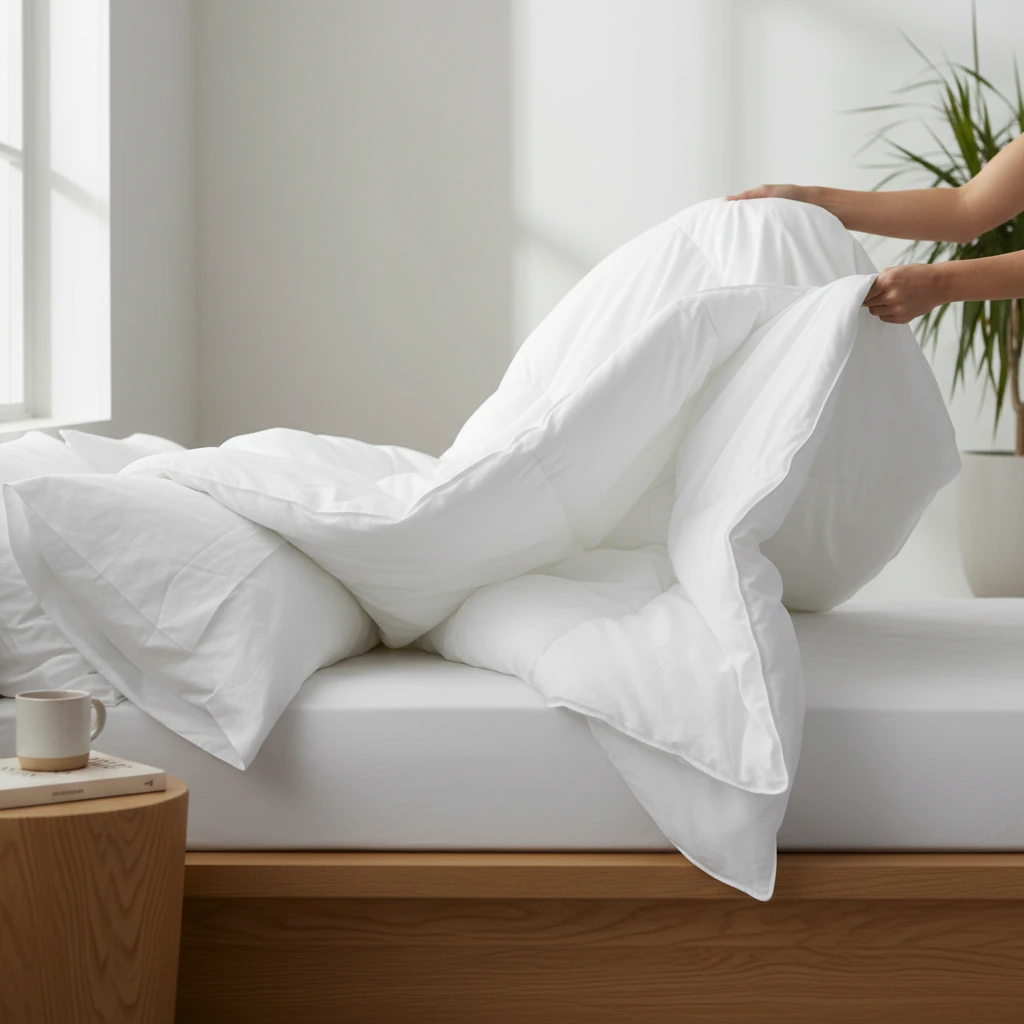
A down comforter warms you because body heat makes the down loft up. A heavy, stiff cover presses that loft flat. That's why even a beautiful mother goose down comforter loses insulating power under a thick, brushed-fleece cover.
- 100% cotton sateen or broadcloth: light and supple, so it never restricts the loft of the down
- Tightly woven, high-density fabric: keeps down from escaping through the weave
- What to avoid: heavy microfiber and thick brushed fabrics. They look cozy, but they undermine how down performs
Always check the inner ties and the zipper
- At least 8 inner corner ties: with ties only at the four corners, the middle shifts and the down comforter bunches up
- A full-length zipper: when one whole side opens end to end, getting the comforter in and out is far easier
- Zipper quality: look for metal or sturdy resin. Cheap resin zippers break within a few years
Why white duvet covers and white sheets are the classic choice
There's more than looks behind the all-white bedding you see in hotels.
- You can see the soil: easy to check at a glance, so it's easy to keep hygienic
- You can bleach it: unlike colors and prints, white holds its hand and texture even after a thorough wash and bleach
- Undyed, so it's gentle on skin: less dye means it suits sensitive skin, too
- Your bedroom looks larger and calmer: less visual stimulation, so nothing gets in the way of falling asleep
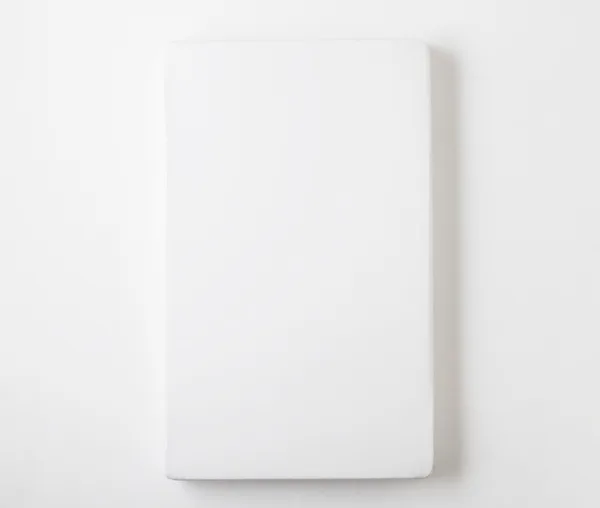
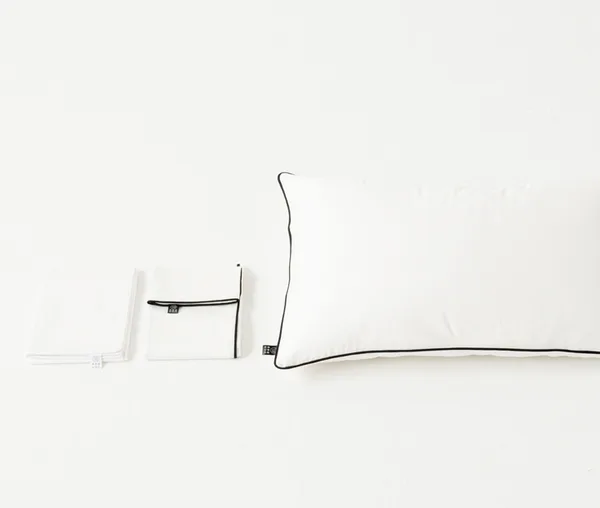
Matching your bedroom with a white fitted sheet and white pillowcases pulls the whole room together. At Omotesando Futonten, we offer the "Clean White Duvet Cover" (¥13,800 tax incl.) and the "Clean White Fitted Sheet" (¥10,800 tax incl.), both made from premium 100s-yarn cotton sateen, plus a "100% Cotton Bed Pad" (¥14,800 tax incl.).
You may be tempted to avoid white because stains show. In reality it's the opposite: because you can see the soiling, you can wash at the right time — that's the advantage of white. With colors and patterns, grime simply builds up unseen.
4. How to choose the right size
Duvet cover sizes
Choose a duvet cover that is the same size as the comforter inside, or just slightly larger. Too large and the comforter swims inside; too small and the down gets compressed.
| Size | Comforter dimensions | Cover dimensions |
|---|---|---|
| Single | 150×210cm | 150×210cm |
| Semi-double | 170×210cm | 170×210cm |
| Double | 190×210cm | 190×210cm |
| Queen | 210×210cm | 210×210cm |
| King | 230×210cm | 230×210cm |
Fitted sheet size and "pocket depth"
The easiest thing to get wrong with a fitted sheet is the pocket depth. Even if the width and length are right, the sheet will slip if it doesn't match your mattress depth.
| Size | Mattress dimensions | Recommended pocket depth |
|---|---|---|
| Single | 97×195cm | Mattress depth + 5–10cm |
| Semi-double | 120×195cm | Same as above |
| Double | 140×195cm | Same as above |
| Queen | 160×195cm | Same as above |
| King | 180×195cm | Same as above |
For example, if your mattress is 25cm thick, choose a pocket depth of 30–35cm. If you use a bed pad, add its thickness as well.
Fitted sheet vs. flat sheet
| Item | Fitted sheets | Flat sheet |
|---|---|---|
| Shape | Box-shaped, with elastic at all four corners | A single flat piece of fabric |
| Putting it on | Easy — just slip it over | Tuck it under the mattress |
| Staying in place | Stays put | Can work loose depending on how you move in your sleep |
| Size flexibility | Unusable if the depth doesn't match | A larger size will usually work |
| Washing & drying | Stays bulky | Easy to fold and quick to dry |
Hotels typically use flat sheets folded into crisp hospital corners, but for everyday use a fitted sheet is far less work. For a full look at sheet types and how to choose, see How to Choose Sheets: Types, Fabrics, Sizes, and Fitted vs. Flat.
Pillowcase sizes
As a rule of thumb, a pillowcase should be 2–3cm larger than the pillow. Japan's standard pillow is 43×63cm, and pillowcases for that size are the most widely available. The hotel-style 50×70cm keeps your head on the pillow as you turn over, making it ideal if you like a roomier sleep.
5. Care and laundering
The finer the material, the more a care mistake shortens its life. Keep these fabric-specific points in mind.
| Material | Washing | Drying | Things to watch for |
|---|---|---|---|
| Extra-long staple cotton | Machine wash (in a mesh laundry bag) with a mild detergent | airing in the shade | High dryer heat causes shrinkage. Go easy on fabric softener, as it reduces absorbency |
| Linen | Machine wash (in a mesh laundry bag), gentle cycle | Dry in the shade; lightly smooth back into shape | Over-spinning sets wrinkles in place. Taking it down while still slightly damp gives the best feel. |
| Silk | Hand wash or dry clean; use a dedicated neutral detergent | Dry in the shade (essential) | UV light causes yellowing. No bleach, no fabric softener. |
| Ramie (Japanese "hon-asa" hemp-family linen) | Machine wash (in a mesh laundry bag) | airing in the shade | Hard rubbing causes fuzzing |
How often to wash
- Sheets and pillowcases: once a week. They absorb perspiration directly, so they soil the fastest
- Duvet covers: once every two weeks. Once a week is ideal in summer
- Bed pads: once a month. Check the care label first
Four tips for making them last
- Go easy on fabric softener: it coats the fibers and reduces absorbency. Linen and extra-long staple cotton, in particular, get better with no softener at all
- Skip chlorine bleach: even on whites, it damages the fibers. If you bleach, use an oxygen-based product
- Rotate two or more sets: keeping a spare set and alternating cuts the wear on each one in half
- Dry in the shade: direct sunlight causes yellowing and breakdown, even with cotton
6. Frequently asked questions
Q. What makes a luxury duvet cover different?
Four things: the quality of the raw cotton (whether it's extra-long staple), the fineness of the yarn (yarn count), the density of the weave, and the sewing specifications. The result is a cover that is light and supple, drapes along the skin, and feels better the more you wash it. Inexpensive covers get their softness from finishing treatments, so they can turn stiff after washing.
Q. How much does a luxury duvet cover cost?
For a Single duvet cover, the luxury tier starts in the ¥10,000s. Expect ¥10,000–¥30,000 for extra-long staple cotton sateen in 80s yarn count or finer, and ¥30,000 and up for silk.
Q. Are linen and "asa" (hemp) the same thing?
Linen (flax) is one type of asa. In Japan, items labeled "hon-asa" usually mean ramie, which has a crisper, firmer hand than linen. For softness and year-round comfort, linen is the better choice.
Q. Which material do you recommend most?
If you're choosing one cover for the whole year, go with extra-long staple cotton sateen. It offers the best balance of moisture absorption, hand feel, and easy care, and it pairs beautifully with a down comforter. If you want something cooler just for summer, add a linen cover.
Q. Don't white sheets and white pillowcases show every stain?
Yes, they do — and that's exactly the point. Because you can see the soil, you know when it's time to wash. With colors and prints, dirt builds up unseen and eventually causes odor. White can also be bleached, which makes it easier to keep genuinely clean.
Q. Can I use a thick, warm cover on a down comforter?
We don't recommend it. A down comforter warms you by lofting up with your body heat, so a heavy, thick cover restricts that loft and actually reduces warmth. Choose a light, supple 100% cotton cover.
Q. My fitted sheet doesn't fit. How should I choose the right size?
Check the pocket depth as well as the width and length. As a guide, add the thickness of your mattress and your bed pad together, then allow another 5–10cm. Too shallow and the sheet pops off; too deep and it sags.
Q. How many should I own?
As a guide, 2–3 sets of sheets and pillowcases, and 2 duvet covers. Rotating between sets while one is in the wash spreads the wear, so each piece lasts longer.
7. Summary
- Five things define a high-end sheet or cover: the quality of the raw cotton (such as extra-long staple), the yarn count, the weave, the sewing specifications and the finishing.
- If you only buy one for year-round use, choose extra-long staple cotton sateen. For cool summer nights, go with linen or ramie; to reduce friction on skin and hair, choose silk.
- Use a light, supple 100% cotton cover on a down comforter. A thick, heavy cover restricts the loft of the down.
- Duvet covers are easiest to use with eight or more inner ties and a full-length zipper.
- For fitted sheets, always check the pocket depth in addition to the width and length.
- White sheets and pillowcases are the practical choice: you can see the soil, bleach them, and keep them hygienic.
- Avoid overusing fabric softener and drying in direct sunlight, and rotate two or more sets to make them last.
Of all your bedding, the sheets and covers are what stay in contact with your skin all night. Upgrade these and you'll feel the difference every single night.
Shop duvet covers and fitted sheets at Omotesando Futonten
8. How to look at brands when choosing a high-end duvet cover
When shopping for a "luxury duvet cover," deciding on brand name alone is an easy way to go wrong. Whatever the brand, the things to look at are the same five points covered in section 1, "What makes a sheet or cover high-end."
- Do they state the quality of the raw cotton? Brands that name a specific extra-long staple cotton, such as Egyptian or Supima, tend to be the more trustworthy ones
- Do they publish the yarn count? When a product only says "luxury" with no yarn count listed, it's hard to compare
- Can you tell the construction from the photos or description? The number of corner ties and whether the zipper opens fully or halfway can be confirmed in the product description or construction details
- Is the size range detailed? Brands that offer a choice of gusset depths to match your mattress height make it much harder to get the size wrong
Rather than focusing on each brand's personality, judge by whether the five conditions explained in this article are properly met. That way you can choose the right one for you without relying on a name.
9. Specifications shared by hotel sheets and duvet covers
Many people search for “hotel sheet material” or “hotel-style sheets” because they want to recreate at home the comfort they felt during a hotel stay. Based on what we've covered in this article, the specs hotels tend to choose share a few traits.
- White cotton sateen: as covered in "3. How to choose a luxury duvet cover," white is ideal for hygiene because soil is easy to spot and the fabric is easy to bleach
- Tightly woven, high-density fabric: fine yarn counts and a dense weave give a smooth feel against the skin along with solid durability
- Most properties use flat sheets: they tuck under the mattress, so one size fits a range of beds — a key reason they're the commercial standard
If you're aiming for hotel-like comfort at home, start with a white cotton sateen duvet cover and fitted sheet, then match the pocket depth using “4. Choosing the Right Size” in this article.