The answer in 30 seconds
- The minimum setup is six pieces of bedding: comforter, duvet cover, mattress bedding, fitted sheet, pillow and pillowcase.
- Spend your budget on the mattress bedding first. It supports your body, and more body heat escapes downward than anywhere else. Then come the comforter, the pillow and finally the covers.
- Figure on around ¥50,000 for the bare minimum. For quality you can count on for 10 years or more, budget ¥100,000–¥200,000.
- Buy the covers at the same time as the bedding itself. Without a cover, the bedding gets soiled directly. Choose a material that absorbs and releases moisture, such as 100% cotton.
When you're putting together a full bedding set, where do you start? Comforter, futon mattress, duvet cover, sheets, pillow, mattress pad. The list is longer than you'd expect, and buying it all at once adds up fast.
In this guide we sort everything into "must-haves," "nice-to-haves that make a real difference," and "things that can wait", then map out the buying order and how to split your budget. It's written for anyone setting up a first apartment, refreshing their bedding after a move, or rethinking what they sleep on now.
What you'll learn in this article
- What a full bedding set includes, and what to buy first
- Realistic budget breakdowns
- Key points for choosing your comforter, base bedding, and covers
- What to add next, and what can wait
What a full bedding set includes
Let's start with the big picture.
| Category | Item | Priority | Typical budget |
|---|---|---|---|
| Top bedding | Comforters | Essential | ¥30,000–¥150,000 |
| Duvet cover | Essential | ¥5,000–¥20,000 | |
| Base bedding | Mattress or futon mattress | Essential | ¥30,000–¥200,000 |
| Fitted sheets | Essential | ¥5,000–¥15,000 | |
| Bed pad / mattress pad | Recommended | ¥10,000–¥20,000 | |
| Head support | Pillows | Essential | ¥5,000–¥30,000 |
| Pillowcase | Essential | ¥2,000–5,000 | |
| Seasonal items | Summer-weight (light) comforter (for summer) | Can wait | ¥20,000–¥100,000 |
| Blankets and throws | Can wait | ¥5,000–¥30,000 |
The minimum setup
To get to "ready to sleep tonight," you need these six pieces.
- Comforters
- Duvet cover
- Mattress (or futon mattress)
- Fitted sheets
- Pillows
- Pillowcase
It's tempting to put covers off until later, but using bedding without them means dirt and body oils go straight into the comforter or mattress, so cleaning and replacement come around much sooner. Treat covers as essential, bought together with the bedding itself.
Buying order: start with the highest priority
1st | Base bedding (mattress or futon mattress)
It may come as a surprise, but the place to put your budget first is what you sleep on. There are two reasons.
- It supports your body: mattress bedding that doesn't suit you leads straight to back and shoulder trouble
- More body heat escapes downward than anywhere else: no matter how thick the comforter, you'll still feel cold if the surface beneath you is cold
A slightly thin comforter can be topped up with a blanket, but base bedding is hard to compensate for after the fact.
2nd | Comforter
One comforter in a weight that suits the season. As your first purchase, we recommend a winter-weight comforter, since it covers the longest stretch of the year. Getting through midwinter under a thin comforter is tough, whereas if a thick one feels warm in early autumn, you can simply fold it back to adjust.
3rd | Pillow
The wrong pillow is a common cause of neck and shoulder trouble. It's also one of the more affordable pieces of bedding to replace. Start with a standard model, then adjust if it doesn't suit you — that's a perfectly good way to go.
4th | Covers and sheets
They protect the bedding underneath and decide how it feels against your skin. Buy them at the same time as the bedding itself.
No. 5 | Bed pads and mattress pads
Not essential, but one of the highest value-for-money items you can buy. For around ¥10,000 you improve both insulation and moisture absorption. The difference you feel can equal or even exceed stepping up to a thicker comforter.
No. 6 and below | Seasonal items
Summer-weight (light) comforters, blankets, cooling pads and the like can simply be added when the season calls for them.
Sample budget breakdowns
¥50,000 budget | Get yourself sleeping properly first
| Item | Allocation |
|---|---|
| Sleep surface (mattress or futon mattress) | ¥20,000 |
| Comforters | ¥15,000 |
| Pillows | ¥5,000 |
| Duvet cover, sheets and pillowcases | ¥10,000 |
At this budget, your comforter options are limited. You'll be looking at a down comforter with a low down cluster ratio or a synthetic fill, so plan on topping up the warmth with a blanket.
¥100,000 budget | The balanced setup
| Item | Allocation |
|---|---|
| Sleep surface (mattress or futon mattress) | ¥35,000 |
| Comforter (down, recycled down, etc.) | ¥35,000 |
| Pillows | ¥10,000 |
| Covers and sheets | ¥15,000 |
| Bed pad | ¥5,000 |
From this price range up, you can choose a down comforter with a down cluster ratio of 90% or higher and a 100% cotton shell fabric. Because it lasts 10 years or more, the cost per year can actually work out lower than the ¥50,000 setup.
¥200,000 budget | Buying for the long haul
| Item | Allocation |
|---|---|
| Sleep surface (mattress) | ¥80,000 |
| Comforter (new goose down) | ¥70,000 |
| Pillows | ¥20,000 |
| Covers and sheets | ¥20,000 |
| Bed pad | ¥10,000 |
Key points for choosing a comforter
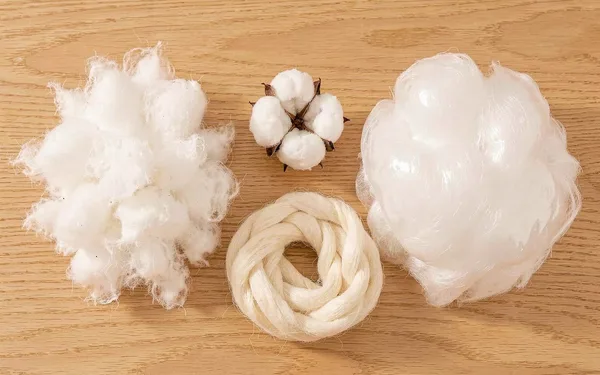
How the materials differ
| Material | Warmth | Weight | Moisture handling | Longevity |
|---|---|---|---|---|
| Down | High | Light | Absorbs moisture and releases it | 10–15 years |
| Wool | Medium to high | Medium | Releases moisture well | 5–7 years |
| Cotton | Medium | Heavy | Absorbs moisture but is slow to release it | 3–5 years |
| Synthetic (polyester) | Medium | Light | Tends to trap moisture | 3–5 years |
Down is so widely used in bedding because it delivers all three at once: light, warm, and able to let moisture escape. Every other material sacrifices at least one of them.
For a detailed material-by-material comparison, see Comforter Materials Compared: Down, Cotton, Synthetic and Wool — the Differences and How to Choose, Explained by a Specialist Store, and for the big picture on types, see Types of Futon Bedding: Comforters, Futon Mattresses and Material Differences — How to Choose, Explained by a Specialist Store.
Four numbers to check when choosing a down comforter
| Measure | Meaning | Guideline for winter | Labeling required |
|---|---|---|---|
| Down cluster ratio | Share of down (down clusters) in the fill | 90% or higher | Yes |
| Fill power | Loft per 1 g of down | 350 cm³/g or higher | No |
| Fill weight | Weight of down filling | Single: 1.2–1.3 kg | Yes |
| Shell fabric yarn count | Yarn fineness. The higher the number, the lighter and more supple the fabric | 60-count or finer | ― |
In particular, there is no labeling requirement for fill power. Even though it's the single most important indicator of warmth, many products simply don't state it. Whether a store publishes the numbers tells you a lot about how it does business.
For a full breakdown of how to choose, see How to Choose a Down Comforter: 5 Criteria — Down Cluster Ratio, Fill Power and Shell Fabric.
Switch by season, or use one comforter year-round?
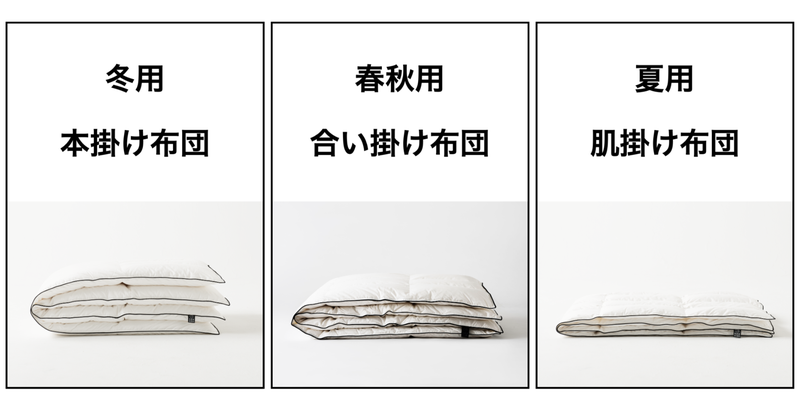
Down comforters come in three types, defined by fill weight. In many cases the down inside is identical and only the amount differs.
| Type | Fill weight (Single) | When to use it |
|---|---|---|
| Summer-weight (light) comforter (down ket) | 0.3〜0.4kg | June to September |
| All-season (medium-weight) comforter | Around 0.8 kg | April to June / September to November |
| Winter-weight comforter (for winter) | 1.2〜1.3kg | November to March |
Ideally you'd own all three weights, but budget and storage space are real constraints. A practical approach is to buy one winter-weight comforter first, then add a summer-weight one the following year.
Key points for what goes under you, and for covers
What adding one layer underneath you does
A mattress or a floor is a cooling surface that draws body heat away all night long. Add one moisture-absorbing pad on top and it insulates while soaking up night sweat, so you stay warm without feeling clammy.
If you've switched to a thicker comforter and still feel cold, the cause is often not the comforter but what's underneath you.
Choose 100% cotton covers
No matter how good the comforter itself is, a cover with poor breathability traps moisture and undermines both warmth and freshness. Choose a material that absorbs and releases moisture, such as 100% cotton.
A cover also stops most of the soiling that would otherwise reach the comforter itself — an important factor in keeping cleaning to a minimum.
Match the size
If the cover is larger than the comforter, the comforter shifts inside and leaves thin, cold spots. If it's smaller, the comforter is squeezed and can't loft. Choose a cover the same size as the comforter or only very slightly larger, and fasten all the corner and mid-point ties.
When to replace
| Item | Typical lifespan | Signs it's time to replace |
|---|---|---|
| Down comforter | 10–15 years | Won't loft up after airing, feathers poking through, feels heavy |
| Synthetic-fill comforter | 3–5 years | Goes flat, loft doesn't come back |
| Mattresses | 5–10 years | Dips in places, hips sink in |
| Pillows | 2–3 years | Center stays compressed, odor won't come out |
| Covers & sheets | 3–5 years | Fabric thins out, pilling, fading |
Before you replace down, consider refurbishing it
Down lasts exceptionally long because washing can restore its performance. The main reason down deteriorates is the soil that builds up on it — wash it, and the loft comes back.
If the loft has dropped, there's another option: down comforter refurbishing, in which the down is removed, washed, topped up where it has fallen short, and re-cased in a new shell fabric. If the down was good quality to begin with, this costs less than buying new.
For guidance on which way to go, see How Long Does a Down Comforter Last? A Specialist Explains When to Replace and When to Refurbish.
Frequently asked questions
How much should I budget for a full set of bedding?
For the bare essentials, figure on around ¥50,000; for quality you can count on for 10 years or more, ¥100,000–¥200,000 is a good guide. The places to put your money first are what you sleep on and your comforter.
What should I buy first?
Start with what you sleep on (mattress or futon mattress). It supports your body, and more body heat escapes downward than anywhere else. After that, in order: comforter, pillow, then covers.
How many comforters do I need?
Ideally three — summer-weight, all-season and winter-weight — but it's perfectly fine to start with a single winter-weight comforter, since that's the one you'll use longest. In early fall you can fine-tune with a blanket.
Can covers wait until later?
No — buy them at the same time as the comforter. Used without a cover, the comforter itself gets soiled, which means cleaning it more often and replacing it sooner.
What's the difference between a cheap comforter and an expensive one?
With down comforters, the main differences are the type of down (goose or duck), the fill power, and the yarn count of the shell fabric. Warmth comes down mostly to fill power; how it feels against you comes down mostly to the shell fabric.
Do I really need a bed pad?
It isn't essential, but it's one of the best-value items you can buy. For around ¥10,000 you improve both insulation and moisture absorption, and the difference you feel can equal or beat stepping up to a thicker comforter.
Summary
- The minimum set of bedding is six pieces: comforter, cover, mattress or futon mattress, sheet, pillow and pillowcase
- Budget priority order: mattress bedding → comforter → pillow → covers → mattress pad
- Start with the winter-weight comforter, since that's the one you'll use for the longest stretch of the year
- When choosing a down comforter, check four specs: down cluster ratio, fill power (dp), fill weight and shell fabric
- A cover is essential with every piece. Choose 100% cotton and fasten all the inner ties
- Down can be renewed through down comforter refurbishing (re-lofting), so look into that before replacing it