The answer in 30 seconds
- Down that has been recovered from used products, washed, sorted and regenerated. Also called "regenerated down." It comes from collected down comforters and offcuts from manufacturing.
- Processed properly, it performs almost the same as new down. The main cause of deterioration is soiling, which washing removes. Clusters with broken filaments are removed during sorting.
- The difference from new down is that the origin can't be identified. That's because down from multiple sources is blended. If origin matters to you, new down is the better fit.
- What to look for: published numbers and disclosed washing methods. For winter use, aim for a fill power of 350 cm³/g or higher and a down cluster ratio of 90% or more. Also check whether the figures come from third-party testing.
Recycled down is down reclaimed from used down products, then washed and sorted so it can be used again. It is also called “regenerated down.”
“Secondhand down” may sound off-putting, but properly washed recycled down performs almost identically to new down. The reason: down deteriorates mainly because of soiling, and washing removes it.
In this article, we explain how recycled down is made, how it differs from new down, and what to look for when choosing it — from a specialist store's perspective.
What you'll learn in this article
- How recycled down is made
- What's the same as new down, and what's different
- How to judge quality (what to look for)
- Why down can be regenerated
What is recycled down?
Recycled down is made from down reclaimed through routes like these:
- Down comforters collected when customers replace them or have them refurbished (uchinaoshi, down comforter refurbishing)
- Offcuts generated during manufacturing
- Down gathered through take-back and recycling programs for down products
These items are taken apart, the down alone is removed, then washed, dried and de-dusted and sorted by quality — and that is what goes to market as recycled down.
Why down can be regenerated
The reason down is a renewable material lies in its structure.
Down has a spherical structure, with fine fibers radiating out from a central core. Those fibers trap air, and that's what creates warmth. The structure itself does not chemically degrade through use.
What actually happens during use comes down to two things:
- Soiling: night sweat, body oils and dust cling to the down, causing the filaments to clump together and the loft to drop
- Physical damage: filaments break from compression or beating
The first is solved by washing. The second can't be reversed, but broken down is removed during sorting.
In other words, down that has stopped lofting because it's dirty will loft again once it's washed. That's fundamentally different from synthetic fill, which can only be thrown away once it goes flat.
How recycled down is made
- Collection: used down products are gathered
- Disassembly: the shell fabric is opened and the down removed
- Dust removal: dust and broken down fragments are blown away with air
- Washing: oils and soiling are removed with water and specialized equipment
- Drying: dried slowly at low temperature
- Sorting: down cluster ratio and fill power are measured, and the down is graded by quality
- Testing: performance is evaluated by a third-party institution
Of all these steps, the two that decide quality are washing and sorting.
Washing decides the quality
If washing falls short, soiling stays behind, odor develops, and loft never comes back. Almost every difference in recycled down quality traces back to this one step.
At Omotesando Futonten, we wash our down in natural underground water from Hakushu in Yamanashi Prefecture, without detergent, to twice the JIS standard. We're particular about the quality of the water itself because what's left behind in the rinse ultimately determines odor and cleanliness.
Sorting sets the ceiling
Collected down is never uniform. Some was originally duck, some goose; some is badly broken down, some still performs beautifully. How strictly it's all sorted is what determines the final quality.
At Omotesando Futonten, we source high-quality recycled down from within Japan ourselves, and select only down with a down cluster ratio of 93% or higher and fill power of 400 cm³/g or higher (Japanese dp).
How it compares with new down
| Item | New down | Recycled down (properly processed) |
|---|---|---|
| Fill power | 300〜450㎤/g | Around 400 cm³/g is achievable with careful sorting |
| Down cluster ratio | 50〜95% | 93–94% is achievable with careful sorting |
| Cleanliness | Depends on the washing standard | Depends on the washing standard (same issue as with new down) |
| Resistance to odor | Depends on the washing standard | Same as above |
| Stable supply of raw material | Stable | Depends on how much is collected |
| Price | High | Can be kept lower |
| Identifying the origin | Possible | Difficult (sources are blended) |
Performance isn't where the difference lies
Omotesando Futonten's Clean Cycle Sleep Down winter-weight comforter was measured by an independent Japanese testing lab at 400㎤/g fill power with a 94% down cluster ratio. That matches our brand-new white goose down comforter (400㎤/g fill power, 93% down cluster ratio).
The accurate way to put it: recycled down isn't inherently lower-performing — it all comes down to the standard of sorting and washing.
The real difference: tracing the origin
With new down, you can pinpoint the origin and type — "Polish white goose down," for example. Recycled down blends feathers from multiple sources, so that level of traceability isn't possible.
So the choice is simple: if origin matters to you, go with new down; if you want the best balance of performance and price, recycled down is the smart pick.
What to look for when choosing recycled down
Quality varies enormously across recycled down. Check the following points.
1 | Are the fill power and down cluster ratio published?
This matters most. If a product doesn't publish its numbers, you have no idea what standard of sorting went into it. For winter use, look for a fill power of at least 350㎤/g and a down cluster ratio of 90% or higher.
2 | Were the figures measured by an independent lab?
Are the numbers verified by an outside testing institute, or just the manufacturer's own claim? Because the raw material in recycled down varies so widely, disclosure of actual measured values is especially important.
3 | Is the washing process explained?
Does the seller explain where the down is washed and to what standard? With recycled down, washing is the heart of quality — if a product says nothing about it, you're safer steering clear.
4 | How odor is handled
Odor is the number-one concern with recycled down. Thorough washing takes care of it, but if you have any doubts, check the return policy before you buy.
We cover the causes of odor and how to deal with it in Why Down Comforters Smell and How to Get Rid of It — A Specialist Store Explains.
How down compares to other "recycled materials"
Recycled materials have gained ground in bedding and apparel in recent years. But "recycled" means very different things depending on the material.
| Material | Recycling method | Change in performance |
|---|---|---|
| Recycled down | Washing and sorting only; the material itself is unchanged | Equal to new down, depending on sorting |
| Recycled polyester | Plastic bottles and similar waste are melted down and re-spun | Virtually equal to new material |
| Shoddy (reclaimed cotton) | Old textiles are mechanically pulled apart and reused | Fibers become shorter and strength drops |
| Recycled wool | Used garments are cut, shredded and re-spun | Fiber length shortens and the hand feel changes |
What makes down unique is that recycling it requires no chemical or mechanical processing. Nothing is melted, cut or re-spun. You simply wash and sort it, and the original structure is ready to use again.
That's because down isn't a "fiber" — it's a three-dimensional structure. The spherical shape of the down cluster is itself the functional part, so as long as that shape is intact, the performance is still there.
Why quality varies in recycled down
Because the raw material is collected from used products, recycled down is never perfectly consistent in quality. This is the biggest difference from new down.
Why quality varies so widely
- The original products differ in quality: premium goose comforters and inexpensive duck comforters all enter the same collection stream
- Years of use differ: down used for 5 years and down used for 30 years show different degrees of damage
- Usage differs: down that was stored compressed, or beaten repeatedly, has broken filaments
That's why sorting is absolutely critical
Use collected down as-is, and the quality lands at "average." Sort it rigorously, and you can pull out only the top tier.
At Omotesando Futonten, we source high-quality recycled down from within Japan through our own channels, and select only down with a down cluster ratio of 93% or higher and fill power of 400 ㎤/g or higher. The extra effort of sorting raises our costs, but it lets us match the numbers of brand-new down.
How to judge the standard of sorting
Shoppers never see the sorting process. The only thing you can judge by is disclosed numbers.
- Are fill power and down cluster ratio shown as specific numbers?
- Are those figures from a third-party lab, or self-reported?
- Is the washing method and standard explained?
If a product simply says "made with recycled down" and gives no numbers, the standard of sorting is unknown. In that case, it's fair to assume the quality matches the price.
A sustainability perspective
Down is a by-product to begin with
Down is a by-product of meat processing. Because it makes use of material that would otherwise be discarded, it is inherently a resource-efficient raw material.
Recycling keeps it in circulation
What's more, when down at the end of its life becomes a comforter again, the resource stays in circulation. No new waterfowl need to be raised, and no waste is created.
A down comforter is bulky to dispose of as oversized waste, and incinerating it takes energy. Sending it for recycling also reduces the burden of disposal itself.
Refurbishing as a form of recycling
Having your current down comforter refurbished (re-made) is part of the same cycle. The down from your own comforter is washed, topped up where it falls short, and re-made into a new comforter.
With Omotesando Futonten's down comforter refurbishing / Clean Cycle Reform service, the down lost during washing is topped up with our own Clean Cycle Down.
Recycled down at Omotesando Futonten
Clean Cycle Down
We select the goose down with outstanding quality and performance from the recycled down circulating in Japan.
- Only down with a down cluster ratio of 93% or higher and fill power of 400 ㎤/g or higher is selected
- Washed in natural underground water from Hakushu, Yamanashi — detergent-free, and to twice the JIS standard
- Measured by a third-party lab in Japan at 400 ㎤/g fill power and a 94% down cluster ratio
- Sewn one by one in Japan by skilled artisans in Fujiyoshida
Our lineup includes winter-weight comforters, all-season (medium-weight) comforters for spring and fall, summer-weight (light) comforters, and pillows.
For the full story behind it, see Clean Cycle Down — Beauty That Surpasses Brand-New Down.
Flower Down
This material blends Italian recycled down with fiber harvested from the seed pods of the kapok tree. Kapok fiber traps air and holds heat in, which is why it's known as "down that grows on trees."
- About 75% Italian recycled down, about 25% kapok
- Fill power 360 ㎤/g (roughly equivalent to 660 fill power)
- The first direct import into Japan from Italy's Minardi
For details, see What Is Flower Down, Born in Italy? The lineup includes winter-weight comforters and more.
Frequently asked questions
Is recycled down hygienic?
It depends on the standard of washing. Properly washed recycled down is just as clean as new down. In fact, insufficiently washed new down is more likely to cause odor or soiling problems. Choose products that publish their numbers and their washing method.
Isn't recycled down less warm than new down?
It depends on the sorting standard. Recycled down with a fill power of 400 cm³/g and new down with a fill power of 400 cm³/g are equally warm. Compare the numbers.
Does it smell?
If the washing has been thorough, there is virtually no odor. When an odor does appear, the cause is insufficient washing or insufficient drying. Exactly the same point applies to new down.
Is recycled down cheaper?
Because the raw material cost is lower, the same level of performance can be offered at a lower price. However, the more care that goes into washing and sorting, the higher the cost — so extremely cheap products may have been sorted loosely.
Does it have a shorter lifespan than new down?
If broken down clusters have been removed during sorting, there is no major difference. With proper care it will last 10 years or more. And a comforter made with recycled down can itself be refurbished again and kept in use.
Is it RDS certified?
RDS certification is a scheme that covers the supply chain for new down. Recycled down involves no new sourcing of down in the first place, so a different framework applies. For more on RDS certification, see RDS down: toward lower-impact down sourcing.
Can a comforter made with recycled down be refurbished?
Yes. Recycled down is still down, so washing restores its loft. In other words, down that has already been regenerated once can be regenerated again and kept in use. Handled properly, the same down keeps circulating for decades.
Summary
- Recycled down is used down that has been washed and sorted so it can be used again
- The main cause of down deterioration is soiling, and washing solves it — which is why regeneration works
- Properly sorted and washed down performs almost identically to new down
- Quality comes down to washing and sorting. Check whether the numbers are disclosed
- The one real difference from new down: the origin and species can't be identified
- Down is a by-product to begin with, and it can keep circulating. Down comforter refurbishing is an extension of the same idea
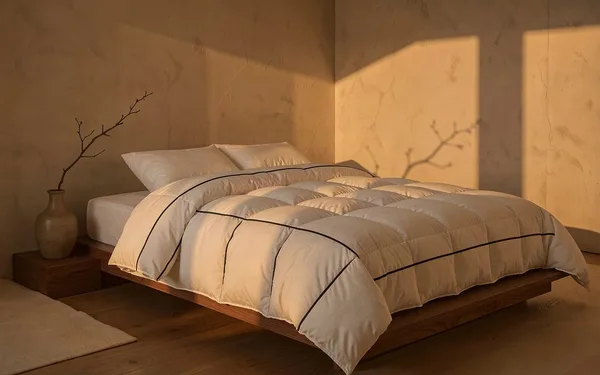
Clean Cycle Sleep Down Winter-Weight Comforter / Recycled Down