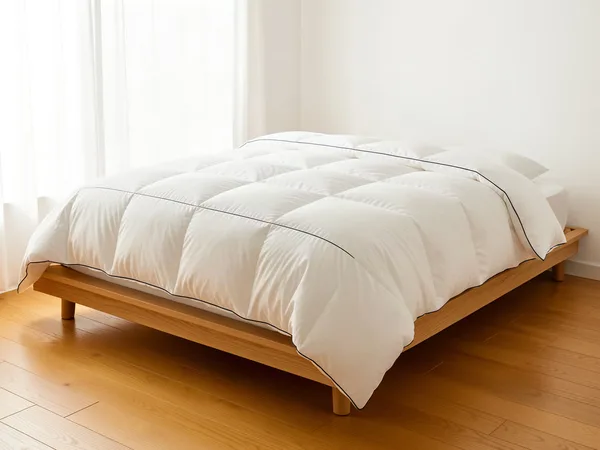
Choosing a down comforter is simple once you know which numbers matter. Of all the items listed in catalogs and on quality labels, only five really determine warmth and sleeping comfort.
This article walks through the five criteria to check when choosing a down comforter, in order of priority. It also sets out what changes at each price point and what differs depending on where you buy. Whether you're buying your first down comforter or replacing an old one, the aim is for this one article to give you everything you need to decide.
What you'll learn in this article
- The five criteria for choosing a down comforter, in order of priority
- How the down cluster ratio, fill power and fill weight relate to each other, and how to read the numbers
- What changes at each price point
- Common mistakes and how to avoid them
In short | The five criteria for choosing a down comforter
Here's the bottom line first. The items are listed from most important down.
| Rank | Criterion | What to check | Guideline |
|---|---|---|---|
| 1 | Down cluster ratio | Share of down (down clusters) in the fill | 90% or higher for winter use |
| 2 | Fill power | Loft per 1 g of down | 350 cm³/g or higher |
| 3 | Fill weight | Weight of down filling | 1.2–1.3 kg for a winter-weight Single |
| 4 | Shell fabric | Fabric, yarn count & quilt construction | 100% cotton / 60-count or finer / baffle-box quilting |
| 5 | Washing and manufacturing | How thoroughly the down is washed; stitching quality | Whether washing standards are disclosed |
Of these five points, 1 and 2 cover the quality of the down itself, 3 covers the quantity, and 4 and 5 cover the construction. Think of it this way: warmth is determined by points 1–3, while comfort and durability come down to points 4–5.
Criterion 1 | Down cluster ratio | The first number to look at
The fill inside a down comforter is made up of two main materials.
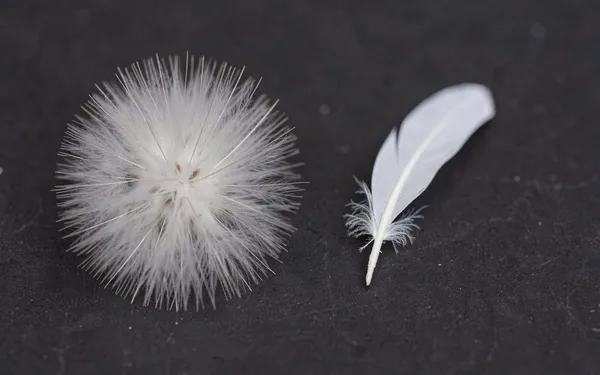
- Down: the round, dandelion-like clusters that grow on a waterfowl's breast. They have no quill and trap a huge amount of air.
- Feather (small feather): a small feather with a quill. It adds springiness, but it is stiff and bulky.
The down cluster ratio is the proportion of down in that combined total. It appears on every quality label in a form such as "93% down / 7% feather."
Down traps air; feathers do not trap much. That means the higher the down cluster ratio, the lighter, warmer and more body-hugging the comforter. Conversely, a high feather content makes the comforter heavy and stiff, and the quills can poke through the fabric — the classic cause of feathers working their way out.
| Down cluster ratio | Rating | Best suited for |
|---|---|---|
| 50〜70% | Low. Essentially closer to a feather comforter | Budget first. Not enough for winter use |
| 80〜85% | Standard | Practical as an all-season (medium-weight) comforter for spring and fall |
| 90〜93% | High quality | Our recommended level for a winter-weight comforter |
| 95% or higher | Top tier | For those who want the lightest possible comforter |
One caveat: a product only needs a down cluster ratio of 50% or more to be labeled a "down comforter." In other words, even 51% down qualifies. You can't judge quality from the product name alone.
For details, see What is the down cluster ratio? A clear guide to this down comforter quality indicator — and how it differs from fill power and The four down cluster ratio labels used on down comforters, explained.
Criterion 2 | Fill power | Why the same amount of down can feel different
If the down cluster ratio tells you what's inside, fill power tells you how good that down actually is.
Fill power measures how much volume 1 g of down springs back to after being compressed under set conditions, expressed in cm³/g. The higher the number, the more air a smaller amount of down can trap.
| Fill power | Rating | Characteristics |
|---|---|---|
| Under 300 cm³/g | Below standard | Needs more fill to deliver warmth, which adds weight |
| 300〜350㎤/g | Standard | The mainstream range for off-the-shelf comforters |
| 350〜400㎤/g | High quality | Plenty warm for winter, and noticeably light |
| 400 cm³/g or more | High quality | Delivers lightness and warmth at the same time |
| 440 cm³/g or more | Top tier | A select few downs, such as mother goose down |
How it differs from fill power
Products made overseas use the unit "fill power (FP)." The test methods differ, so there is no exact conversion, but as a rough guide the fill power figure is about 1.8 times the Japanese dp (down power) figure. A down power of 400 cm³/g works out to roughly 730 fill power.
We explain this conversion in detail in Loft (fill power) vs. down power: a specialist store explains the meaning, the differences and the benchmarks.
Read down cluster ratio and fill power together
Neither number means much on its own. A high down cluster ratio won't loft if the down clusters are all small, and high fill power still feels heavy if there is a lot of feather in the mix.
Comparing actual products makes the relationship much easier to grasp.
| Product | Down cluster ratio | Fill power | Fill weight (Single) |
|---|---|---|---|
| Mother Goose Sleep Down Winter-Weight Comforter | 93% | 450㎤/g | 1.2kg |
| White Goose Sleep Down Winter-Weight Comforter | 93% | 400㎤/g | 1.3kg |
| Clean Cycle Sleep Down Winter-Weight Comforter | 94% | 400㎤/g | 1.3kg |
| Flower Sleep Down Winter-Weight Comforter | — (kapok blend) | 360㎤/g | 1.3kg |
High-fill-power mother goose down delivers the same warmth or more with 0.1 kg less fill weight than the others. That is what "better quality means lighter" looks like in practice.
Criterion 3 | Fill weight | Choose by season and how warm you sleep
Fill weight is the weight of the down inside the comforter. Using Single size as the benchmark, the figures break down like this.
| Type | Fill weight (Single) | When to use it |
|---|---|---|
| Summer-weight (light) comforter (down blanket) | 0.3〜0.4kg | June to September |
| All-season (medium-weight) comforter | Around 0.8 kg | April to June / September to November |
| Winter-weight comforter (for winter) | 1.2〜1.3kg | November to March |
Semi-double and larger sizes carry the Single fill weight multiplied by the size ratio. For example, if the Single holds 1.3 kg, the Semi-double holds 1.47 kg and the Double 1.65 kg.
Does more fill weight mean more warmth?
Up to a point, yes — but past a certain level it backfires. A down comforter keeps you warm by following the contours of your body and closing off gaps. A comforter that is too heavy won't drape against you, leaving cold gaps at the shoulders and feet.
Rather than thinking "it isn't warm enough, so I need something heavier," our experience as a specialist store says the better answer is "step up the quality so it drapes over your body."
We also cover how to think about fill weight in How to choose a down comforter by fill power: the complete guide to benchmarks, grades and checkpoints.
Criterion 4 | Shell fabric and quilting | The part that decides how it sleeps
Material
A shell fabric has to deliver two opposing qualities.
- A weave tight enough to stop down from working its way out (down-proof construction)
- Breathability and moisture release that let night sweat escape
The best material for doing both is 100% cotton. Polyester-blend fabrics are cheap and light, but they trap moisture and leave you feeling clammy. Even in winter a person sweats about a cupful over the course of a night, so breathability matters in every season.
Yarn count
Thread count ("bancha" yarn number) indicates how fine the yarn is — the higher the number, the finer the yarn. Fabric woven from fine yarn is supple and light, and it follows the body.
- 60-count yarn: the standard. Durable and great value for money.
- 80-count yarn: supple and light, with a softer feel against the skin.
- 100-count yarn: the finest grade. Silk-like smoothness.
For a full breakdown of the differences, see 60 Satin vs. 80 Satin: How to Choose the Shell Fabric for a Down Comforter, Explained by a Specialist and What Is a Down Comforter Shell Fabric? Choosing the Right Material, Yarn Count and Weave, Explained by a Specialist.
Quilt construction
Quilting refers to the stitched channels that divide a comforter into compartments so the down can't shift to one side. The construction makes a big difference to performance.
| Quilting | Construction | Characteristics |
|---|---|---|
| Sewn-through (flat) quilting | The top and bottom fabrics are stitched directly together | The down is interrupted at each seam, creating cold spots. Best suited to summer-weight comforters |
| Baffle-box quilting | Fabric walls (baffles) are built into the sides of each box | The down isn't crushed, so it lofts to full thickness. The standard for winter-weight comforters |
| Double-layer baffle-box quilting | Two layers of baffle boxes are stacked, upper and lower | No seams line up, so warmth is excellent — but the comforter tends to be heavier |
If you're choosing a winter-weight comforter, go with baffle-box quilting at a minimum.
Criterion 5 | Washing and Craftsmanship | The quality that never shows up in the numbers
The first four points can all be compared using numbers. The fifth can't: there's no labeling requirement for it, which makes it hard to compare. Even so, it has a major impact on how the comforter actually feels in use.
Washing
Down is an animal-derived material. Straight from the source it still carries natural oils and dirt, and if these aren't fully washed out, even a brand-new comforter can have a distinctive odor. The idea that "down comforters smell" usually comes down to insufficient washing.
How thoroughly down has been washed is measured by the clarity of the water afterward. Japan has a JIS (Japanese Industrial Standards) benchmark for this, and how far a maker exceeds it says a lot about their standards. At Omotesando Futonten, we wash our down in natural spring water drawn from underground in Hakushu, Yamanashi — with no detergent — to twice the JIS requirement.
We cover odor in detail in What Causes Down Comforter Odor and How to Get Rid of It (Explained by a Specialist).
Sewing and filling
Even with identical down and identical fill weight, the finished comforter changes depending on how precisely each box is filled. Machines alone leave uneven spots, so the final adjustment has to be made by hand. At Omotesando Futonten, skilled sewers in Fujiyoshida, Yamanashi finish every comforter one at a time.
We document our production process in a series beginning with How Omotesando Futonten Makes a Comforter, STEP 1: Down Quality.
Traceability and certification
In recent years, how the down was sourced has also become part of the decision. RDS (Responsible Down Standard) certification is an international standard that guarantees, among other things, that no live-plucking was used to harvest the down.
For details, see RDS Down: Toward Lower-Impact Down Sourcing.
What changes at each price point
Price differences between down comforters come down almost entirely to these four factors stacked together.
- Type of down: duck < goose < mother goose. The colder the region of origin, the higher the rating.
- Fill power: even within goose down, the part of the bird it comes from and the sorting process make a real difference.
- Shell fabric: the higher the yarn count, the higher the cost.
- Distribution: whether it passes through department stores or large retail chains.
Worth noting: the fourth factor, distribution cost, accounts for a far from trivial share of the price. For the same quality, the final price changes depending on whether you're buying direct. "Expensive" doesn't always mean "good," because the price includes things that have nothing to do with quality.
We compare the differences between grades in detail in Down Comforter Grades and Rankings Explained: How to Tell Real Quality, from a Specialist Store.
How to read the quality label
Down comforters sold in Japan are required to carry a quality label under the Household Goods Quality Labeling Act. Once you can read it, you won't be swayed by marketing copy.
What's on the label
| Item | What it tells you | What to look for |
|---|---|---|
| Fill | Down ○%, feather ○% | Down cluster ratio. For winter, look for 90% or higher |
| Fill weight | 1.3kg, for example | Whether the amount suits the season |
| Shell fabric (face and backing) | 100% cotton, ○% polyester, etc. | 100% cotton is ideal |
| Size | 150×210cm, for example | Whether it fits your build and your mattress or futon |
| Care label | Whether washing and tumble drying are allowed | Whether you can wash it at home |
What the label doesn't tell you
Crucially, there is no legal requirement to disclose any of the following.
- Fill power: the single most important measure of warmth, yet there is no requirement to state it. Conscientious makers disclose it voluntarily.
- Origin of the down: statements such as "Polish down" are optional.
- Goose or duck: some labels say nothing more than "down."
- Degree of washing: entirely up to each company's own standards.
In other words, how much of this unlisted information a retailer chooses to disclose says a great deal about its standards. If fill power isn't stated for a product, it's worth considering that the figure may simply not be worth stating.
What the "Gold Label" means
It's a quality label issued by the Japan Down Products Cooperative Association, with four grades based on fill power and composition (New Gold / Excel Gold / Royal Gold / Premium Gold). It's a useful rough guide, but even the top grades say nothing about the quality of the washing or the stitching. Treat the label as a guarantee of a minimum standard, and judge each comforter on its actual numbers.
How the place you buy from makes a difference
| Where to buy | Advantages | Things to watch for |
|---|---|---|
| Department stores | In-person service and the reassurance of a known brand | Distribution costs are built into the price; be wary of the "original" price shown in sales |
| Big-box and home improvement stores | Low prices, and you can take it home the same day | Mostly products with a lower down cluster ratio and fill power |
| Major online marketplaces | Easy to compare, and there are reviews | Accuracy of quality labeling varies from seller to seller |
| Bedding specialty stores & direct-from-maker sales | The numbers are disclosed and you can ask questions. No added distribution markups | Physical store locations may be limited |
For a detailed comparison of where to buy, see Why buy from a bedding specialty store? A specialist explains the difference from big-box retailers and online marketplaces.
Pre-purchase checklist
Once you've narrowed down your options, check the following points before you buy. If there's even one question you can't answer, that product is worth putting on hold.
- What is the down cluster ratio? (90% or higher for winter use)
- What is the fill power in cm³/g? (350 cm³/g or more, ideally 400 cm³/g or more)
- What is the fill weight in kg? (1.2–1.3 kg for a winter-weight Single)
- What is the shell fabric made of, and what is the yarn count? (100% cotton, 60-count or finer)
- Is the quilting boxed (3D) or flat? (boxed for winter weight)
- Is it goose or duck down, and where does it come from?
- Is there an explanation of how the down was washed?
- Does the size suit your build and your mattress or futon?
- What are the return and exchange conditions?
- Whether they handle down comforter refurbishing (re-lofting your existing down) and other maintenance
That last point is easy to overlook, but a down comforter is something you'll use for 10 years or more. Over the long run, having someone you can turn to after the purchase matters more than a difference in price.
Five common mistakes
1. Shopping by the "XX% OFF" sale tag
Every company sets its own list price. Compare the numbers that describe what's inside — down cluster ratio, fill power and fill weight — rather than the discount percentage.
2. Assuming the label "down comforter" is enough
As noted above, a product can be called a down comforter with a down cluster ratio of just 50% or more. Always check the down cluster ratio on the label.
3. Judging by how firm it feels when you press it
The springiness you feel when pressing a comforter in a store also depends on how tightly the quilting is stitched. It's more reliable to spread it out and see whether the loft is even throughout.
4. Matching the size too closely to your mattress
A down comforter needs to stop heat from escaping along the sides of your body. If you have a larger build or move around a lot in your sleep, the next size up may be more comfortable. See How to choose your down comforter size (Single, Semi-double, Double).
5. Treating the duvet cover as an afterthought
A cover with poor breathability keeps the comforter from performing as it should. Choose a material that absorbs and releases moisture, such as 100% cotton.
How to choose, by situation
If you're buying your first down comforter
Start with a single winter-weight comforter with a down cluster ratio of 90% or higher and fill power around 400 cm³/g. That alone completes your winter bedding. Add a summer-weight (light) comforter the following season and you're covered year-round.
If you want the lightest possible comforter
Look for high-fill-power down (440 cm³/g or more) paired with a fine-count shell fabric (80–100 count). This gives you the same warmth at the lowest possible weight.
If you're on a budget but don't want to compromise on quality
One option is "recycled down" — down collected in Japan, then washed and regenerated. When it has been properly washed, there is virtually no functional difference from new down. For Clean Cycle Sleep Down winter-weight comforter, we publish third-party test results: fill power 400 cm³/g and a down cluster ratio of 94%.
If your current down comforter has gone flat
Before you replace it, consider down comforter refurbishing (re-making). The down inside is washed, topped up where needed and rebuilt into a new shell fabric. If the original down was good quality, this costs less than buying new. See What is down comforter refurbishing? A specialist explains the cost, the process and when to have it done.
Five ways to get the most out of your comforter after you buy
Even a great down comforter may deliver less than half its performance if it isn't used properly. This part matters just as much as the purchase itself.
1 | Use a 100% cotton cover, match the size, and tie every loop
A cover with poor breathability traps moisture and keeps it from escaping. And if the cover doesn't match the size, the comforter shifts inside it, leaving thin spots that let cold in. Tie all of the corner and mid-edge loops.
2 | Put blankets on top of the down comforter
Down lofts up in response to your body heat and moisture. A blanket in between blocks that warmth, so the down never reaches full loft. We explain this in detail in Down Comforter and Blanket: The Right Order (A Pro's Best Answer).
3 | In the morning, fold the comforter back and leave it for 10–15 minutes
Making the bed the moment you get up seals in a whole night's worth of moisture. Simply folding the comforter back and letting it air out lets that moisture escape. With this habit, airing it out once a month is plenty.
4 | Don't dry it in direct sunlight, and never beat it with a futon paddle
UV rays break down the natural oils in the down, and beating it snaps the down fibers. Neither type of damage can be undone. One to two hours in a well-ventilated shady spot is all you need.
5 | Don't store it long-term in a vacuum compression bag
The down fibers snap, and the comforter won't loft again the following year. Fold it loosely and store it in a breathable non-woven storage bag.
Thinking in terms of a seasonal set
Down comforters come in three types, defined by fill weight. In many cases the down inside is identical and only the amount differs.
| Type | Fill weight (Single) | When to use it |
|---|---|---|
| Summer-weight (light) comforter (down ket) | 0.3〜0.4kg | June to September |
| All-season (medium-weight) comforter | Around 0.8 kg | April to June / September to November |
| Winter-weight comforter (for winter) | 1.2〜1.3kg | November to March |
Choosing all three from the same series keeps the feel of your sleep consistent as the seasons change. Different types of down loft differently and feel different against the skin.
If buying all three at once isn't realistic, a practical order is to start with the winter-weight comforter, since you'll use it longest, then add the summer-weight comforter the next year, and the all-season comforter after that.
Frequently asked questions
What's the difference between a down comforter and a feather comforter?
The difference is the ratio of the fill. If 50% or more is down, it's a down comforter; if more than 50% is feather, it's a feather comforter. Feathers have quills, so a feather comforter is heavier, stiffer and less insulating.
Which matters more, down cluster ratio or fill weight?
Down cluster ratio. Packing in large amounts of low-ratio down only adds weight, not warmth. First make sure the down cluster ratio is 90% or higher, then choose the fill weight that suits the season.
Do I really need mother goose down?
No, it isn't essential. White goose down in the 400 cm³/g fill power class will carry you comfortably through a Japanese winter. The value of mother goose down is that it delivers the same warmth with less weight, so it suits anyone who prioritizes lightness.
How long does a down comforter last?
With quality down and proper care, expect 10–15 years. The signs are loft that no longer bounces back, a comforter that feels heavy, and feathers working their way out. See How Long Does a Down Comforter Last? A Specialist Explains When to Replace or Refurbish.
Is it safe to buy online?
If the quality specs are stated as actual figures and the test results are published, you can judge quality without touching the product. If anything, it's the shops that don't publish numbers that call for caution. If you're still unsure, you can also use a service that lets you try one first.
What should I do if it doesn't feel warm after I buy it?
Start by reviewing how you're using it. More often than not, the cause is the layering order of your blankets, the cover material, or the insulation of what you sleep on. If that doesn't fix it, the fill weight or the quality of the down may be insufficient.
Summary
- The five things to check when choosing a down comforter: down cluster ratio, fill power, fill weight, shell fabric and quilting, and washing and construction
- Down cluster ratio comes first. For a winter comforter, aim for 90% or higher
- Look for fill power of 350 cm³/g or more — ideally 400 cm³/g or more — for both lightness and warmth
- Let the season decide the fill weight. A winter Single is 1.2–1.3kg. More is not automatically better
- For the shell fabric, the baseline is 100% cotton, 60-count yarn or finer, with baffle-box quilting
- Washing and stitching never show up in the specs, yet they decide both odor and comfort
At Omotesando Futonten, we publish the measured down cluster ratio and fill power for every product. Each comforter is made to order and sewn individually after you place your order.
Shop down comforters at Omotesando Futonten
Want to try before you buy? | Monthly comforter rental (from ¥3,960 per month)