The answer in 30 seconds
- Choose your comforter on two axes: material and weight. Materials are down, feather, cotton and synthetic; weights are winter-weight, all-season, summer-weight and two-in-one.
- Winter-weight in winter, all-season in spring and fall, summer-weight in summer. Typical fill weights for a Single: 1.0–1.5 kg winter-weight, 0.5–0.9 kg all-season, 0.2–0.4 kg summer-weight.
- For down, aim for a down cluster ratio of 90% or more and 350 dp or higher. Choose a down comforter for quality and comfort, or a feather comforter for value.
- A thicker comforter isn't always a warmer one. High-quality down stays warm with less fill, and overfilling makes the comforter less likely to drape closely around your body.

With so many materials, thicknesses, and sizes to choose from, the comforter is one of the trickiest pieces of bedding to pick.
"What's the difference between down and feather?" "Should I buy a winter-weight or an all-season comforter?" "Is a Single big enough?" — this one article answers the questions we hear most.
Here, Omotesando Futonten — with more than 25 years in the futon and bedding business — walks you through everything you need to know about choosing a comforter.
A down comforter is bedding you reach for all year round.
To sleep comfortably, it helps to know which thickness, or weight, is right for you.
In this article, we explain the different down comforter weights and when to use each one through the year.
Whether you already use a down comforter year-round and want to get more out of it, or you're thinking about buying your first one, we hope you'll find this guide useful.
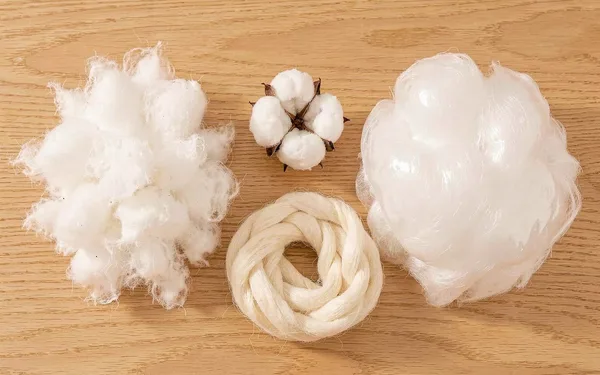
Comforter Fill Materials Compared: 4 Types
| Material | Warmth | Lightness | Moisture absorption | Price range | Who it's best for |
| Down | ◎ Excellent | ◎ Lightest | ○ High | ¥20,000–¥500,000+ | Shoppers who put quality and comfort first, and want a comforter that lasts for years |
| Feather | ○ High | △ Slightly heavy | ○ High | ¥10,000–¥50,000 | Value-focused shoppers who like a springy, resilient feel |
| Cotton | ○ High | △ On the heavy side | ◎ Excellent | ¥10,000–¥30,000 | Lovers of natural fibers, and anyone who sleeps hot or clammy |
| Synthetic (polyester) | △ Average | ○ Light | △ Low | ¥5,000–¥30,000 | Budget-first shoppers who want easy washing |
The first thing to understand is what your comforter is filled with.
The material determines a comforter's warmth, weight, moisture absorption and price.
Here, we'll focus on down comforters.
What determines the thickness of a down comforter?
Not all down comforters are alike — they range from very thin to very thick.
Two main factors determine how thick a down comforter is.
- Inside a down comforter: how it's constructed
- Down fill weight
Let's look at each factor in detail.
Inside a down comforter: how it's built
One factor that determines a down comforter's thickness is its internal construction.
Thickness (loft) increases the wider the baffle walls inside the comforter are. Conversely, the narrower the baffle walls, the less thickness you get.
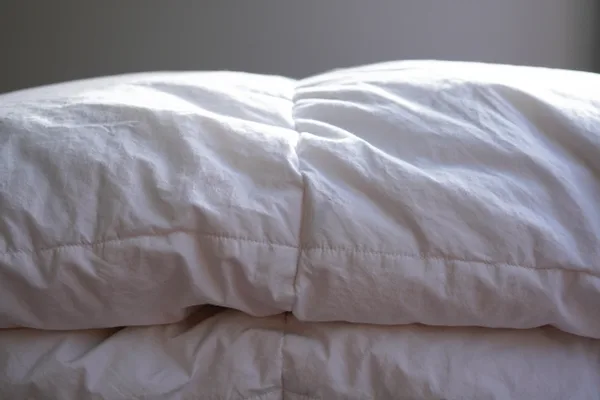
Here's another detail: down comforters are stitched into compartments so the down can't shift, and when those compartments are three-dimensional (box-baffle) construction, the comforter tends to loft up thicker.
With European-style quilting, where no down sits in the stitched seams, the comforter is characteristically less thick.
In short, the internal construction — stitching and baffle wall height — governs the thickness.
Down fill weight
The other factor that determines a down comforter's thickness is the down fill weight.
Fill weight is said to be one of the key factors that affects not only thickness, but also how heavy the comforter feels.
The more down inside, the thicker the comforter; the less down, the thinner it is.
Fill weight alone doesn't tell you whether a down comforter is good or not, so judge it by the balance between down quality and loft.
How to Choose Comforter Thickness by Season
| Type | Fill weight guide (Single) | Ideal room temperature | Season of use | Characteristics |
| Winter-weight comforter (thick) | 1.0〜1.5kg | 〜15℃ | November–March | Your main comforter for winter. Ideal if you feel the cold or live in a wood-frame home |
| All-season comforter (medium weight) | 0.5〜0.9kg | 15〜25℃ | April–June and October | For the spring and fall changeover seasons — and even winter in an apartment or with the heating on |
| Summer-weight (light) comforter | 0.2〜0.4kg | 25℃〜 | July–September | Summer and air-conditioned rooms. Light and comfortable |
How to choose the right size
| Size | Width × Length (approx.) | Best for | Keep in mind |
| Single | 150×210cm | 1 person | Check the size against your bed |
| Semi-double | 170×210cm | 1 person (roomy) | Stays on the bed and lets you turn over easily |
| Double | 190〜200×210cm | 2 people | If two people share it, consider the long size (230cm) |
| Queen / King | 210〜230×210cm | 2 people (roomy) | Fits larger beds |
Down comforter weights and when to use each
Down comforters come in several types, and each type has a different thickness.
The season and time of year you use them changes with the type, so it's worth knowing the basics.
Winter-weight comforter
A winter-weight comforter is used mainly through the winter season to keep the cold at bay.
It's the warmest of the types covered here, with noticeably more loft.
It's mainly a winter comforter, but you can also use it in spring and fall when the chill sets in.
The finer the down comforter — made with high-quality down with large down clusters — the less fill weight it needs.
Conversely, when there's a higher proportion of feather or the down clusters are small, more fill tends to be used to build up visible loft.
Goose down in particular has large clusters that trap more air, making the comforter lighter and warmer.
Goose down with large clusters is what lets you truly feel what a down comforter is meant to be: light and warm.
Keep in mind that the fill weight of a winter-weight down comforter varies with the quality of the down.
A sustainable down comforter that delivers the ultimate in down comforter craftsmanship
Summer-weight (light) comforter
A summer-weight (light) comforter has a light, airy feel and a thin, breathable shell.
Because it's so thin, it's really only suited to the warmest months, such as midsummer.
Some people who run hot keep using a summer-weight comforter until around November, though this generally assumes you're also adjusting with air conditioning, heating and what you wear to bed.
A summer-weight comforter is easy to reach for whenever there's a slight chill in the air, so it's handy to keep one on hand.
▼ You may also like this article.
Clean Cycle Down summer-weight (light) comforter / recycled down
Looking for a luxury comforter? Take a look below.
Related article: Luxury comforter lineup
All-season (medium-weight) comforter
An all-season comforter isn't as thick as a winter-weight comforter, yet it's thicker than a summer-weight one — that in-between loft is exactly what defines it.
It comes into its own at the change of seasons, as fall turns to winter and as winter turns to spring.
It also works well as your main comforter in spring and fall, which makes it very versatile.
Clean Cycle Down All-Season (Medium-Weight) Comforter for Spring & Fall / Recycled Down
Two-in-one (duo) comforter
A two-piece set is exactly what it sounds like: a way of using two down comforters together.
A two-in-one comforter typically combines a summer-weight comforter with an all-season one, so you get the best of both.
With two comforters on hand, you can mix and match: the all-season comforter in spring and fall, the summer-weight comforter alone in warm weather, and both layered together in winter.
Compared with a winter-weight comforter, a two-piece set simply weighs as much as two comforters, so if light weight matters most to you, a winter-weight comforter that delivers plenty of warmth in a single layer is the better choice.
The appeal of a two-piece set is that you can fine-tune your warmth to how you actually feel.

If you're shopping for a luxury comforter, take a look below.
Related article: Luxury comforter collection
How comforter thickness relates to warmth
Is there a connection between a down comforter's thickness and its warmth?
The answer isn't a simple yes or no.
That's because the quality of the down used in a comforter affects its thickness, and the warmth changes along with it.
With high-quality down, even a smaller fill weight and a slimmer comforter create the loft and air space that trap warmth, so you get both. Low-quality down, on the other hand, has less loft, so the only way to compensate is with sheer volume — which tends to make the comforter bulky.
A thicker down comforter means a larger fill weight, but overfilling makes the comforter stiffer, so it hugs the body less closely and is said to warm up less effectively.
Packing in too much down can also reduce the comforter's ability to regulate temperature.
All of these factors need to be weighed up together.
Related reading: What is loft in a down comforter? How it differs from fill power
What else matters besides thickness when choosing a down comforter
Thickness is certainly an important factor when choosing a down comforter, but there are several other points worth checking.
Here are the main ones.
- Type of down
- Type of quilting
- Shell fabric quality
Let's look at each one in turn.
Types of down
When choosing a down comforter, it's important to consider the type of down.
There are three main types: duck down, goose down and mother goose down.
Duck down is relatively inexpensive, and some products deliver impressive fill power for the price. The downside: ducks are omnivores, so duck down is more prone to developing an odor.
Goose down is lighter than duck down and loft better, and because geese are herbivores it is far less likely to smell. In return, goose down costs more than duck down.
Mother goose down is lighter than both duck and regular goose down while still offering plenty of loft. It tends to be the most expensive, and it is widely regarded as the highest quality.
Weigh up which benefits matter most to you — and which drawbacks you can live with — before you decide.
Related reading: How to choose a down comforter: the key points
Types of quilting
Every down comforter is divided into compartments by quilting.
The reason for the quilting is simple: each sealed compartment holds its own portion of down, and the stitching keeps that down from shifting and bunching up in one place.
With quilting sewn straight through from the top fabric to the backing, moisture escapes easily, so the comforter stays comfortable even in summer. The flip side is that warm air escapes just as easily.
Baffle-box quilting, which uses fabric walls to create depth at each seam, drapes closely around the body and holds warmth beautifully — but it takes more work to make, so prices tend to be higher.
There is also two-layer quilting, where the seams of the two layers are offset. Warm air can't escape through the stitching and moisture is held inside, making it a good choice for people in cold regions.
Even among down comforters, the stitching method alone makes a big difference to warmth and breathability, so it's well worth checking.
Shell fabric quality
The shell fabric (gawakiji) is the outer fabric that encases the comforter.
Many people assume the fabric hardly matters because the comforter will be covered anyway — but it's no exaggeration to say that the shell fabric makes or breaks how comfortably you sleep.
For a down comforter's shell fabric, we recommend cotton. It's a little heavier than other fabrics, but it reduces the rustling sound the comforter makes and feels wonderfully soft against the skin.
Besides cotton, you'll also find polyester and Tencel shells, each with its own pros and cons — choose based on what matters most to you at bedtime.
Related article: Don't overlook the shell fabric of your down comforter! Fabric types and how to choose
Frequently Asked Questions
Q1. Should I choose a down comforter or a feather comforter?
A. If quality and comfort come first, go with a down comforter; if value for money is your priority, a feather comforter is a good pick. With a down comforter, look for a down cluster ratio of 90% or higher and a fill power of 350 dp or more and you won't go wrong.
Q2. What size is a Single comforter?
A. A standard Single comforter measures 150cm wide × 210cm long (about 59" × 83"). Sizes vary slightly by product. As a rule of thumb, aim for roughly your bed width + 50cm.
Getting the balance right between loft and warmth matters
In this article we've looked at the relationship between a down comforter's thickness and its warmth.
Thicker doesn't automatically mean warmer — but a certain amount of loft is still essential.
And a "good" down comforter isn't decided by thickness alone: the shell fabric, the type of quilting and the type of down all play a part.
Look at a down comforter as a whole — thickness included — and you'll be well on your way to a truly comfortable night's sleep.
At Omotesando Futonten, sustainability is at the heart of how we make things. We use high-quality recycled down carefully selected from around the world,
and our RDS Down (virgin down) carries RDS certification, an international standard with strict animal welfare requirements.
If you're looking for a light, warm down comforter (duvet) that combines Japan's finest quality with a refined design that fits right into your interior, take a look at the Omotesando Futonten collection.
For high-quality Japanese-made premium down comforters (duvets), choose Omotesando Futonten
| Related articles
・Blanket over or under your down comforter? A pro explains the best order, material by material |
Comforter types are defined by two things: material and weight
Most people searching for "types of comforters" end up mixing two different things: differences in material and differences in weight. In reality, comforters can be organized along these two axes.
- By material: four options — down, feather, cotton and synthetic (polyester)
- By weight: four options — winter-weight comforter, mid-weight comforter (aigake), summer-weight (light) comforter, and a two-in-one set (two comforters that snap together)
Material determines the fabric and the fill inside; weight determines which season you'll use it in and how warm it will be. Combine the two and you'll land on the comforter that's right for you.
The difference between a comforter and a down comforter
"Comforter" is a bedding category, and it includes down comforters, feather comforters, cotton-filled comforters and synthetic-fill comforters. In other words, a down comforter is one kind of comforter — the two are not competing options.
The easiest way to shop is to decide in this order: first the fill material (down, feather, cotton or synthetic), then the weight — winter-weight, all-season (medium-weight) or summer-weight (light) — to match the season.
Summer vs. winter down comforters: what's different
A summer-weight (light) down comforter and a winter-weight down comforter use the same down, but differ in fill weight and quilt construction.
- Winter-weight: a higher fill weight, with baffle-box quilting and similar constructions that keep warm air from escaping
- Summer-weight (light): a lower fill weight and thinner profile, built for breathability
An all-season (medium-weight) comforter for spring and fall sits between the two in fill weight. For season-by-season fill weight guidelines, see the table in "How to choose comforter weight by season" below.