The answer in 30 seconds
- The down cluster ratio is the percentage of down in the fill. The more down, the more air it traps — lighter, warmer and better molded to your body.
- Aim for a down cluster ratio of 90% or higher. Even at 80% or higher you can feel what makes a down comforter special. If quality is your priority, go for 93% or higher.
- Under 50% is classed as a feather comforter. Comforters in the 50% range still count as down comforters, but you won't feel much lightness or warmth.
- Labels are allowed a tolerance of plus or minus 5%. Since the stated figure isn't always exact, also consider the maker's reliability and the Gold Label.
When choosing a down comforter, it's important to check the down cluster ratio. Overlook this figure and you may end up with a comforter that never quite delivers what down is known for. Here we explain what the down cluster ratio means for down comforters, and how this figure affects quality.
With the information below, it should be much easier to find the down comforter that fits your needs. If you're shopping for one, we hope this helps.
What is the down cluster ratio of a down comforter?
It indicates the proportion of down in a down comforter. The fill of a down comforter is made up of down (down clusters) and feathers.
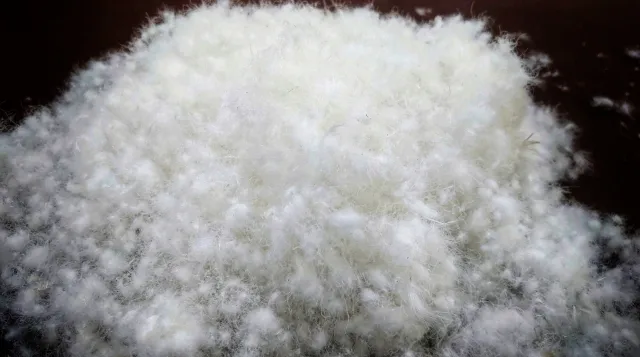
Down is the plumage that grows on the breast of waterfowl; feathers come from the wings or the belly (small feathers). Down has no quill running through the center — it looks something like a dandelion seed head.
Feathers are what most people picture when they think of plumage. Down, which spreads out softly, traps far more air than feathers (it also expands to hold air when it's cold and contracts to release air when it's warm).
That's why a down comforter with a high down cluster ratio is lighter, warmer and drapes better around the body — in other words, it's higher quality.
What down cluster ratio should you look for?
Below, we look at how quality changes with the down cluster ratio.
Down cluster ratio of 50% or higher
This sits right at the line between a down comforter and a feather comforter (below 50% it's a feather comforter). It is technically a down comforter, but you may not feel what makes down special — the lightness, the warmth and the way it hugs your body.
On the other hand, prices tend to be lower. In a sense, you could call it a down comforter that sits close to a feather comforter. Feather comforters breathe well, but they are not especially warm or lightweight.
This is not a down cluster ratio we can actively recommend to anyone who wants to experience what makes a down comforter special.
Down cluster ratio of 80% or higher
This is the down cluster ratio at which you can feel the lightness and drape — in other words, the real benefits of a down comforter. Below this level, the comforter may start to feel heavy. Another plus is that many products in this range are reasonably priced. You could call it the down cluster ratio with the best balance of quality and price.
For reference, this percentage is the Excel Gold Label standard (down content ratio) under the Gold Label (quality recommendation label) issued by the Japan Down Products Cooperative Association. The Gold Label standards are as follows. [1]
| Label | Down content ratio | Fill power | cleanliness | Oxygen number |
| Premium Gold | 93% or more | 440dp or higher | 1,000 mm or more | 4.8 mg or less |
| Royal Gold | 90% or more | 400 dp or higher | 1,000 mm or more | 4.8 mg or less |
| Excel Gold | 80% or more | 350 dp or higher | 500 mm or more | 4.8 mg or less |
| New Gold | 50% or more | 300 dp or higher | 500 mm or more | 4.8 mg or less |
| Silver Label | 50% or more | 250 dp or more | 500 mm or more | 4.8 mg or less |
| Bronze Label | 50% or more | 200 dp or more | 500 mm or more | 4.8 mg or less |
That said, you may not notice the same moisture-balancing effect you get from products with a down cluster ratio of 90% or more. It's a good choice if you want to experience the benefits of a down comforter at an affordable price.
Down cluster ratio of 90% or higher
This down cluster ratio delivers excellent lightness, warmth and drape. It's also worth noting that it keeps you warm without feeling stuffy. And because it contains less than 10% feather, the comforter feels softer against the skin, too. This is a down cluster ratio at which you can really appreciate what a down comforter has to offer.
Under the Gold Label program issued by the Japan Down Products Cooperative Association, this is the Royal Gold Label standard. It's arguably the level most specialty stores feel confident recommending to their customers. A good fit if you're looking for a down comforter with genuinely good quality.
Down cluster ratio of 93% or higher
This is the standard for the Premium Gold Label, the top class of the Gold Label issued by the Japan Down Products Cooperative Association. Naturally, it excels in lightness, warmth, drape and moisture balance.
The main difference from a down cluster ratio of 90% or more is the amount of down actually filling the comforter. Because down is so light, even a 3% difference translates into a significant difference in fill weight.
Another key point, related to the tolerance range explained below, is that quality tends to be more consistent. You can expect a genuinely luxurious feel in bed. Recommended for anyone who wants the very best down comforter quality.
Looking for a luxury comforter? Take a look below.
Related article: Luxury comforter lineup
Look for a down cluster ratio of 90% or higher
The down cluster ratio is a useful yardstick for judging the quality of a down comforter. So what percentage should you look for?
Generally speaking, a down comforter with 90% or more is recommended, because that's where you most easily feel the hallmarks of down: lightness, warmth, moisture balance and the way it drapes around you. The trade-off is that these products tend to cost a bit more. If the budget doesn't work, it's fine to go a little lower on the down cluster ratio.
At 80% or more, you'll still feel the benefits of a down comforter. If quality is your priority, look for 93% or more — even allowing for tolerance, you'll still enjoy everything a down comforter does well. Keep these points in mind as you choose your comforter.
There is a tolerance range for the down cluster ratio
When assessing the down cluster ratio, pay attention to the tolerance range. The tolerance is the margin of difference permitted between the stated down cluster ratio and the actual ratio. Japan's Household Goods Quality Labeling Act allows a margin of plus or minus 5%. So the actual ratio isn't necessarily exactly as stated.
The exact figure varies with each manufacturer's production technology and product policy. Some makers aim to come as close as possible to the stated figure, while others are said to work to the lower limit. That's why it's important to choose products from a manufacturer you can trust.
Alternatively, you can use the Gold Label issued by the Japan Down Products Cooperative Association as a guide. Its tolerance limits are stricter, so quality tends to be more consistent. For the Premium Gold Label (the top grade), for example, the permitted tolerance is −1% at the lower limit and +3% at the upper limit.

Other points to check besides the down cluster ratio
The quality of a down comforter isn't determined by the down cluster ratio alone. Here are the other points worth checking.
Fill power
This is the volume of 1 g of down once it's filled into the comforter — in other words, the loft, or how much the down expands. On quality labels it appears as a figure such as 300 dp. For reference, 300 dp means 1 g of down occupies 300 ml.
Down with a high fill power traps more air, so it's light yet warm. Essentially, think of it as an indicator of warmth. As a general rule, 400 dp or more (360 dp or more for duck down) is considered high quality.
Related article: What is fill power, and why is it essential when choosing a high-quality down comforter?
Shell fabric material and breathability
The shell fabric is the fabric that encases the down comforter. When choosing a down comforter, you also need to check the quality of the shell fabric, because even excellent down will sleep poorly inside a low-quality shell. The key things to assess are the material and the breathability of the shell fabric.
Shell fabrics are mainly made from polyester, cotton or silk. Cotton is generally considered the best suited to the job: it's durable and breathable, which makes it ideal for down comforters. Fabrics woven from 80-count yarn or finer are especially recommended, as they offer both a lovely hand feel and good breathability. (Count refers to yarn thickness — the higher the number, the finer the yarn.)
Polyester, by contrast, isn't recommended because it doesn't breathe well. Silk is a wonderful material, but it's very delicate to care for.
Related article: Don't overlook the shell fabric of your down comforter! Fabric types and how to choose
How thoroughly the down is washed
Cleanliness (washing level) is an indicator of how thoroughly the down has been washed. Naturally, freshly harvested down carries dirt such as mud and dust, which has to be washed out before the down is made into a product.
Cleanliness is expressed as a figure such as 500 mm. In this case, it means you can see 500 mm through the water used to wash the down. In other words, the cleaner the down is washed, the higher the cleanliness figure.
Higher cleanliness means a more hygienic comforter with less odor. The common benchmark is 500 mm or more. If you're sensitive to dirt or smell, choose down rated at 1,000 mm or more.
If you're shopping for a luxury comforter, take a look below.
Related article: Luxury comforter collection
All goose down at Omotesando Futonten is labeled with the same guaranteed minimum of 93%
If you're looking for a high-quality down comforter, add Omotesando Futonten to your shortlist. The goose down comforters we carry are labeled with a down cluster ratio of 93%. Following the recommendation of the Japan Down Association, we state the minimum guaranteed figure.
In other words, 93% is the floor. We never take advantage of the allowable tolerance to label a comforter with an 88% down cluster ratio as 93%. In actual testing, our down cluster ratio measures around 96%.[2] Because we always state the minimum guaranteed figure, it is still labeled 93% in that case. Even if you're particular about quality, you can buy with confidence.
Summary
The down cluster ratio is the percentage of down in the fill. Quality varies with this ratio, and products at 90% or higher are where you really feel what makes a down comforter special.
That said, because of the allowable tolerance, the actual down cluster ratio can vary by roughly ±5%. If you want a high-quality down comforter, or you're investing in a premium one, it's important to check how trustworthy the specialist store is.
At Omotesando Futonten, every product is labeled with the minimum guaranteed down cluster ratio of 93%, just as the Japan Down Association recommends. Our Premium RDS Down uses clean down that has passed the strict RDS certification tests, so it's also sound from an animal welfare standpoint. Fill power is 450 cm³/g, and the shell is 100% cotton made from GRAN RISHU, a finest-grade extra-long staple cotton. Light, highly breathable and absorbent, with a gentle feel against the skin — please give it a try.
If you're looking for a down comforter (duvet) that combines Japan's finest quality with a refined design that complements your interior, do take a look at the Omotesando Futonten collection.
Premium RDS Down Winter-Weight Comforter / Mother Goose Down
For high-quality Japanese-made premium down comforters (duvets), choose Omotesando Futonten
[1] Source: Japan Down Products Cooperative Association, "Gold Label" quality recommendation label for down comforters
[2] Omotesando Futonten, "Test Result Certificate"
Frequently asked questions
What's the difference between an 80% and a 90% down cluster ratio?
At 80% or higher you can still enjoy what makes a down comforter special — lightness and the way it drapes over your body — and many of these are more affordable. At 90% or higher, feather content is under 10%, so lightness, warmth and drape are all superior, making it easier to stay warm without feeling stuffy.
Can the stated down cluster ratio differ from the actual one?
Yes. Japan's Household Goods Quality Labeling Act permits a tolerance of plus or minus 5%, so the label isn't always exact. The Gold Label sets stricter tolerances: for Premium Gold, the lower limit is −1% and the upper limit is +3%.
What should you check besides the down cluster ratio?
Fill power, the material and breathability of the shell fabric, and how thoroughly the down has been washed. Fill power of 400 dp or higher (360 dp or higher for duck down) is considered high quality. Cotton is the ideal shell fabric, 500mm or higher is the common standard for down cleanliness, and 1,000mm or higher is a good guide if odor concerns you.