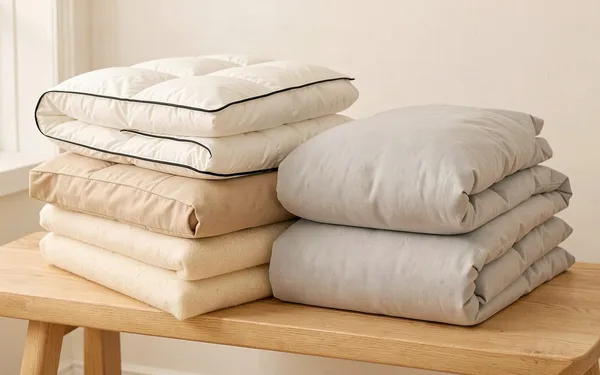
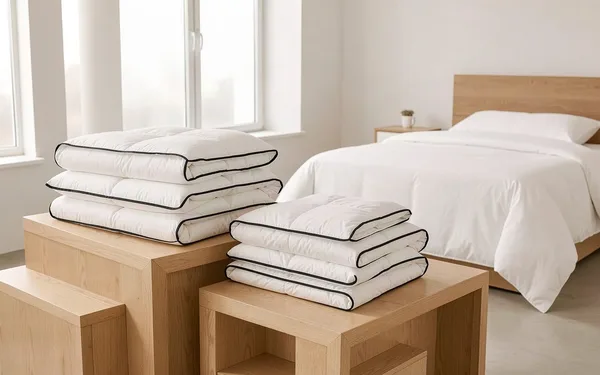
STEP 2: Sewing the down comforter shell
STEP 4: Inspection & shipping →
Why we insist on a traditional textile-weaving region
Fujiyoshida in Yamanashi Prefecture has drawn attention in recent years as a textile-weaving region, and when we started out, we asked a small sewing workshop there — with a team of about 10 people — to sew our down comforters.
Our in-house product manager introduced us, recommending the area for its many skilled craftspeople and its flexibility with small runs. The town is home to many small sewing workshops, and we commissioned two of them.
Then, two years ago, the manager of one of those workshops fell seriously ill and the workshop suddenly closed. *After six months, he made a full recovery and the workshop is open again today.
Let me tell the story through what I personally experienced at the time.
Back then, sales at Omotesando Futonten were growing steadily, and from the beginning we had expected that these small sewing workshops alone wouldn't be able to keep up with production in the long run.
I saw this as the moment to switch to one of Japan's large sewing factories, so I requested sewing samples.
Honestly, I had never paid much attention to sewing quality until then — and I was shocked by how poor the finish was. We had several more samples made, but sadly neither the machinery nor the craftspeople came close to the quality of our original workshop.
The reason: Japan's large futon sewing factories don't actually sew patterned fabrics themselves. They import shells sewn in bulk in China and use those instead.
We gave up on that factory, of course. But having taken our previous sewing quality for granted, I realized that relying on a single small workshop carried real risks going forward — so I began looking for skilled sewing factories in other industries as well, not just futon makers.
I requested samples from small domestic futon sewing workshops, as well as apparel and curtain sewing factories and others across many industries — yet every one of them fell short of the quality of our original workshop.
I later learned that this weaving district, located next to Lake Kawaguchi at the foot of Mt. Fuji, was historically not a futon region at all: it was the only area in Japan devoted to sewing woven textiles for local weaving mills.
After that experience, I firmly believe there is no sewing anywhere that surpasses what is made in this district, with all its history and tradition of weaving.
After our factory manager came back, I rethought everything. We live in an age when household goods can be ordered online cheaply and delivered the same day, but we decided to set aside production costs and speed, and to work only with skilled artisans whose work we can oversee down to the last detail, within a deliberately minimal setup.
The artisans who handle our work today are a team of three women: one with more than 30 years on the job, one with more than 20 years, and one now in her sixth year.
In busy seasons, orders pile up and some customers have waited more than a month. Whatever the reason, we never farm the work out to another sewing factory — we ask our customers to wait and keep production at the pace of these three artisans.
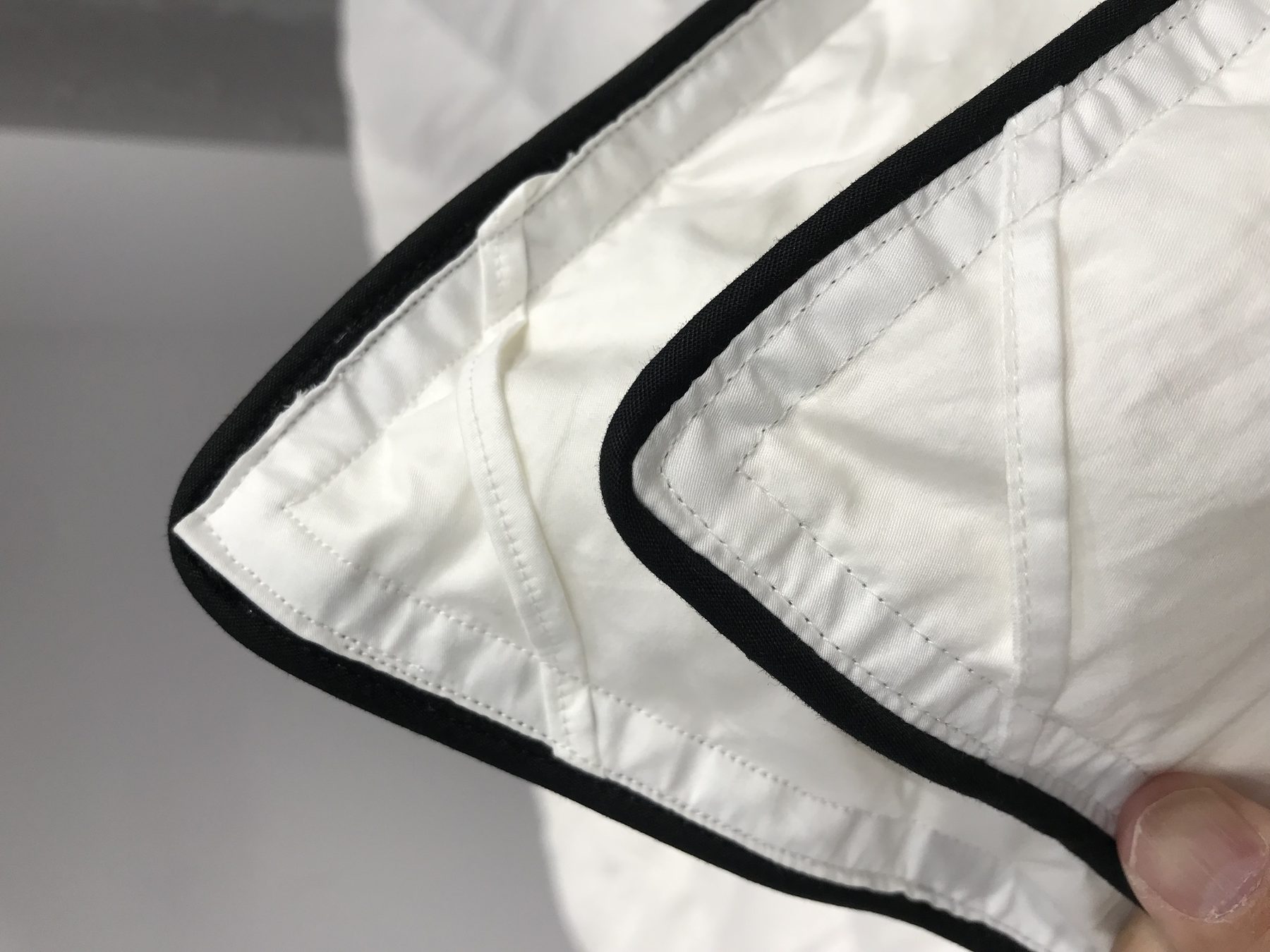
Every seam is sewn by hand, guided through twin-needle sewing machines. If you look closely at every corner of a comforter you've purchased, we think you'll see the quality for yourself.
The stitching on the left is from a typical factory that works with the big comforter manufacturers.
The stitching on the right is from the factory we work with.
For high-quality Japanese-made premium down comforters (duvets), choose Omotesando Futonten