The answer in 30 seconds
- A winter-weight comforter is the thickest down comforter of all, made for winter. It's also called a "winter down comforter" or "heavy-weight comforter." What sets it apart from all-season and summer-weight comforters is the fill weight of down.
- A good cue to start using it is when your bedroom drops to 15°C or below. Generally that's November through March; in Hokkaido and the Tohoku region, many households switch over during October.
- Check four specs when you shop. Fill weight, fill power, down cluster ratio, and shell fabric plus quilting. For winter, aim for a down cluster ratio of 90% or higher.
- Layering an all-season comforter over a summer-weight one is less efficient. It works as a substitute, but the air between the two layers escapes before it warms up, so a single winter-weight comforter retains heat better.
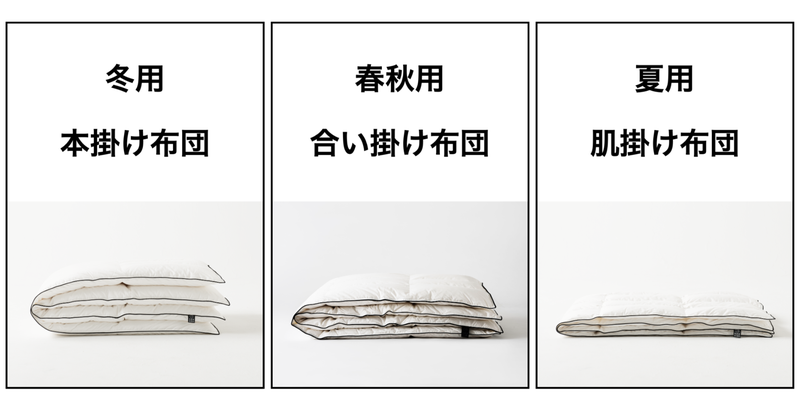
A winter-weight comforter is the type of down comforter with the highest fill weight — the one made for winter. In Single size it holds roughly 1.2–1.3 kg of down, giving it enough loft to carry you through the entire winter on its own. Of the three standard types — the all-season (medium-weight) comforter (around 0.8 kg) and the summer-weight (light) comforter (around 0.3–0.4 kg) — think of it as the warmest.
This article sets out the differences between winter-weight, all-season and summer-weight comforters in terms of both fill weight and season of use, so you can decide exactly which one you should buy.
What you'll learn in this article
- What a winter-weight comforter is, and how it differs from all-season and summer-weight comforters
- When to start using a winter-weight comforter — and when to put it away
- Which is better: one winter-weight comforter, or an all-season plus a summer-weight comforter layered together?
- The 4 specs to check when choosing a winter-weight comforter
What Is a Winter-Weight Comforter? The Warmest, Loftiest Down Comforter for Winter
A winter-weight comforter (hongake futon) is a down comforter built to be used on its own in the depths of winter. You'll also see it called a "winter down comforter" or a "thick comforter" — all of these refer to the same thing.
The warmth of a down comforter is determined by the quantity of down inside multiplied by its quality. A winter-weight comforter sits at the top end for quantity, typically holding 1.2–1.3 kg of down in Single size. Picture down that was compressed into roughly the volume of a tissue box expanding to full loft inside the comforter, and you have the right idea.
Down does not generate heat by itself. It creates layers of air between the clusters, and those layers are warmed by your body heat and held in place — that's what keeps you warm. In other words, warmth comes down to how much air the fill can trap. A winter-weight comforter is warm not simply because it's heavier, but because the layer of air it traps is thicker.
Warmth of a down comforter = quantity of down (fill weight) × quality of down (down cluster ratio and fill power) × the construction of the shell fabric. Winter-weight comforters top the scale on quantity, but they only deliver their true performance when the quality is there as well.
Winter-weight vs. all-season vs. summer-weight comforters
Down comforters fall into three broad types according to fill weight. In many cases the down inside is exactly the same and only the name differs — the real difference is how much of it goes in.
| Type | Typical fill weight (Single) | Main season of use | Suitable room temperature |
|---|---|---|---|
| Winter-weight comforter (for winter) | 1.2〜1.3kg | November–March | Around 15°C or below |
| All-season (medium-weight) comforter (spring & fall) | Around 0.8 kg | April to June / September to November | Around 15–20°C |
| Summer-weight (light) comforter (for summer; down blanket) | 0.3〜0.4kg | June to September | Around 20°C or above |
Winter-weight vs. all-season comforters
These two are the easiest to confuse. The difference is fill weight: a winter-weight comforter holds about 1.5 times as much down as an all-season one.
In everyday terms, an all-season comforter has just the right loft for those first chilly nights, while a winter-weight comforter is thick enough that you can turn the heating off and still sleep comfortably. In the lowland areas of Kanto and points west, the switch to a winter-weight comforter usually comes in early November, once mornings and evenings start to turn cold.
For more on all-season comforters, see How to Choose an All-Season Comforter: A Specialist's Guide to the Best Down Comforters for Spring and Fall.
Winter-weight vs. summer-weight comforters
A summer-weight (light) comforter, or down blanket, is made for summer and holds only about a quarter of the fill weight of a winter-weight comforter. Think of it as something to drape over you in an air-conditioned room in midsummer so your stomach doesn't get cold. Sleeping under nothing but a summer-weight comforter in winter simply isn't realistic, even with down.
For full details on summer-weight comforters, see What Is a Lightweight or Summer-Weight Down Comforter? A Specialist's Guide to Choosing for Summer and How It Differs from an All-Season Comforter.
How this differs from a "two-piece" comforter set
Some down comforters on the market are sold as "two-piece" (duet-type) sets, where an all-season and a summer-weight comforter snap together to form one. It looks like a smart solution, but there are two things to be aware of.
- Gaps open up between the two snapped-together comforters, and those gaps become escape routes for heat.
- Even when the combined fill weight matches that of a winter-weight comforter, the doubled-up quilting (baffle boxes) stops the down from reaching full loft, so the same amount of down delivers less warmth.
If warmth is your only criterion, our view as a specialist store is that a single comforter built from the start as a winter-weight model is more efficient. That said, if storage space is tight and you can only keep one set of bedding, a two-piece comforter is a perfectly sensible choice.
When should you start using a winter-weight comforter?
Rather than going by the calendar month, judge by room temperature — you'll get it right far more often. Once your bedroom drops below 15°C, it's time for the winter-weight comforter.
| Season | Typical bedroom temperature | Recommended bedding |
|---|---|---|
| Early to mid-September | Around 22℃ | Summer-weight (light) comforter |
| Late September to October | 18〜20℃ | All-season (medium-weight) comforter |
| November–March | 15℃ or below | Winter-weight comforter |
| April to May | 18〜20℃ | All-season (medium-weight) comforter |
Regional differences are significant: in Hokkaido and the Tohoku region, many households switch to a winter-weight comforter during October, while in Kyushu and Okinawa it may not happen until December. Go by the thermometer in your own bedroom rather than the calendar.
For more on when to make the switch, see What Is an All-Season Comforter? When to Use It and How to Choose for the Change of Seasons, Explained by a Specialist Store.
What to do when you change over your bedding
When you take your winter-weight comforter out of storage, let it air for about half a day before using it. Down that has been compressed in storage takes in air again and returns to its natural loft. Shade on a sunny day, or simply draped over the back of a chair indoors, is plenty. There is no need to put it in direct sunlight — in fact, please avoid it (we explain why in How to Care for and Maintain a Down Comforter: Airing It Out Without Inviting Mold).
How to choose a winter-weight comforter: the 4 specs to check
1. Fill weight (1.2kg or 1.3kg)
Most Single winter-weight comforters use either 1.2kg or 1.3kg of down. What that 0.1kg difference means depends on the quality of the down.
High-quality down lofts up dramatically even in smaller amounts. That is why "1.2kg of down at 450㎤/g fill power" and "1.3kg of down at 400㎤/g fill power" end up close in terms of total lofted volume. The former is lighter; the latter is easier on the budget.
At Omotesando Futonten, the Mother Goose Sleep Down Winter-Weight Comforter uses 1.2kg of down at 450㎤/g fill power, while the White Goose Sleep Down Winter-Weight Comforter uses 1.3kg at 400㎤/g.
2. Fill power (loft)
Fill power is a measure of how much volume 1g of down expands to. It is expressed in ㎤/g, and the higher the number, the less down is needed to keep you warm.
- Around 300㎤/g: standard quality
- 350–400㎤/g: good quality, with plenty of performance for winter use
- 400㎤/g and above: high quality, combining light weight with real warmth
For details, see Loft (Fill Power) vs. Japanese Down Power: Meanings, Differences and Benchmarks, Explained by a Specialist Store.
3. Down cluster ratio
This is the percentage of the fill made up of "down" — the soft, dandelion-like clusters. The remainder is "feather" (small quill-bearing feathers), and too much of it makes a comforter stiff and can cause a scratchy, prickly feel. For a winter-weight comforter, look for a down cluster ratio of 90% or higher.
You'll find more detail in What is down cluster ratio? A plain-English guide to down comforter quality specs.
4. Shell fabric and quilting
The fabric that encases the down also affects warmth. There are two things to look at.
- Weave density and yarn count: 100% cotton high-count sateen (60s, 80s, 100s) keeps down from leaking while letting moisture escape. The higher the number, the finer the yarn, and the softer and lighter the fabric.
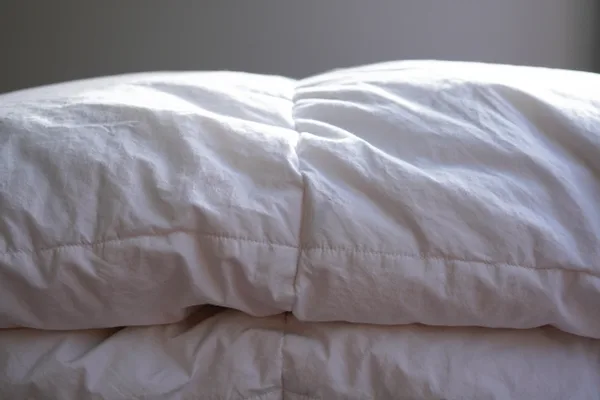
- Quilting construction: Winter-weight comforters are built with <x1 />baffle-box quilting as standard. Fabric walls along the sides of each box give the chambers height, so the down keeps its loft instead of being crushed. With flat (sewn-through) quilting, the down is pinched off at the seams and cold spots form there.
We compare shell fabrics in 60 Sateen vs. 80 Sateen: How to Choose the Shell Fabric for Your Down Comforter, Explained by a Specialist Store.
One winter-weight comforter, or two layered together?
We are often asked, "Can't I just layer an all-season comforter with a summer-weight one instead of a winter-weight comforter?" The short answer: yes, it works — but it is less efficient.
The reason is that the layer of air trapped between the two comforters escapes before your body heat can warm it. With a single winter-weight comforter, a thick layer of down sits directly above you, and the air warmed there stays right where it is. When you layer two, the top one only starts doing its job after the bottom one has warmed up, so the first few minutes after you get into bed feel chilly.
That said, layering does have its advantages in the following situations.
- You want the option to peel off a layer when you get too warm in the middle of the night during seasonal changes
- You don't want to add more bedding because storage space is limited
- You tend to sleep with the heat turned up high
For how to layer a blanket with your comforter, see The Right Order for a Down Comforter and Blanket: A Specialist's Answer.
Caring for a winter-weight comforter, and how long it lasts
In-season care
Because you use a winter-weight comforter every night, moisture builds up inside it. People are said to lose about a cup of sweat over a single night, and most of it is absorbed by the bedding.
- When you get up, fold the comforter back and let it air out for 10–15 minutes before making the bed
- Once or twice a month, air it for 1–2 hours in a well-ventilated shady spot
- Wash the duvet cover about once a week
Never beat it with a futon paddle. It snaps the down fibers, and the loft never comes back.
Off-season storage
When you finish using it in spring, dry it thoroughly, place it in a breathable non-woven storage bag, and store it loosely folded on an upper closet shelf. Avoid keeping it crushed in a vacuum compression bag for long periods. For details, see Can You Vacuum-Compress a Down Comforter? Why Not, How to Store It Properly, and How to Restore the Loft — Explained by Specialists.
Typical lifespan
A winter-weight comforter made with high-quality down and properly cared for will last about 10 to 15 years. When the loft no longer returns, replacement isn't your only option — there's also down comforter refurbishing (re-making). The down inside is washed, topped up where it has thinned, and re-sewn into a new shell — and the better the original down, the more worthwhile it is.
We've summarized how to decide in How Long Does a Down Comforter Last? How to Decide Between Replacing and Refurbishing — Explained by Specialists.
What actually differs between price points
Winter-weight comforters range enormously in price, from a few thousand yen to several hundred thousand. Even though they all go by the name "winter down comforter," it's closer to the truth to think of them as entirely different products inside. The differences come down to four main points.
Type and origin of the down
Waterfowl down falls into two main categories: goose and duck. Geese are larger birds with larger individual down clusters, so goose down tends to loft better and give off less odor. Within goose down, mother goose down — taken from mature parent birds — has the largest clusters and sits at the very top of the range.
As for origin, down from cold regions such as Poland and Hungary is the most highly regarded. The colder the climate, the denser the down a waterfowl grows to protect itself. For details, see What Is Goose Down? How It Differs from Duck Down and Eiderdown — Explained by Specialists and Down Origins Used in Down Comforters: Where They Come From and What Sets Them Apart.
How thoroughly the down is washed
Washing is the factor most often overlooked. Down is an animal-derived material, so if it isn't washed thoroughly, oils and residues remain — and that's what causes odor. A down comforter that "smells like an animal even though it's brand new" almost always wasn't washed enough.
At Omotesando Futonten, we wash our down in natural underground water from Hakushu in Yamanashi Prefecture, without detergent, to twice the JIS standard. We're particular about the quality of the water itself because what's left behind in the rinse ultimately determines odor and cleanliness.
Sewing and quilting precision
Even with the same amount of down inside, loft changes with the baffle-box design and the precision of the stitching. If the baffle walls are too short, the down is crushed; too tall, and the down shifts unevenly. There's a clear difference in precision between comforters sewn one at a time by craftsmen in Japan and those produced on a mass-production line.
How it reaches you
Products sold through department stores and big-box retailers naturally carry distribution costs. At the same quality, the final price changes depending on whether you're buying direct. "Expensive means good" and "cheap means bad" are both unreliable, because price includes factors that have nothing to do with quality.
We compare what's inside comforters at each price point in detail in Down Comforter Grades and Rankings: How to Judge Quality — A Specialist's Complete Guide.
Common buying mistakes, and how to avoid them
Judging by "90% down cluster ratio" alone
Down cluster ratio is an important figure, but it doesn't determine warmth on its own. Even at 90%, down with small clusters won't loft. Always check the down cluster ratio and the fill power together.
Looking only at how much fill weight you get
Thinking "1.5 kg must be warmer" can lead you to a heavy comforter densely packed with low-grade down. A down comforter keeps you warm by draping along your body and sealing out gaps, so one that's too heavy won't follow your contours — and you'll actually feel colder.
Pressing it in the store and deciding "it's firm, so it must be good"
The springiness you feel when you press down depends not only on down quality but also on how tightly the quilting is tensioned. A more reliable test is to open it out and check that the thickness is even, rather than judging by how it looks and feels folded.
Treating the cover as an afterthought
No matter how good the comforter itself is, a duvet cover with poor breathability traps moisture and undermines both warmth and cleanliness. Choose a cover in a material that absorbs and releases moisture, such as 100% cotton.
Frequently asked questions
Is a winter-weight comforter different from a down comforter?
No — a winter-weight comforter is one type of down comforter. "Down comforter" refers to any comforter filled with down, and the winter version with the highest fill weight is called a winter-weight comforter. That said, winter-weight comforters also exist with wool or polyester fill, so "winter-weight" doesn't automatically mean down.
Which months is a winter-weight comforter for?
Generally November through March. But climate and home environments vary widely, so a more reliable rule is to start using it once your bedroom drops below 15°C.
Can I use a winter-weight comforter all year round?
You can, but we don't recommend it. Using a thick down comforter in warm weather means the down absorbs your night sweat, which leads to stuffiness and odor. It also puts a heavy strain on the down and shortens its life. At minimum, we suggest having two comforters — a winter-weight and a summer-weight — and switching with the seasons. In the long run, it's the more economical choice.
My winter-weight comforter feels heavy. Can it be made lighter?
Upgrading the quality of the down gives you the same warmth with less weight. High fill power down lofts up dramatically from a smaller amount, so less fill weight is needed. Choosing a shell fabric in a high thread count (80s or 100s yarn) also makes the fabric itself lighter. If your current comforter feels heavy, it may be filled mainly with feathers rather than down. Check the down cluster ratio on the quality label.
Can I wash a winter-weight comforter?
We don't recommend washing it in a home washing machine. If it doesn't dry completely, moisture stays trapped inside, the down clumps together, and the loft never fully comes back. If you're concerned about soiling, take it to a cleaner experienced with down comforters; if the loft has flattened, consider down comforter refurbishing (remaking with the existing down). For details, see What to Know Before Sending Your Down Comforter to a Professional Cleaner.
How do I choose the right size winter-weight comforter?
As a rule, match the width of your bed or futon mattress. That said, a down comforter works by keeping warmth from escaping along the sides of your body, so we sometimes recommend going one size up for larger builds or for people who move around a lot in their sleep. See How to Choose Your Down Comforter Size (Single, Semi-double, Double) for guidelines.
How many winter-weight comforters do I need?
One per person is plenty. If you often have overnight guests, though, it's reassuring to keep one extra on hand. For guests, an all-season (medium-weight) comforter is usually more practical year-round than a winter-weight one — and it takes up less storage space.
Do I need a blanket with a winter-weight comforter?
With a winter-weight comforter holding 1.2–1.3 kg of fill at around 400 dp (cm³/g) fill power, you can get through a Japanese winter without a blanket. If you find yourself wanting to add one, the comforter may not be the right size for your build, or there may not be enough insulation underneath you.
What's the difference between a winter-weight down comforter and a feather comforter?
"Winter-weight" classifies a comforter by fill weight; "feather comforter" classifies it by what's inside. If the filling is 50% or more down, it's a down comforter; if more than 50% is feather, it's a feather comforter. Winter-weight feather comforters do exist, but the quills make them heavier and stiffer, and they insulate less well.
Do you offer winter-weight comforters in junior size?
Yes. Junior size is slightly smaller than Single, and fill weight is typically around 0.8–1.0 kg. Children run warmer than adults, so a comforter as thick as an adult's will leave them too hot and kicking it off — which ends up making them cold.
Summary
- A winter-weight comforter is a down comforter for winter, filled with roughly 1.2–1.3 kg of down in Single size
- That's about 1.5 times the fill weight of an all-season comforter (around 0.8 kg) and more than three times that of a summer-weight comforter (0.3–0.4 kg)
- A good cue to start using it: when your bedroom drops below 15°C. Generally November through March
- When choosing one, check four things: fill weight, fill power, down cluster ratio, and the shell fabric and quilting
- Layering an all-season comforter with a summer-weight one works as a substitute, but a single winter-weight comforter traps heat more efficiently
At Omotesando Futonten, we offer winter down comforters across a range of price points — from winter-weight comforters filled with new Polish down to ones remade with high-quality recycled down sourced in Japan. Every comforter is made to order, sewn one at a time after you place your order.
Shop winter-weight down comforters at Omotesando Futonten
Want to try one first? | Monthly comforter rental (from ¥3,960/month)
What is a "single ket"? How it differs from a winter-weight comforter
"Single ket" is a Japanese term for any thin, summer-weight top covering in Single size. It can be made from linen, cotton, gauze, towel cloth and more — it isn't necessarily filled with down. The summer-weight comforter (down ket) covered in this article is one type of single ket, filled with a small amount of down (around 0.3–0.4 kg).
How to decide which one you need
If you want something that absorbs sweat and stays fresh against the skin, a cotton or gauze single ket is the better choice. If air conditioning tends to leave you chilled even at the height of summer, a summer-weight comforter (down ket) with some insulating power suits you better. Both are thin coverings that can't replace a winter-weight comforter, so the basic approach is seasonal: a winter-weight comforter in winter, and a single ket or summer-weight comforter in summer.
How fill power and fill weight work together in a winter-weight comforter
When you're shopping for a winter-weight comforter, looking at figures like "400 fill power," "1.2 kg fill weight" or "1.3 kg" in isolation won't give you an accurate comparison of actual warmth. As noted above, warmth is determined by fill power and fill weight multiplied together, so two comforters both filled with 1.3 kg will differ in loft and lightness if their fill power differs. When comparing products, always check that both the fill weight and the fill power are clearly stated.