The answer in 30 seconds
- Start with where you'll lay it. If it goes directly on a floor or tatami, choose enough thickness and a firm core (hard cotton wadding or foam) so you don't feel the floor underneath.
- Choose the material by how easy it is to care for. Cotton absorbs moisture well but is heavy; synthetics are light and dry quickly. Wool releases moisture easily and works well year-round.
- Firmness should be "not too sinking, not too hard." As a guide, your hips shouldn't sink when lying on your back, and your shoulder shouldn't ache when lying on your side.
- The standard size is Single, 100 × 210 cm (about 39 × 83 in). Match your covers and sheets to the 210 cm length.
Contents: 1. Shikibuton vs. mattress / 2. The five criteria for choosing / 3. Material comparison / 4. Sizes / 5. How to make it last / 6. Frequently asked questions
"Which shikibuton should I buy?" "Is a mattress better?" Compared with a comforter, the differences between floor mattresses are harder to see, and it's not obvious where the price gap comes from. Yet this is the bedding that supports your body all night long. Choose the wrong one and you may end up with strain on your lower back and shoulders, and restless nights.
In this article, Omotesando Futonten, a bedding specialist in Omotesando, Tokyo, breaks down how to choose a shikibuton using five criteria — where you'll lay it, thickness, firmness, material and size — and explains how it differs from a mattress, plus how to make yours last.
Related reading: Japanese Bedding Size Chart: Single, Semi-double and Double Dimensions
1. Shikibuton vs. mattress
Both go underneath you, but they differ in how they're used and how they're built.
| Futon mattress (shikibuton) | Mattresses | |
|---|---|---|
| Where it goes | Floor or tatami | On a bed frame |
| Thickness | A few cm to around 10 cm | Around 10-plus cm to 30 cm |
| Fill | Cotton, wool, polyester, hard cotton wadding, etc. | Springs (coils), foam, latex, etc. |
| Can it be folded? | Folds up for storage | Generally cannot be folded (except tri-fold types) |
| Care | Release moisture by airing it out and putting it away each day | Rotate it and stand it up to air out |
| Best suited for | Japanese-style rooms; making the most of your floor space | Western-style rooms; making it easier to get in and out of bed |
If you want your room to stay open and usable during the day, a Japanese futon mattress (shikibuton) is the better fit; if you'd rather skip folding and storing bedding every morning and want firm support, go with a bed and mattress. One caution: laying a futon mattress on top of a bed blocks the bed's airflow, so moisture builds up easily.
2. How to choose a futon mattress: 5 key points
① Where you'll lay it
If you lay it directly on a floor or tatami, the top priority is that you don't "bottom out" (feel the floor through the mattress where your body is heaviest). Look for one with a firm cotton or urethane foam core inside, or simply a thicker model. Wood floors trap moisture easily, so also consider pairing it with a slatted base (sunoko) or a moisture-absorbing sheet.
② Thickness
Laid directly on the floor, a mattress without enough thickness lets your lower back and hips sink toward the floor — a common reason for waking up sore. If you use a thin futon mattress, you can add a mattress pad or topper underneath to make up the difference. On the other hand, a very thick futon mattress is heavy and becomes a chore to fold, store and air out, so factor in whether you'll be putting it away every day.
③ Firmness
Too soft and your hips sink, curving your spine; too firm and pressure concentrates on your shoulders and lower back. A good guide: on your back, your hips shouldn't sink, and on your side, your shoulder shouldn't ache. Heavier sleepers tend to do better with a slightly firmer mattress, lighter sleepers with a slightly softer one.
④ Material
The material affects not just comfort but also how easily moisture escapes and how simple the mattress is to care for. We compare the options in the next section.
⑤ Size
Single 100×210cm is the standard. If two people share the bedding, or for larger builds, consider Semi-double and Double as well. See Section 4 for details.
3. Futon mattress materials compared
| Material | Strengths | Things to watch for |
|---|---|---|
| Cotton (cotton batting) | Highly absorbent; soaks up night sweat. Can be renewed through refurbishing (re-carding and re-fluffing the filling) | Heavy. Flattens easily once it absorbs moisture, so it needs frequent airing |
| Wool | Absorbs moisture and releases it outward; warm in winter and less stuffy in summer | Can have a distinctive smell. Air it in the shade rather than direct sun |
| Polyester (synthetic) | Light and quick-drying. Affordable | Low moisture absorption, so it can feel stuffy. Some models flatten quickly |
| With a firm cotton or urethane foam core | The core supports your body, so you're less likely to bottom out. Usually lightweight | Urethane foam traps moisture, so always air it in the shade |
Most futon mattresses use a "multi-layer" build: cotton or wool at the surface with a firm cotton or urethane foam core inside. It's easier to choose once you think of the surface material as determining feel and moisture absorption, and the core material as determining support.
4. Futon mattress sizes
| Size | Width × length | Matching comforter |
|---|---|---|
| Single | 100×210cm | Single 150×210cm |
| Semi-double | 120×210cm | Semi-double 170×210cm |
| Double | 140×210cm | Double 190×210cm |
Futon mattresses 200cm long used to be common, so measure the length of the one you own before buying extra covers or sheets. For two sleepers, two Single mattresses side by side often beat one Double: movement transfers less, and each one is easier to air out. For the full size picture, see our bedding size chart, and for pairing with a comforter, see How to choose the right down comforter size.
5. How to make your futon mattress last
We sweat a great deal while we sleep, and most of that moisture settles into the futon mattress. Moisture leads to flattening, mold and dust mites, so use these habits to let it escape.
- Don't leave it on the floor all day. Fold it up after you get up, or at the very least fold it in half so air can move between the mattress and the floor.
- Air it out regularly. Cotton does well in direct sunlight; wool and urethane foam models should be aired in the shade. When you can't air it outside, a futon dryer works well too.
- Use a mattress pad and a cover. They catch sweat and body oils and can be washed often, keeping the mattress itself clean.
- Give moisture a way out underneath. On wood floors, a slatted base (sunoko) or a moisture-absorbing sheet makes mold far less likely.
For what to do if mold appears, see How to remove and prevent mold on bedding, and for what a bed pad actually does, see Do you really need a bed pad?
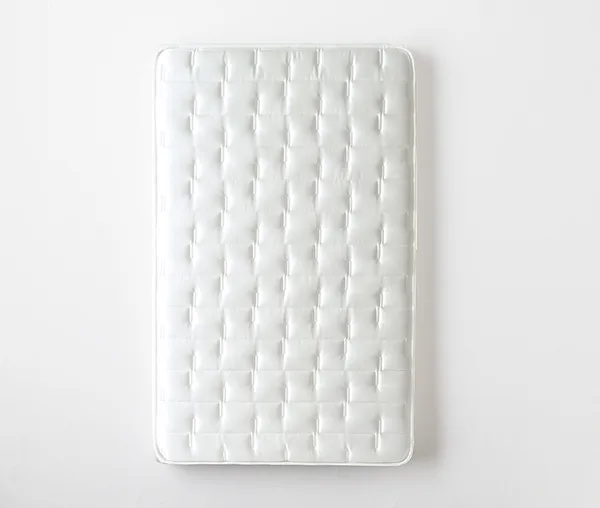
Omotesando Futonten doesn't carry futon mattresses, but for those who sleep on a bed we offer the Silky Pocket Mattress, developed together with leading Japanese manufacturer Nihon Bed, plus the Cotton Bed Pad — 100% cotton on both sides — as the layer that catches your sweat.
6. Frequently asked questions
Q. Which is better, a futon mattress or a bed mattress?
A. It depends on your home and lifestyle. A futon mattress suits you if you want the room free and open during the day, or if you sleep in a Japanese-style tatami room. A bed and mattress suit you if you'd rather skip laying out and putting away bedding every day, or want to get up more easily.
Q. Can I put a futon mattress directly on a hardwood floor?
A. You can, but moisture builds up easily between the futon and the floor, which leads to mold. Use a slatted wooden base (sunoko) or a moisture-absorbing sheet, and in the morning either put the futon away or fold it in half so air can reach both the floor and the futon.
Q. How do I choose a futon mattress that won't leave my lower back sore?
A. As a rule of thumb, look for a firmness where your hips don't sink too deeply when you lie on your back, and your shoulder doesn't hurt when you lie on your side. If a thin futon is letting you feel the floor underneath, switch to one with a firm core, or add a mat beneath it for extra thickness. If the pain continues, don't rely on bedding alone — please see a doctor.
Q. How long does a futon mattress last?
A. It varies widely with the material and how it's used. Synthetic-fiber futons flatten out quickly and are often replaced after a few years, while cotton futons can be refurbished — the filling is re-fluffed and restored so you can keep using them. When the loft no longer comes back, you feel the floor through it, or odor or mold won't come out, it's time to replace it.
Q. Do I need a mattress pad with a futon mattress too?
A. We recommend it. A mattress pad absorbs sweat and body oils, so you'll need to wash the futon itself less often and can keep it clean for longer. Choosing pads and sheets in easy-wash materials makes care much simpler.