| What you'll learn in this article
・What a down ket (summer-weight light comforter) is, and how it differs from a regular comforter ・Fill weight, down cluster ratio, and how to choose the right materials ・How to choose a down ket that won't feel stuffy in summer ・How it compares with a towel blanket, and when to use each |
"What exactly is a down ket?" "How is it different from a summer-weight comforter?" — a down ket is the comforter best suited to comfortable summer sleep, yet many people aren't familiar with the name.
In short, a down ket is a thin down comforter made for summer, with a reduced fill weight. It's more comfortable than a towel blanket and thinner and lighter than a winter down comforter — just right for summer nights with the air conditioning on.
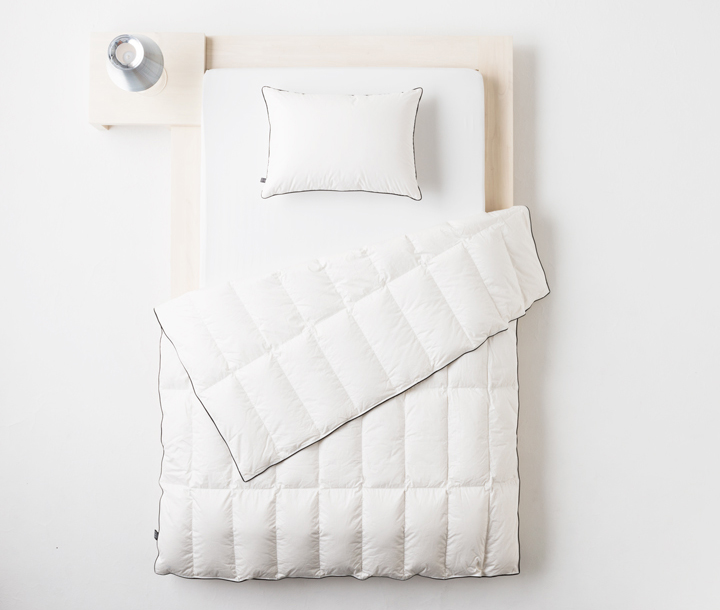
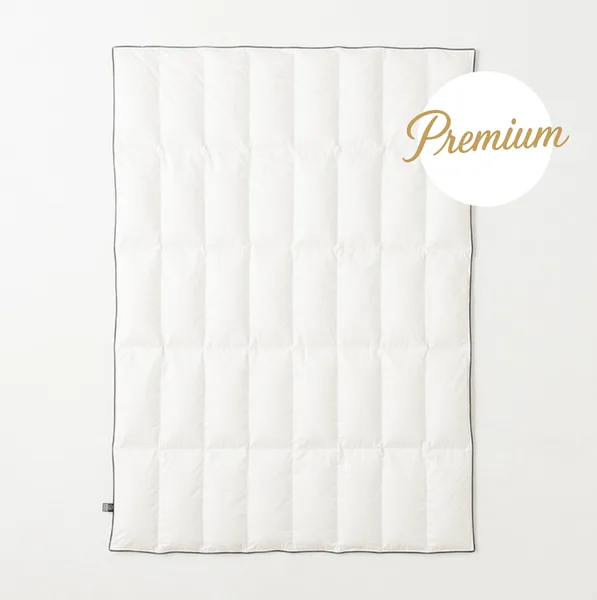
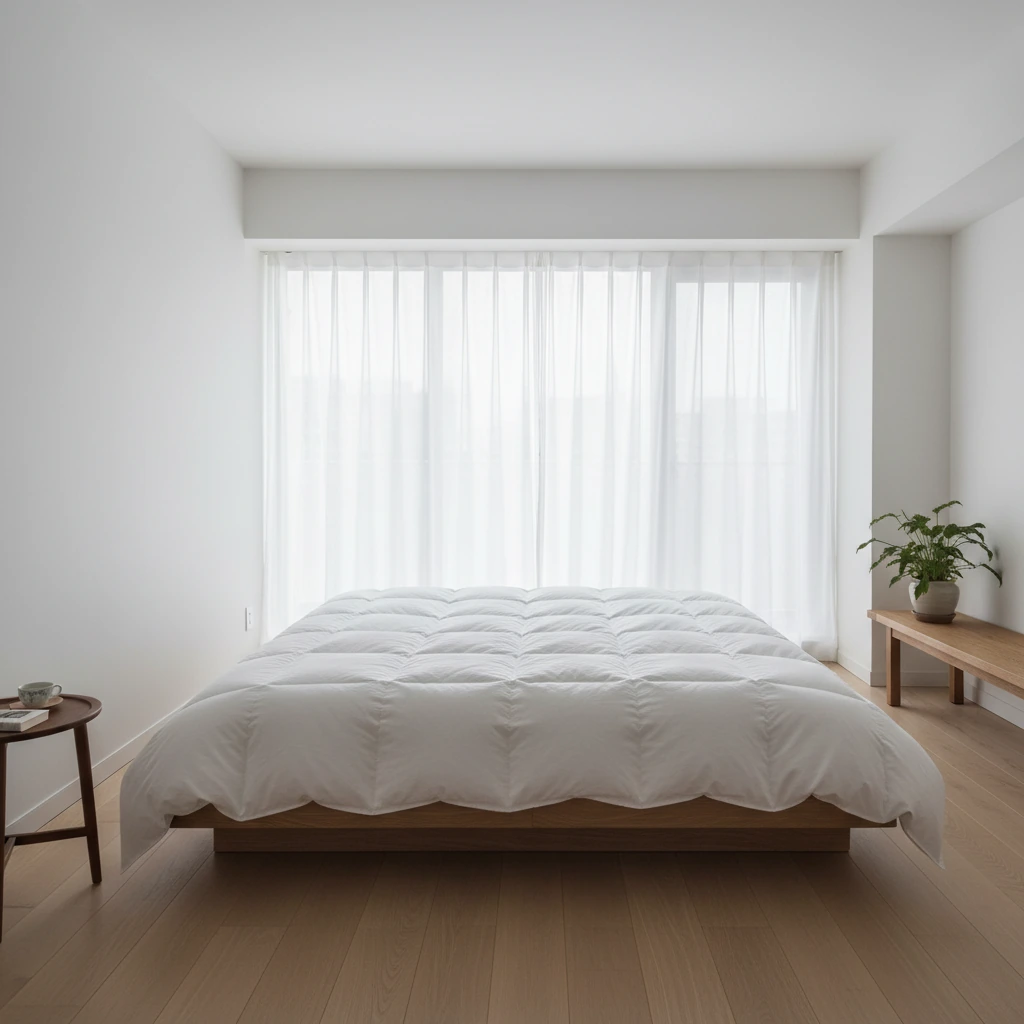
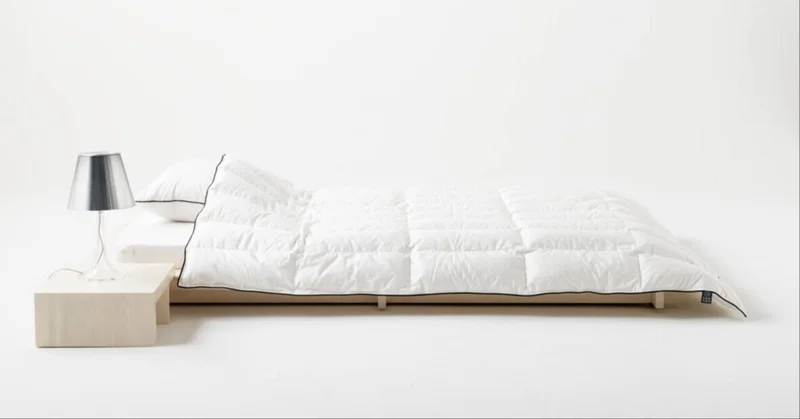
A white, softly lofted lightweight summer down comforter from Omotesando Futonten. About a quarter the thickness of a winter down comforter — ideal for summer nights.
What is a dauncket (summer-weight comforter)? How it differs from a regular down comforter
“Down ket,” “summer-weight (light) comforter,” and “summer down comforter” all refer to exactly the same thing. Only the name changes from one maker or retailer to the next.
| Type | Fill weight (Single) | Season of use | Characteristics |
| Winter-weight comforter (for winter) | 1.2〜1.3kg | November–March | Warmest and loftiest |
| All-season (medium-weight) comforter (for spring and fall) | 0.5〜0.8kg | April–June and October–November | Mid-weight, for the change of seasons |
| Dauncket = summer-weight comforter (for summer) | 0.2〜0.4kg | June to September | Thin, light and breathable |
How to choose a dauncket
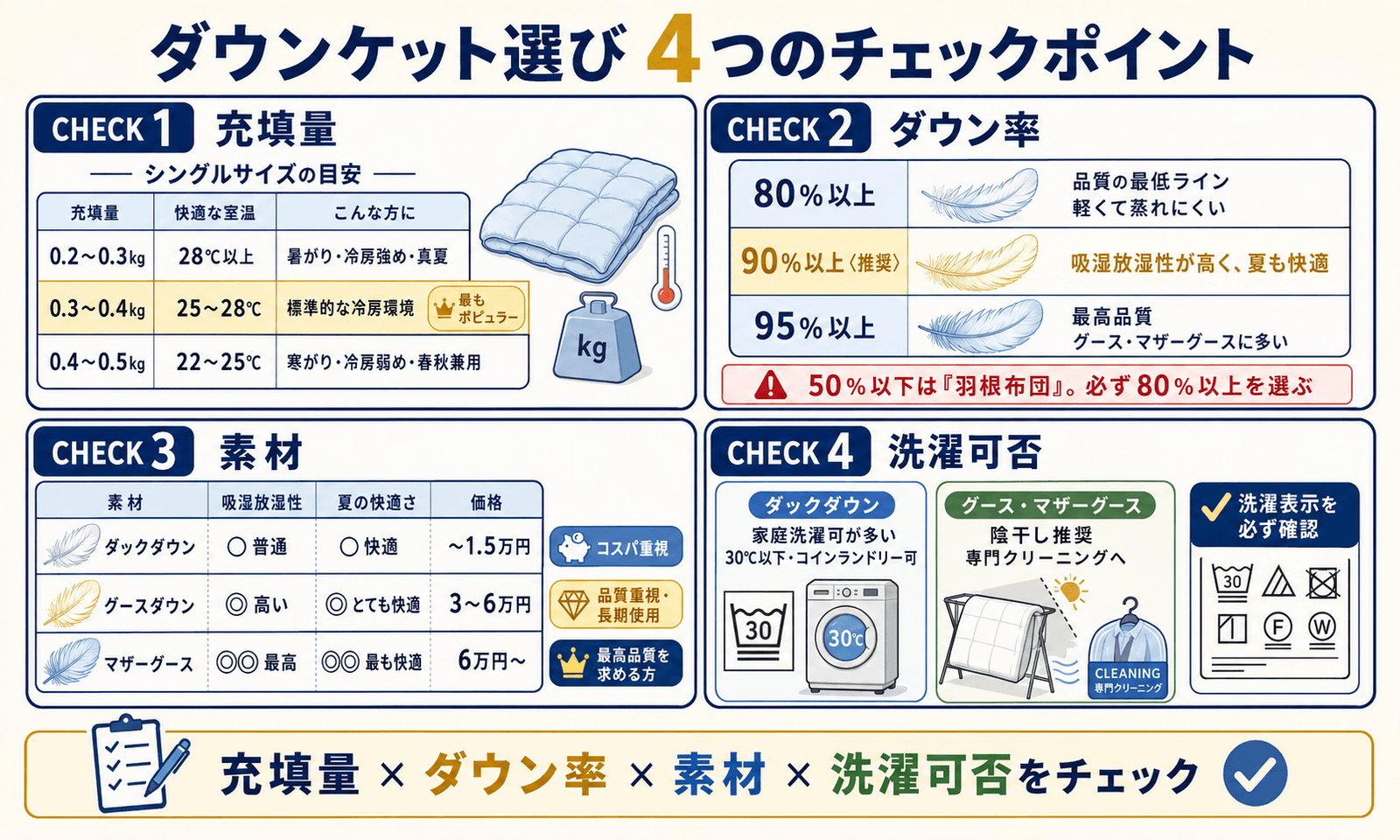
A checklist illustrating the four key points: fill weight, down cluster ratio, material, and washability.
Choosing tip 1: Go by fill weight
| Fill weight (Single) | Comfortable room temperature guide | Best for |
| 0.2〜0.3kg | Summer, 28°C and above | If you sleep hot, run the A/C high, or it's midsummer |
| 0.3〜0.4kg | 25〜28℃ | Standard air-conditioned room (the most popular choice) |
| 0.4〜0.5kg | 22〜25℃ | If you sleep cold, keep the A/C low, or want spring–fall use too |
Choosing tip 2: Go by down cluster ratio
- 80% or higher: the minimum quality line. Light and breathable.
- 90% or higher: our recommended line. Excellent moisture absorption and release, so it stays comfortable even in summer.
- 95% or higher: the highest quality. Common in goose and mother goose down.
| Products with a down cluster ratio of 50% or less are classified as feather comforters, and you can't expect them to perform as a summer dauncket (they trap moisture). Always choose 80% or higher. |
Choosing tip 3: Material (goose vs. duck)
| Material | Moisture absorption & release | Summer comfort | Price | Best for |
| Duck down | ○ Average | ○ Comfortable | Up to ¥15,000 | Best value for money |
| Goose down | ◎ High | ◎ Very comfortable | ¥30,000–¥60,000 | Quality-focused, long-term use |
| Mother goose down | ◎◎ The very best | ◎◎ Most comfortable | ¥60,000 and up | Those who want the very best quality |
Choosing tip 4: Is it washable?
- Duck down: most can be washed at home (below 30°C; laundromat OK)
- Goose and mother goose down: airing in the shade is recommended; use a specialist cleaner
Cotton towel blanket vs. dauncket: which should you choose?
| Comparison | Cotton towel blanket | Dauncket (down) |
| Moisture absorption and release | Absorbs sweat but is slow to release moisture | Fast absorb-and-release moisture cycle |
| Breathability | △ Can feel slightly stuffy | ◎ Resists stuffiness |
| Warmth in the early morning | × You can get chilly | ○ Moderate warmth |
| Price | Low | Higher |
| Ease of washing | ◎ Easy to wash | ○ Many types are washable |
| Best for | Best value for money | For those who prioritize quality sleep |
| On summer nights with the air conditioning on, most people sleep better under a down dauncket than under a cotton towel blanket. Down breathes — absorbing and releasing moisture to prevent that clammy feeling — while still keeping you warm when it cools down before dawn. |
Frequently Asked Questions
- When should I start using a dauncket?
- A good guide is when room temperature stays consistently above 20°C — typically late May to early June in the greater Tokyo (Kanto) area. If your bedding feels muggy when you wake up, or you find yourself sticking a foot out during the night, it's time to switch.
- Which is better for summer: a dauncket or a cotton gauze blanket?
- They serve different purposes. A gauze blanket has a crisp, dry feel that suits hot nights. A summer down comforter is the all-rounder: it works with the air conditioning on and also protects you from the early-morning chill. If you sleep with the A/C running, we recommend the summer down comforter.
- Does a dauncket need a duvet cover?
- Yes — a cover keeps things more hygienic. In summer, when you sweat more, simply washing the cover once a week keeps the comforter itself clean. For both moisture absorption and breathability, we recommend a 100% cotton or linen cover.
Summary
- A "downket" is a thin down comforter with a reduced fill weight, made for summer.
- A fill weight of 0.3–0.4 kg (Single) is the summer standard
- Choose a down cluster ratio of 80% or higher — ideally 90% or higher
- A down summer comforter beats a cotton towel blanket for sleeping well in summer
- Choose goose down or better and it stays breathable even in summer, so it lasts for years
| ▶ Browse all dauncket and summer-weight comforters at Omotesando Futonten |
Making sense of the term "downket"
Several different words refer to exactly the same thing, so let's sort them out first.
| Term | What it means | Where you'll see it |
|---|---|---|
| A downket | A thin down comforter for summer | The usual term in the bedding industry and at retail |
| Summer-weight (light) comforter | Same as above | The most common Japanese wording |
| Summer-weight down comforter (hadabuton) | Same as above | Used mainly in the Kansai region |
| Summer-weight down comforter | Same as above | Wording that makes the down fill explicit |
| Summer-weight down comforters | Same as above | Wording that makes the season explicit |
"Downket" is a Japanese coinage combining "down" and "blanket." It rarely translates abroad; in English, you'll hear summer duvet or lightweight duvet instead.
All of them describe the same product: a thin down comforter with a fill weight of roughly 0.3–0.4 kg. Whatever it's called, the criteria for choosing one stay the same.
When to use a summer-weight down comforter
The reliable way to decide is not by the calendar but by your bedroom temperature just before dawn.
| Bedroom temperature before dawn | Best bedding | Approximate timing (Kanto plains) |
|---|---|---|
| 25°C (77°F) and above | A cotton towel blanket, or a summer-weight down comforter over your stomach only | Late July–August |
| 23〜25℃ | A downket | June–mid-July / early September |
| 20〜23℃ | Summer-weight down comforter plus a thin blanket, or an all-season (medium-weight) comforter | Mid to late September |
| Below 20°C (68°F) | All-season (medium-weight) comforter | October onward |
For how to think about switching, see When should you start using a down comforter? A specialist store explains the switch-over timing by temperature.
If you run the air conditioning, you need a summer-weight down comforter
"Do I really need a comforter in summer?" It's a fair question — and the answer is yes, if you use air conditioning.
While we sleep, the body releases heat through the hands and feet to lower its core temperature. If the air-conditioner blows directly on you in that state, you end up colder than you need to be. A chilled abdomen, in particular, can lead to digestive upset and trouble falling asleep.
The job of a summer-weight down comforter isn't to warm you up; it's to protect you from being overcooled. Because down absorbs and releases moisture, you won't feel clammy under it.
Caring for your summer-weight down comforter
During the season
- Wash the cover once a week
- When you get up, fold the comforter back and let it air out for 10–15 minutes before making the bed
- Air it for 1–2 hours in a well-ventilated shaded spot, once or twice a month
You sweat far more in summer, so managing moisture matters even more than it does with a winter comforter. Avoid direct sunlight: UV rays break down the natural oils in the down and degrade the shell fabric as well.
Washing
Because a summer-weight down comforter holds so little fill, you can wash it at home as long as the care label says it is washable in water. It is far easier to launder than a winter-weight comforter.
That said, almost every mishap happens at the drying stage. Wet down clumps together, and if it dries in that state the loft never comes back. Break up the clumps as it dries, and make sure it is completely dry all the way through.
Step-by-step washing instructions are covered in How to Wash a Summer-Weight Down Comforter: Home Washing, Laundromat and Professional Cleaning Explained by a Specialty Store.
Off-season storage
- Wash it, or air it in the shade with good airflow
- Dry it completely all the way through (this is the most important step)
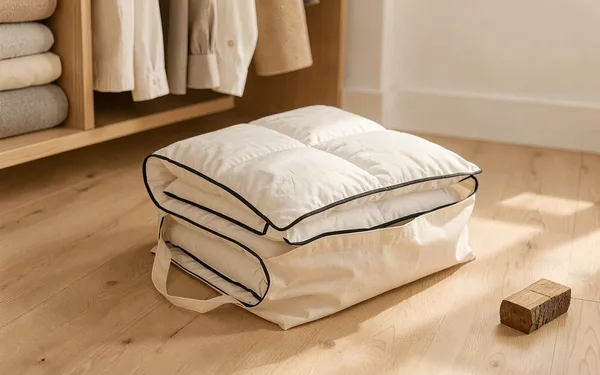
- Fold it loosely and place it in a breathable non-woven storage bag
- Store it somewhere dry and high, such as the upper shelf of a closet
Avoid vacuum compression bags. They break the down fibers, and the comforter won't loft again next year. Choose a dry day to pack it away, ideally after several days of clear weather.
For full instructions, see How to Store Summer Bedding: The Right Way to Wash, Dry and Compress, Explained by a Specialty Store.
Putting a summer-weight down comforter to work in winter
A summer-weight down comforter isn't just for summer.
Layer it over your winter-weight comforter
If a winter-weight comforter alone isn't quite enough in midwinter, layering a summer-weight down comforter on top adds another insulating layer. It's lighter than a blanket, so there's less weight pressing on your body.
The order matters. Down lofts with your body heat, so keep the thicker winter-weight comforter closer to you and lay the summer-weight down comforter over it. Reverse the order and the winter-weight comforter won't reach full loft.
For the change of seasons
When an all-season (medium-weight) comforter feels too warm but a cotton summer blanket feels too cool, a summer-weight down comforter on its own — or paired with a cotton summer blanket — works beautifully.
As a guest comforter
It stores compactly and can be used year-round. As a spare for guests, it is often more practical than a winter-weight comforter.
More FAQs about summer-weight down comforters
Is a "down ket" different from a summer-weight comforter?
They are the same thing. "Down ket," "hadagake futon," "hada-buton" and "summer down comforter" all refer to a thin down comforter with roughly 0.3–0.4 kg of fill.
When should you use a downket, and until when?
Use one when the bedroom temperature at dawn is 23°C or above. In the Kanto plains that generally means June through early September, but it varies widely depending on your region and home.
Isn't a down comforter too warm for summer?
A summer-weight down comforter holds less than one third the fill weight of a winter-weight comforter. Down absorbs and releases moisture, so it won't leave you feeling clammy. In an air-conditioned room, it actually makes sleep more comfortable.
Can I wash a summer-weight down comforter at home?
Yes, if the care label says it is washable in water. With less fill inside, it is easier to wash than a winter-weight comforter. Just be sure to dry it completely, all the way to the center.
Can a summer-weight down comforter be used in winter too?
Not on its own, but layering it over your winter-weight comforter adds another insulating layer. Since it's lighter than a blanket, it puts less weight on your body.
How much fill should a summer-weight down comforter have?
0.3–0.4 kg is standard. Less than that provides almost no warmth; more than that gets too warm in summer. If you run the air conditioning cold or tend to feel chilly, aim for around 0.4 kg; if you sleep hot, around 0.3 kg.
What down cluster ratio do I need?
For summer use, you don't need the high numbers a winter comforter calls for. A down cluster ratio of 85% or higher and a fill power of about 200–280 cm³/g (Japanese dp) is plenty.
However, if the down cluster ratio is too low, feather quills can poke through the shell fabric and prickle your skin. In summer you're wearing thinner sleepwear, so that discomfort shows up more easily.
Do I still need one if I don't use air conditioning?
In midsummer without air conditioning, even a summer-weight down comforter can feel too warm. In that case, drape it over your midsection only, or switch to a cotton summer blanket.
Temperatures do drop toward dawn, though. Sleeping with nothing over you can leave you chilled in the early morning, so keep it folded at the foot of the bed, ready to pull up when you start to feel cold.
How long does a summer-weight down comforter last?
With less fill, it takes less strain in use than a winter-weight comforter, so with proper care it can last around 10 years. Because you perspire more in summer, though, that assumes washing and thoroughly drying it every year.
Names for thin comforters and what "hadagake futon" means
Many people search because they don't know what a thin comforter is called. The short answer: the lightweight comforters used in summer go by "down ket," "hadagake futon" and "hada-buton," and they all refer to the same type of bedding.
A hadagake futon — a summer-weight comforter — is a comforter filled with less than one third the down of a winter-weight comforter, designed to stay breathable through the summer. Unlike a single-layer cotton summer blanket, it keeps the same construction as a winter down comforter and simply reduces the fill weight.
"What is a down ket?" in one sentence
A down ket is a thin down comforter made for summer with a reduced amount of down. Despite the "ket" in the name, it is not a blanket or a cotton summer blanket: the key difference is that the down is enclosed within a shell fabric.
- Names for a thin comforter = down ket, hadagake futon, hada-buton (all the same thing)
- A hadagake futon = a summer down comforter with a reduced amount of down
- It is built differently from a cotton summer blanket, and it offers the moisture-absorbing, moisture-releasing qualities unique to down