The answer in 30 seconds
- The usual culprits are insufficient drying, clumped down and long-term compression. Down that's seen 10+ years of use can also simply be worn out. The right fix depends on the cause.
- The most effective method is a laundromat dryer. Allow roughly 60–80 minutes for a Single. Taking the comforter out once partway through and shaking out the down gives you an even, fluffy finish.
- Fluff it right away when you take it out, then let it cool before storing. Lay it out flat and let it cool for at least 30 minutes. Putting it away while still warm traps moisture and invites mold.
- If the loft doesn't come back, consider refurbishing. There's only so much you can do at home about down that's been misshapen by long-term compression or worn down by 10+ years of use.
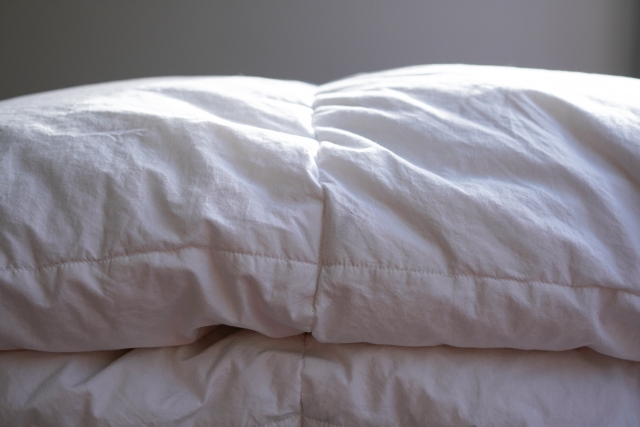
"It came out of the storage bag flat and stayed that way." "It got thinner after washing." "It just isn't as fluffy as it used to be." If any of that sounds familiar, this article is for you.
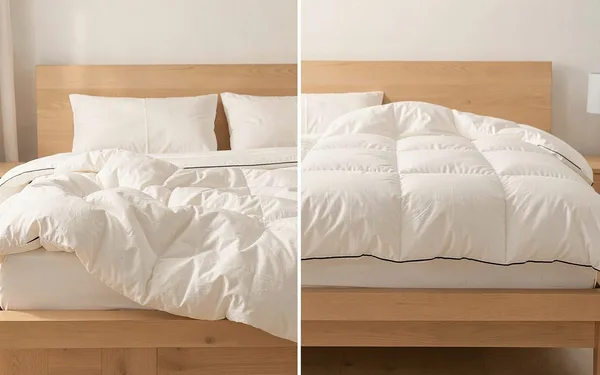
There are three main reasons a down comforter goes flat: insufficient drying, clumped (tangled) down, and loss of shape from long-term compression.
The fix depends on the cause, so start by checking the condition of your own comforter before you do anything else.
In this guide, Omotesando Futonten — with over 25 years of experience in bedding — walks you through how to restore loft at home, step by step, and what to do when that isn't enough.
Has your down comforter stopped lofting up after being stored in a vacuum bag? Looking for a way to fluff it back up and get that comfort back? When a down comforter goes flat, it loses warmth and insulating power. These aren't cheap purchases, so it's no surprise that so many people want to bring theirs back to life.
Below, we explain how to restore loft to a flattened down comforter, plus the right way to care for down bedding day to day. If you're not happy with the state of your comforter, read on.
Related reading: Never store a down comforter in a compression bag!
Check first: what's making your comforter go flat?
Before choosing a fix, check which of these patterns matches your comforter.
| Cause | What you're seeing | → What to do | |
| ① | Not fully dry / trapped moisture | Flat after washing or at the end of the rainy season; puffs up a little after airing | Tumble dryer (laundromat) or air-drying in the sun |
| ② | Clumped (tangled) down | Lumpy in spots; you can feel hard knots when you touch it | Break up the clumps by hand, then tumble dry |
| ③ | Long-term compression | Stored in a vacuum bag for several months; won't recover even in the dryer | Repeat tumble drying plus hand-fluffing. If it still doesn't recover, have it refurbished (down comforter refurbishing) |
| ④ | Worn-out down | Used for 10+ years; nothing brings it back | Down comforter refurbishing (re-making) is needed |
How to fluff up a down comforter
Step 1: Check the condition of your comforter
Check the care label to see whether the comforter can be washed with water. If it can, go to “Step 3.” If it can't, use the dryer or sun-airing in “Step 2.”
Step 2: Air it outdoors (in the shade)
If the problem is simply that the comforter isn't fully dry, try airing it in the sun first and see if that fixes it.
- Remove the duvet cover
- On a sunny day between 10 a.m. and 2 p.m., hang the comforter in an airy, shaded spot, draped over two drying poles in an M shape
- Turn it over every 1 to 1.5 hours (2 to 3 hours total)
- Once you bring it in, pat it by hand to spread the down back out
Step 3: Break up the clumps by hand
Run your hand over the surface; if you feel knots or clumps, break them up before using the dryer.
- Spread the comforter out flat and find the clumped areas (they feel like hard knots)
- Using both hands, gently pat that baffle box from the outside
- Loosening the whole comforter first gives you a much better result in the dryer
Step 4: Tumble dry at a laundromat [most effective]
The tumbling action of a dryer (the drum rotating and gently beating the comforter) separates the down clusters and brings back the loft.
- For a Single, use a large 10–12 kg dryer
- Adding 2–3 tennis balls (each tucked inside a sock) makes it even more effective
- Use a low to medium heat setting (60°C or below). Never use high heat — it damages the proteins in the down
- Rough timing: 60–80 minutes for a Single
- Take it out after 30 minutes, fluff it by hand, then put it back in for an even finish
| ❌ Never use a high-heat setting
Down is made of protein (keratin). Exposed to high heat, the barbs break and the comforter loses warmth permanently. Always choose a low to medium heat setting. |
Step 5: Fluff it by hand right after taking it out
As soon as you take the comforter out of the dryer, spread it out flat and pat each quilted box with your palms to redistribute the down evenly. Skip this step and the down will clump together as it cools.
Step 6: Let it cool completely before storing
Straight out of the dryer, the down is still warm. Leave the comforter spread out to cool for at least 30 minutes before putting it away. Storing it while warm traps moisture and can lead to mildew.
What to do if it still won't fluff up after tumble drying
Cause 1: Soil (sweat and body oils) is coating the down clusters
In a comforter that hasn't been washed in years, sweat and body oils cling to the down so the clusters can no longer move freely. Drying alone won't fix it.
For six ways to deal with a flat down comforter — and how to decide between fixing it yourself and calling in a professional — see how to restore a down comforter to fluffy condition.
→ A full wash by a specialist cleaner removes the soil, and the loft often comes back.
Cause 2: Long-term compression has deformed the down clusters
If the comforter has been kept in a vacuum storage bag for several months or more, the down clusters may be permanently crushed.
→ Running it through the dryer several times can help somewhat, but it may never fully recover. The real fix is down comforter refurbishing, where the down is removed, washed and restored.
Cause 3: The down itself has worn out (10+ years of use)
After 10 years or more of use, the down clusters have broken into tiny fibers, and no amount of tumble drying will bring them back.
→ Consider down comforter refurbishing, in which the down inside is washed, sorted and restored.
| ▶ See our down comforter refurbishing (re-making) service |
How to care for a down comforter the right way
Most down comforter problems are easy to prevent with the right care. Here are the basics.
Air it in the sun once or twice a month
Air your comforter in the sun once or twice a month to drive out moisture. Removing moisture helps prevent dust mites and mildew, and it also helps the down clusters loft up. Aim for about one hour per side.
Don't leave it out longer than that, because UV rays can damage the shell fabric. A damaged shell raises the risk of down leaking out. If that worries you, air the comforter with the duvet cover left on.
Wash it regularly
Down comforters can generally be washed in water, and washing removes most dust mites and soil. Regular washing is worth doing. That said, drying a comforter completely at home can be difficult.
Thick down comforters call for extra care. If you bring one in while it's still damp, dust mites and mildew can take hold. For that reason, we generally don't recommend washing at home.
If you have any doubts, use a specialist cleaner whenever possible.
Related reading: Down comforter allergies: causes and what you can do
Check the care label first
If you do wash at home, check the care label first. A wash-tub symbol or a hand-wash symbol means the item can be washed at home. A wash-tub symbol with an X through it means it cannot (a circled P or circled F means dry cleaning is possible).
If you're using a washing machine, also make sure the machine is rated for down comforters. Check the owner's manual to confirm.
Refresh the air trapped inside the down comforter
To a greater or lesser degree, every down comforter has its own smell. It comes from the natural oils in the down and tends to get stronger in hot, humid weather. If the odor bothers you, exchange the air inside the comforter.
The method is simple: fold the comforter and gently press the air out. Repeat a few times and the smell will fade.
Related article: How many years does a down comforter last? How to decide between replacing and refurbishing

How to store a down comforter the right way
How you store a down comforter matters too. Store it the wrong way and it can end up flat. Here's how to do it right.
Wrap it in a cotton sheet
Remove moisture first, then wrap the comforter in a sheet before storing. You can air out moisture in a shaded, well-ventilated spot. In a hurry, point a fan at it.
The way you fold it differs by size. For a Single, fold it in thirds lengthwise; for a Double or larger, fold it in quarters first, then in thirds crosswise. To make it more compact, press gently on the comforter to push the air out.
Use a storage bag in the off-season
When you won't be using it for a while — at the change of seasons, for example — make sure it's thoroughly dry, then store it in a dedicated storage case. The case or bag it came in is fine.
The key is not to close the zipper all the way. Leave a few centimeters open so moisture doesn't build up. Even if storage space is tight, we don't recommend vacuum storage bags — they can damage both the down and the shell fabric. Treat your down comforter gently.
Looking for a luxury comforter? Take a look below.
Related article: Luxury comforter lineup
Frequently Asked Questions
Q1. My down comforter won't loft back up after coming out of a vacuum storage bag. What should I do?
- Run it through a large dryer at a laundromat (low heat, 60–80 minutes). Tossing in a couple of tennis balls makes it even more effective. If it was compressed for only a short time (within two weeks), it will almost always recover. If it was compressed for several months or more, recovery can take longer.
Q2. My down comforter went flat after washing.
- It's almost always a matter of insufficient drying. Run it through a laundromat dryer again on low to medium heat (60°C or below) for another 60–80 minutes. If you used fabric softener, rinse the comforter once more before drying.
Q3. It still won't fluff up even after the dryer. Should I just throw it out?
- Before you throw it away, consider down comforter refurbishing (re-making). With a high-quality comforter in particular (goose down or mother goose down), the down can be removed, washed and revitalized — often bringing it back to like-new condition.
Q4. How long does it take for a down comforter to feel fluffy again?
A. If insufficient drying is the cause, one cycle in the dryer (60–80 minutes) usually does the trick. If clumped down is the cause, break up the clumps by hand and repeat the dryer cycle 2–3 times. If the problem is long-term compression or age-related deterioration, there's only so much you can do at home.
Summary
To bring the loft back to your down comforter, start by pinpointing what's causing the problem.
- Not fully dried → solved with a laundromat (coin laundry) dryer, low heat for 60–80 minutes
- Clumped down → Break up the clumps by hand, then use the dryer
- Long-term compression → Repeat dryer cycles. If it doesn't improve, go for refurbishing
- Worn-out down → refurbishing (re-making) is the real fix
If nothing you try brings the loft back, or you've been using the same comforter for 10 years or more, talk to us about refurbishing (re-making) before you throw it away.
For high-quality Japanese-made premium down comforters (duvets), choose Omotesando Futonten
| Related articles
・Can a down comforter trigger asthma? The real causes and what to do about them |