The answer in 30 seconds
- A summer-weight (light) down comforter is a thin, lightweight down comforter made for summer. "Lightweight down comforter," "hadabuton" and "down ket (summer down throw)" all refer to the same thing.
- The standard fill weight is 0.3–0.4 kg in Single. If you get cold easily, aim for around 0.4 kg; if you tend to sleep hot, around 0.3 kg.
- If you sleep with air conditioning, a summer-weight comforter is the right choice. Its job is to protect you from getting too cold. Down absorbs and releases moisture, so it doesn't feel clammy even when you're under it.
- Choose a shell fabric in 100% cotton or gauze. Polyester blends don't absorb moisture well, so they aren't suited to summer.
A summer-weight (light) down comforter is a thin, lightweight comforter for use in summer. The fill weight is roughly 0.2–0.4 kg in Single — far lighter than an all-season (medium-weight) comforter for spring and fall, which holds 0.5–0.8 kg.
Some people ask, "Do I really need a down comforter in summer?" In fact, it's remarkably comfortable if you sleep in an air-conditioned room. Compared with a thin cotton comforter, it retains warmth better, and down's ability to absorb and release moisture means it won't feel clammy even if you perspire — its biggest advantage.
In this article, a specialist store explains what makes a summer-weight down comforter different, how it compares with an all-season comforter, when to start using it, and what to look for when choosing one.
What Is a Summer-Weight (Light) Down Comforter?
A summer-weight down comforter is a thin comforter designed mainly for summer use (July to September). With a fill weight of about 0.2–0.4 kg in Single, it's extremely light — less than a quarter of a winter-weight comforter (1.2–1.3 kg).
"Summer-weight comforter" and "lightweight down comforter" mean the same thing. The name simply varies by manufacturer; both refer to a thin down comforter for summer. You may also see it called a "summer comforter."
Why Use a Down Comforter in Summer?
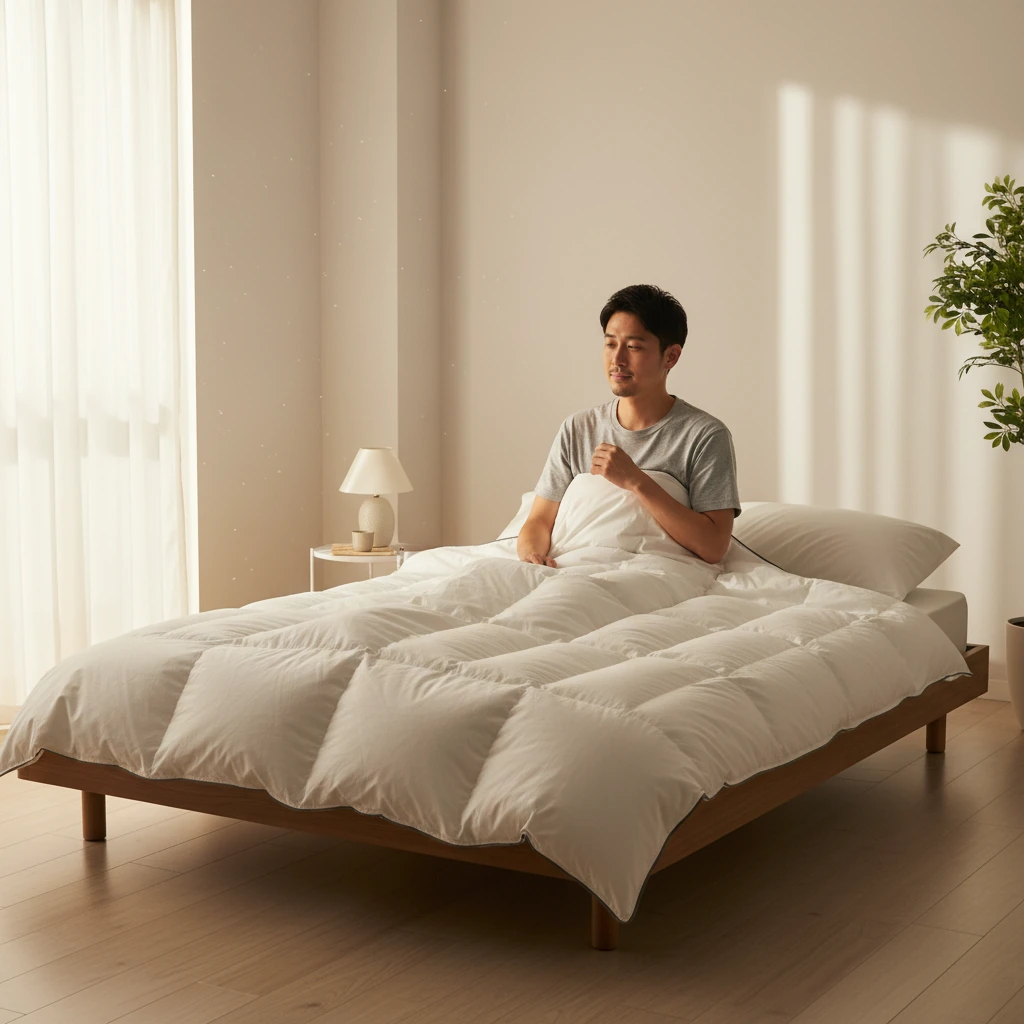
Many people assume it's too hot to need any comforter in summer, but for the following reasons, a summer-weight down comforter helps you sleep more comfortably.
- Air-conditioning protection: keeps the AC from chilling you too much
- Moisture management: down absorbs night sweat and releases it quickly, so it doesn't feel clammy
- Lightness: at just 0.3–0.4 kg, it's so light that its weight won't wake you on warm nights
- Temperature regulation: down clusters loft in response to your body heat, helping hold a comfortable temperature naturally
| Especially recommended if you find air conditioning chilly even in summer
If the AC at work leaves you cold, if running the air conditioning at night chills you, or if you wake up cold toward morning, a summer-weight down comforter is the most effective answer. |
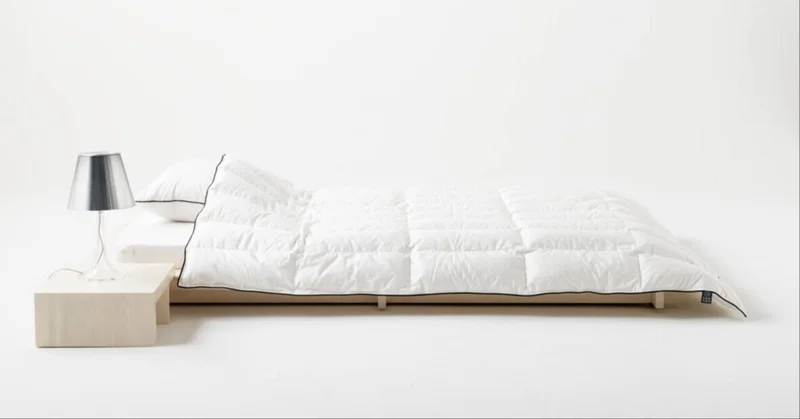
Those sticky, restless summer nights — it's hard to know what you should actually sleep under.
Towel blankets and performance blankets tend to cling to your body, can leave you cold when used with air conditioning, and many people feel they just don't look good in the bedroom.
That's exactly where a summer-weight down comforter comes in.
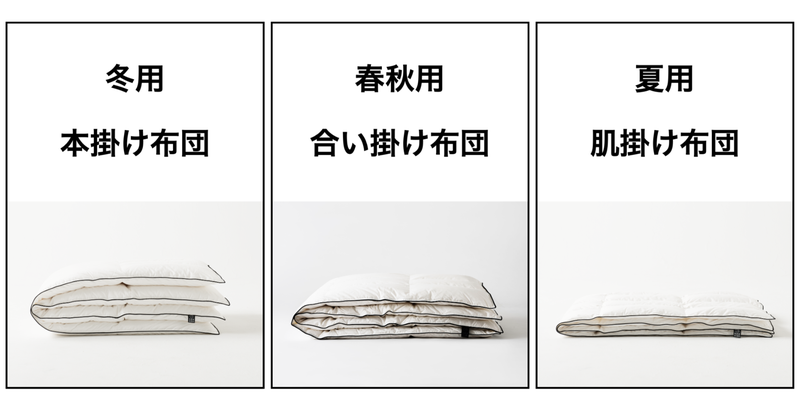
In fact, down comforters come in different thicknesses for different seasons — and the thinnest of them all is the summer-weight comforter.
Summer-Weight vs. All-Season Comforter: The Difference
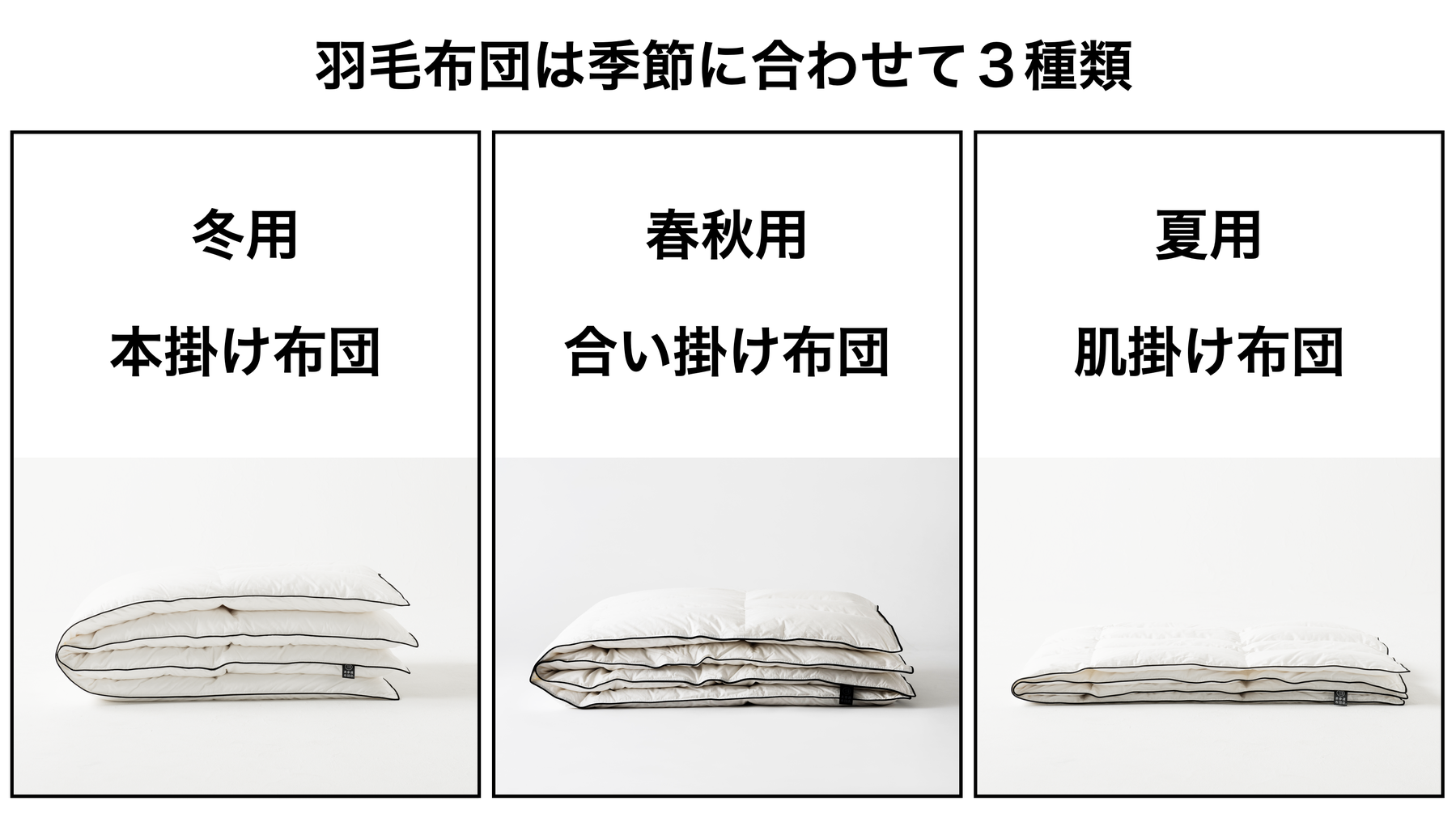
Here we answer the question we hear most often: "What's the difference between a summer-weight and an all-season comforter, and which one should I buy?"
| Summer-weight (light) down comforter | All-season (medium-weight) down comforter | |
| Fill weight | 0.2–0.4kg (Single) | 0.5–0.8kg (Single) |
| Warmth | Thin and lightweight | Medium (just right) |
| Ideal room temperature | 25℃ and above (summer, or with A/C on) | 15–23℃ (spring and fall) |
| Season of use | July–September, and any air-conditioned room | March–June and October–November |
| Comfort with A/C on | ◎ Ideal | Can feel a little too warm |
| Best for | People who sleep hot, or rooms with strong A/C | People who feel the cold, mainly for spring and fall |
| Using one comforter year-round | A 4-season 2-in-1 comforter (summer-weight plus winter-weight) is the convenient choice | Same as above |
If you're only buying one, here's a quick guide:
- Mostly for summer nights (25℃ and above) → a summer-weight (light) comforter
- Mostly for spring and fall (15–23℃) → an all-season (medium-weight) comforter
- Want one comforter to cover the whole year → a 4-season 2-in-1 comforter (summer-weight plus winter-weight set)
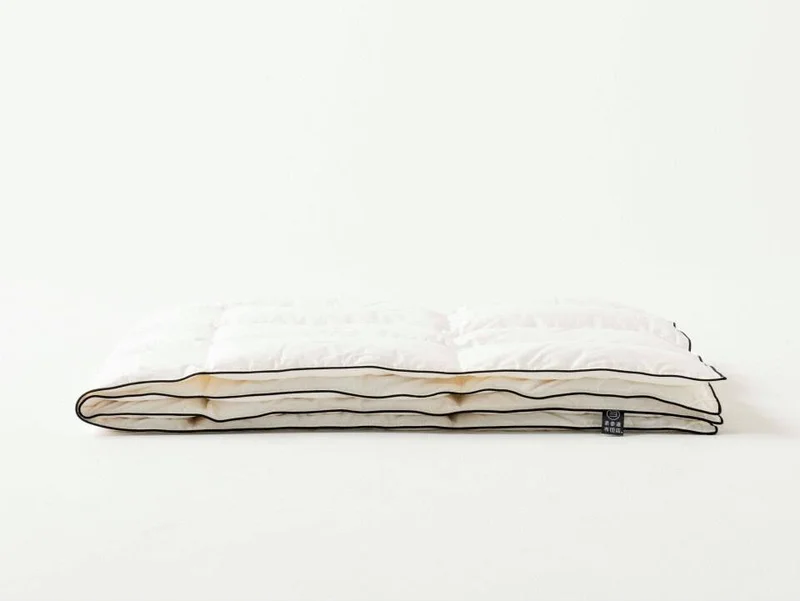
As you can see in the photo, it's made remarkably thin compared with a standard down comforter.
Taking Omotesando Futonten's best-selling lineup, the "RDS White Goose Down Comforter," as an example, the down fill weights are as follows.
RDS White Goose Down winter-weight comforter (Single) — down fill weight: 1.3kg
RDS White Goose Down all-season (medium-weight) comforter for spring and fall (Single) — down fill weight: 0.85kg
RDS white goose down summer-weight (light) comforter (Single) — down fill weight: 0.25kg
As shown above, a summer-weight comforter uses about 1/5 the down of a winter-weight comforter, and roughly 1/3 to 1/4 that of an all-season comforter.
How to choose a summer-weight (light) down comforter: 4 key points
Point 1: Aim for a fill weight of 0.3–0.4kg
Too much fill and you'll be too hot to sleep in summer; too little and it won't keep off the chill from the air conditioning. If you sleep with the A/C on, 0.3–0.4kg (Single size) is just the right fill weight.
If air conditioning tends to leave your room feeling too cold, 0.4–0.5kg will be more comfortable. If you turn the A/C off at bedtime, or live in a tropical climate, an ultra-light 0.2–0.3kg is the better fit.
Point 2: Choose a shell fabric in 100% cotton or gauze
You sweat more in summer, so a highly absorbent shell fabric matters. A shell made of 100% cotton, cotton gauze or double gauze quickly wicks away perspiration and prevents that clammy, stuffy feeling.
Polyester-blend shells absorb much less moisture, which makes them a poor match for summer bedding. If you have sensitive skin or tend to sweat, 100% cotton will keep you far more comfortable through the night.
Point 3: Choose one you can put in the washing machine
Because you perspire more in the warmer months, many people want to wash their bedding regularly. Check the care label before you buy and choose a comforter marked "machine washable" or "hand washable" so you can keep it fresh season after season.
If the comforter can also go in a dryer at a laundromat (coin laundry), it's much easier to bring back that fluffy loft after washing (low heat, 60 minutes or less as a guide).
Point 4: Around 200–280 dp of fill power is plenty
A summer-weight (light) comforter is thin by design, so you don't need the high fill power of a winter comforter (350 dp and up). Around 200–280 dp delivers plenty of quality.
That said, cheap summer-weight comforters made with low-grade materials tend to leak down and lose quality after just a few seasons. Don't choose on price alone — check whether the comforter carries the Gold Label as well.
Frequently asked questions
Q1. What exactly is a thin down comforter (summer-weight)?
- It's a thin, lightweight down comforter made for summer. Fill weight is roughly 0.2–0.4 kg in Single size — far less than an all-season (medium-weight) comforter for spring and fall (0.5–0.8 kg). It's also called a "summer-weight comforter" or "summer duvet," and it's ideal if you sleep in an air-conditioned room.
Q2. When should I use a summer-weight comforter?
- July through September (summer) is the usual window, but some people use one from spring through fall — or year-round — wherever air conditioning runs strong, whether at work, while traveling or at home. As a rule of thumb, it's for times when the room is above 25°C or when you sleep with the AC on. If you often wake up chilled in the early morning, a summer-weight comforter is exactly what you need.
Q3. Should I buy a summer-weight or an all-season comforter?
- If you'll mainly use it on summer nights (25°C and above), go with the summer-weight comforter; if spring and fall (15–23°C) are your main seasons, choose the all-season (medium-weight) comforter. If you'd rather cover the whole year with one purchase, the 4-season 2-in-1 comforter — a summer-weight and a winter-weight comforter that snap together — is the most versatile option and a popular choice, since it can also be adjusted to roughly all-season thickness.
Q4. Which is better for summer: a down summer-weight comforter or a thin cotton one?
- Each has its strengths. A thin cotton comforter is easy to wash and inexpensive, but it retains little warmth and can feel cold in a strongly air-conditioned room. A down summer-weight comforter absorbs and releases moisture beautifully, so it stays breathable even when you perspire and makes it easier to regulate your body temperature — which is why we recommend down if sleep quality is your priority.
Summary
At Omotesando Futonten, our recommended way to sleep on summer nights is simple: run the air conditioning and sleep under a summer-weight comforter.
With just a towel blanket, the AC leaves you chilled and you wake up heavy and tired. A summer-weight comforter keeps that chill off your body while your head stays cool — comfortable sleep all night long.
If summer nights are keeping you from sleeping well, do try a summer-weight comforter from Omotesando Futonten.
Here's a look at the summer-weight (light) comforters available at Omotesando Futonten.
We offer four different types of down.
1_Flower Down (a blend of Italian recycled down and kapok)
2_Clean Cycle Down (high-quality Japanese recycled down)
3_RDS White Goose Down (white goose down, RDS certified)
4_RDS Premium Goose Down (premium goose down, RDS certified)
Clean Cycle Down summer-weight (light) comforter / recycled down
Flower Down and Clean Cycle Down were featured in Brutus Casa.
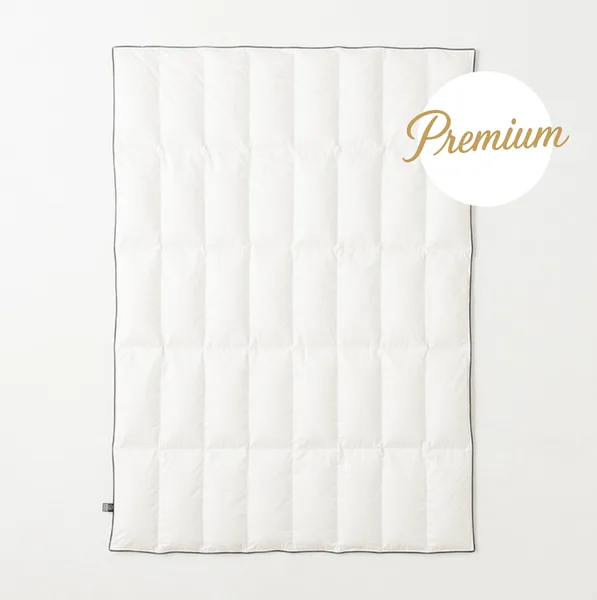
Premium RDS Down Summer-Weight Comforter / Mother Goose Down
Questions about any of our products? Reach out anytime via our contact form or on LINE.
Omotesando Futonten
For high-quality Japanese-made premium down comforters (duvets), choose Omotesando Futonten
| Related articles
・What Is an All-Season (Medium-Weight) Comforter, and When to Use It |
| ▶ Browse all summer-weight down comforters at Omotesando Futonten |
A note on the terms “summer duvet,” “lightweight down comforter” and “summer-weight down comforter”
“Summer duvet,” “lightweight down comforter” and “summer-weight down comforter” all refer to exactly what this article covers: a thin, lightweight down comforter made for summer. Only the wording differs from one retailer or manufacturer to the next — the product itself and the job it does are the same. Whichever term you searched for, the guidance here on fill weight, shell fabric, washability and fill power applies just as it is.
Just how thin is a “thin down comforter”?
The summer-weight type is the thinnest down comforter made. Its fill weight is far lower than a winter-weight comforter or a spring/fall all-season comforter, and it's constructed with less loft, so if you're shopping for a “thin down comforter” or a “lightweight duvet,” start with summer-weight models with a fill weight of roughly 0.2–0.4 kg.
Storing your summer down comforter in the off-season
When your summer-weight down comforter isn't in use, the key is to store it somewhere with low humidity. For detailed storage, washing and care guidance, please also see the information on each product page.
When to start and stop using a summer-weight comforter
The most reliable guide isn't the calendar — it's your bedroom temperature just before dawn. Aim to use a summer-weight comforter at 23°C (73°F) and above. Once it starts dropping below that, it's time to consider switching to an all-season comforter.
| Bedroom temperature before dawn | Best bedding | Approximate timing (Kanto plains) |
|---|---|---|
| 25°C (77°F) and above | A cotton blanket, or a summer-weight comforter over your midsection only | Late July–August |
| 23〜25℃ | Summer-weight (light) comforter | June–mid-July / early September |
| 20〜23℃ | Summer-weight comforter plus a light blanket, or an all-season comforter | Mid to late September |
| Below 20°C (68°F) | All-season (medium-weight) comforter | October onward |
Regional differences are significant, too: in Hokkaido a summer-weight comforter may only take you to late August, while in Kyushu and Okinawa you might use one until mid-October. For more on how to time the switch, see When to start using a down comforter: switch-over timing by temperature, explained by a specialist store.
Air conditioning is exactly why you need a summer-weight comforter
We're often asked, “Do you really need a comforter in summer?” The answer: yes, if you run the air conditioning.
While we sleep, the body releases heat through the hands and feet to lower its core temperature. If the air-conditioner blows directly on you in that state, you end up colder than you need to be. A chilled abdomen, in particular, can lead to digestive upset and trouble falling asleep.
The job of a summer-weight (light) comforter isn't to warm you up — it's to protect you from being over-cooled. Because down absorbs and releases moisture, it won't leave you feeling clammy, even under the covers. That's what sets it apart from a cotton towel blanket or a synthetic throw.
How it compares to other summer bedding
| Bedding | Warmth | Moisture absorption | Moisture release | Characteristics |
|---|---|---|---|---|
| Summer-weight down comforter (down throw) | Medium | High | High | Absorbs perspiration and releases it. The most consistent choice in air conditioning. |
| Towel blanket | Low | High | Low | Absorbs perspiration but is slow to release it, and gets heavy when damp. |
| Gauze (muslin) blanket | Low | Medium | High | Light and breathable. Offers almost no warmth. |
| Cool-touch throw | Low | Low | Low | Cool the instant you touch it, but moisture tends to build up. |
| Linen throw | Low | High | High | Excellent at releasing moisture. The hand-feel is a matter of personal taste. |
When choosing summer bedding, what matters most is not how cool it feels but how well it releases moisture. A fabric that soaks up perspiration without letting it go turns damp and cold by dawn. That's the usual reason people wake up chilled in the early morning.
For a full comparison of summer comforters, see The Best Summer Comforters: Types, How to Choose, and Down Summer-Weight vs. Towel Blanket — A Specialist's In-Depth Comparison.
Putting your summer-weight comforter to work in winter
A summer-weight comforter isn't just for summer. Here's how to use it in the colder months, too.
Layer it over your winter-weight comforter
If your winter-weight comforter alone isn't quite enough in midwinter, layering a summer-weight comforter on top adds another insulating layer. It's lighter than piling on a blanket, so there's less weight pressing on your body.
The order matters, though. Down lofts up with your body heat, so keep the thicker winter-weight comforter closer to you and place the summer-weight one on top. Reverse the order and the winter-weight comforter can't fully loft.
Use it on its own between seasons
In spring and fall, when an all-season (medium-weight) comforter feels too warm but a summer-weight one leaves you cold, pairing the summer-weight comforter with a towel blanket works well.
As a guest comforter
A summer-weight comforter stores compactly and works year-round. As a single spare for guests, it can be more practical than a winter-weight comforter.
Caring for your summer-weight comforter
During the season
- Wash the cover once a week
- When you get up, fold the comforter back and let it air out for 10–15 minutes before making the bed
- Air it for 1–2 hours in a well-ventilated shaded spot, once or twice a month
You perspire more in summer, so managing moisture matters even more than it does with winter bedding. Avoid direct sunlight — UV rays break down the natural oils in the down.
Off-season
Because a summer-weight comforter has a low fill weight, you can wash it at home if the care label says it's machine washable. Be aware, though, that if it isn't dried thoroughly the down will clump and never regain its loft.
We've outlined the steps to take before storing it in How to Store Summer Bedding: The Right Way to Wash, Dry, and Compress — Explained by a Specialist Store. For washing details, see How to Wash a Down Throw (Summer-Weight Comforter): At Home, at the Laundromat, or Professionally Cleaned — Explained by a Specialist Store.
More frequently asked questions about summer-weight comforters
Is a hadagake-buton different from a hadabuton?
They are the same thing. "Hadagake," "hadabuton," "hadagake down comforter" and "down ket" all refer to a thin, summer-weight down comforter. Only the name changes depending on the region or the manufacturer.
Isn't a down comforter too warm for summer?
A summer-weight comforter has a fill weight of about 0.3–0.4 kg — less than a third of a winter-weight comforter (1.2–1.3 kg). Down absorbs and releases moisture, so it doesn't trap humidity against you. In an air-conditioned room, it actually feels more comfortable.
Which is better, a cotton towel blanket or a summer-weight down comforter?
If you sleep with air conditioning, choose the summer-weight down comforter. A towel blanket absorbs sweat but doesn't release it well; once damp it gets heavy, and you end up chilled toward dawn. If you sleep without air conditioning and simply want something to soak up sweat, a towel blanket works well.
Can I use a summer-weight comforter in winter?
Not on its own, but layering it over your winter-weight comforter adds another insulating layer. Since it's lighter than a blanket, it puts less weight on your body.
Can I use a summer-weight comforter without air conditioning?
In midsummer without air conditioning, even a summer-weight comforter can feel too warm. In that case, drape it over your stomach only, or switch to a towel blanket.
That said, temperatures drop before dawn. Sleeping with nothing over you leaves you chilled in the early morning. Keep it folded at the foot of the bed so you can pull it over yourself the moment you feel cold.
What fill weight is right for a summer-weight comforter?
0.3–0.4 kg is standard. Any less and there's almost no warmth; any more and it's too hot for summer.
If you keep the air conditioning turned up or tend to feel the cold, aim for around 0.4 kg; if you sleep hot, around 0.3 kg.
What down cluster ratio do I need?
For summer use, you don't need the high numbers a winter comforter calls for. A down cluster ratio of 85% or more and a fill power of roughly 200–280㎤/g (Japanese dp) deliver plenty of performance.
However, if the down cluster ratio is too low, feather quills can poke through the shell fabric and prickle your skin. In summer you're wearing thinner sleepwear, so that discomfort shows up more easily.
How long does a summer-weight comforter last?
Because the fill weight is low, day-to-day stress on the down is less than with a winter comforter, and with proper care it will last around 10 years. Summer means heavy perspiration, though, so washing and drying it thoroughly every year is essential. Store it unwashed and it will come out yellowed and smelling the following year.